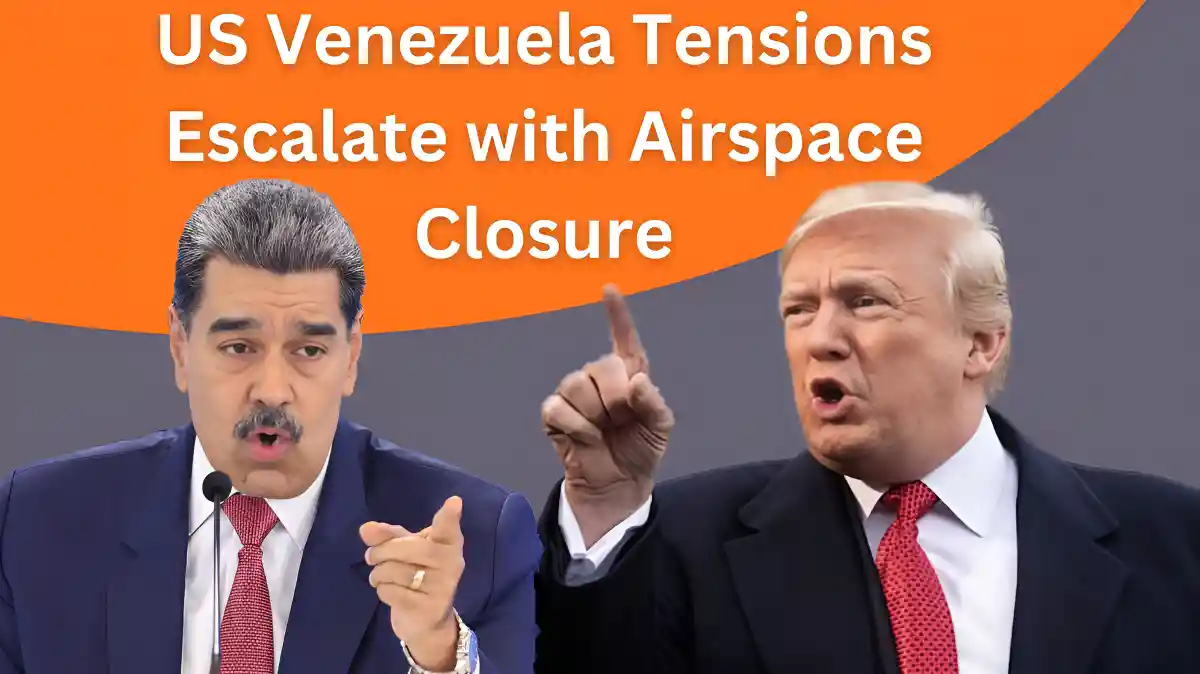
US Venezuela tensions: Tensions between the United States and Venezuela have taken a dramatic turn, escalating US Venezuela tensions to a new level. US President Donald Trump has taken an unexpected and stringent step by declaring the entire airspace over and around Venezuela as a “restricted zone.” Following this decision, concerns of confrontation between the two nations have intensified, while military activity in the Caribbean region has also surged.
In his official statements and social media posts, Trump warned all airlines, pilots, and drug and human traffickers that the US administration now considers Venezuelan airspace a “no-fly zone.” However, he did not clarify whether this move is purely a policy directive or a preparation for potential military action. The White House stated, “The United States will take all necessary steps to protect its borders and citizens.”
US Strategy
The Trump administration has long regarded Venezuela as a hub for drug trafficking in South America. According to Washington, Maduro’s government provides protection to the network known as “Cartel de los Soles,” which allegedly traffics billions of dollars worth of cocaine annually. Based on these allegations, the US recently designated this organization as a “foreign terrorist organization.”
US Secretary of State and the Department of Defense claim this move is part of an effort to curb Venezuela’s drug networks, which directly impact American society. However, experts believe that this is not just an anti-drug measure but also a strategy to increase pressure on Nicolás Maduro’s government, potentially paving the way for regime change.
US Naval Presence in the Caribbean
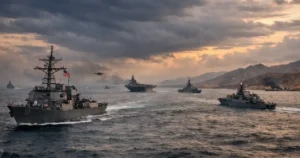
Amid this tense environment, the US has significantly increased its military deployment in the Caribbean Sea. According to media reports, the powerful US aircraft carrier USS Gerald R. Ford is stationed in the region, alongside enhanced surveillance by the US Air Force.
Since September, US forces have conducted over 20 direct maritime anti-drug operations, reportedly resulting in more than 80 deaths. US defense officials maintain that these operations aim to eliminate the illicit drug trade. However, many analysts view them as a show of military strength, designed to exert psychological pressure on Venezuela.
Venezuela’s Strong Response
Venezuelan President Nicolás Maduro described US rhetoric as a “political attack.” He accused the United States of repeatedly attempting to discredit his country to justify intervention. Maduro alleged that Washington seeks to control South American resources, using false accusations as a pretext.
Venezuela’s Foreign Ministry called the decision an attack on the nation’s sovereignty, stating, “The United States is turning others into villains to hide its internal political failures.” At a press conference in Caracas, Maduro emphasized, “We do not fear any military threat. Our country is and will remain independent.”
Phone Conversation Between Trump and Maduro
Last week, a phone call between Trump and Maduro offered a glimmer of hope. Both leaders discussed a potential face-to-face meeting, but the talks produced no concrete results. Trump described the conversation as “neither good nor bad,” signaling that mistrust between the two countries persists.
White House sources indicate that the Trump administration was considering offering limited relief to Venezuela in exchange for “restricted reforms,” but the airspace closure decision has changed the dynamics. The focus now appears to be more on “tough diplomatic and military options” than on dialogue.
Domestic Pressure and Electoral Politics in the US
Political analysts suggest that Trump’s decision is not merely foreign policy but also tied to domestic politics. Issues like drug trafficking and Latin American migration are gaining attention in the US southern states. Trump aims to send a message to his supporter base that he takes a “hardline stance” on border security.
Meanwhile, Democratic members of Congress criticized the move, arguing that “the Trump administration is heading down a path of conflict, while diplomacy could provide lasting solutions.” Some former diplomats also warned that military intervention could destabilize the entire region.
Possibility of War?
Trump’s increased pressure on Venezuela and the airspace closure clearly point towards potential confrontation. While US officials have not confirmed any direct military action, the scale of deployment in the Caribbean region cannot rule out the possibility.
Experts say the US is currently pursuing a “hybrid strategy,” combining economic, cyber, and tactical pressure. The Trump administration has reportedly issued Maduro an ultimatum to leave the country, which Caracas has outright rejected. The situation remains highly volatile.
Political analyst Luis Torres warned, “Even a small aggressive move by the US could prompt Venezuela to seek support from Russia and China, potentially escalating this conflict into a global crisis.” According to him, the coming weeks will determine whether Washington returns to the negotiating table or opts for military measures.
Conclusion
US-Venezuela relations are already strained by deep mistrust, and the recent developments have further heightened US Venezuela tensions. The airspace closure has intensified the confrontation between the two nations. It is evident that the Trump administration has moved beyond “soft diplomacy” and is now entering the phase of “hard strategic moves.”
Although some White House advisors advocate keeping dialogue channels open, the rapid pace of developments suggests that tensions in the Caribbean skies are likely to escalate. All eyes are now on Trump’s next move—whether he will return to the negotiating table or take another decisive step toward war.
Also Read