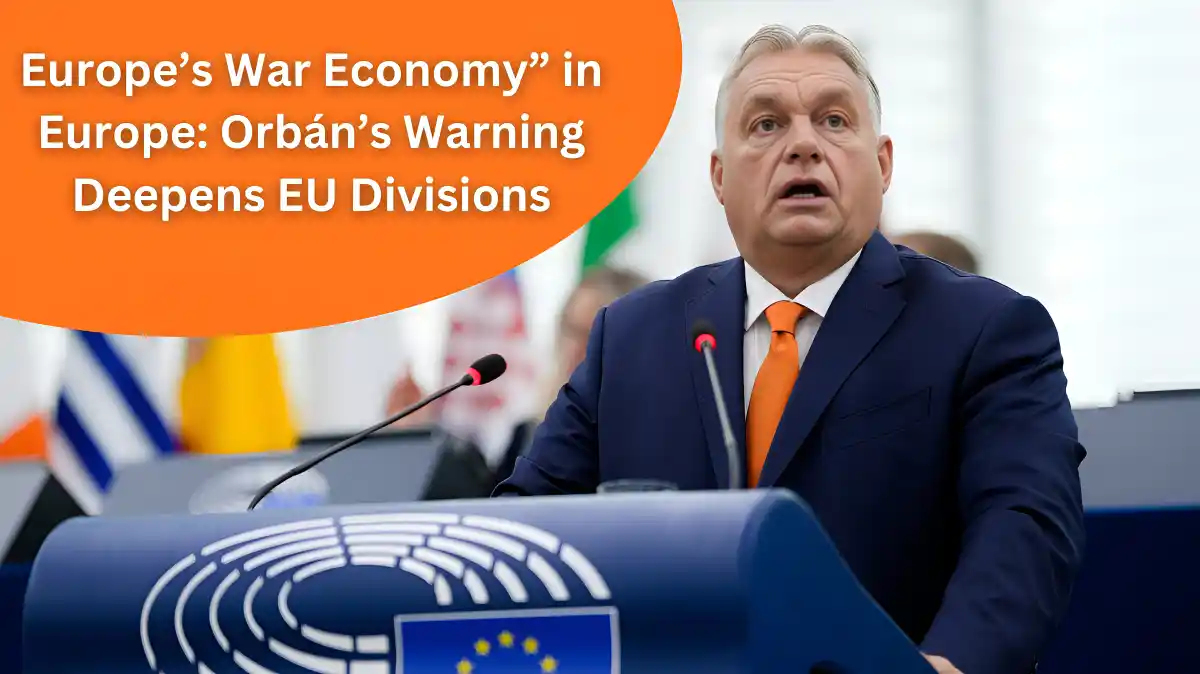
Hungarian Prime Minister Viktor Orbán’s recent statements have sent ripples through European politics. Speaking at an anti-war rally in Kecskemét, Orbán leveled serious accusations at the European Union, claiming that “the EU is preparing for a full-scale war with Russia by 2030.”
According to him, Europe is gradually moving toward a full “war economy”—an economic model in which industries, transportation, and financial resources are increasingly aligned with war-centered strategies. Orbán argued that this shift is deliberate, aimed at ensuring the continent is ready for any major conflict in the coming years.
Orbán’s Warning: “The EU Has Passed Three Stages”
In his speech, Orbán referred to a “four-stage process” that can push any country toward war:
- Breaking diplomatic ties,
- Imposing economic sanctions,
- Ending economic cooperation,
- And ultimately, engaging in armed conflict.
He claimed that Europe has already completed the first three stages, leaving only the fourth—war—as a matter of time. “Even if EU leaders haven’t formalized any document, the decision to achieve full military readiness by 2030 has already been made,” Orbán said.
His remarks have created new rifts within the EU, which was already divided over issues such as aid to Ukraine, sanctions on Russia, and defense budgets.
EU and Hungary Clash Again Over Ukraine Funding
Hungary has consistently opposed military and economic aid to Ukraine. The EU proposed a €30.6 billion assistance plan for 2025, including revenue from frozen Russian assets. Hungary, however, has threatened to veto this plan.
Orbán argued that funneling excessive funds and weapons into the Ukraine conflict endangers European peace. He accused Western countries of adopting a strategy to “prolong the war,” while Hungary advocates for “peace negotiations.”
Hungary also blocked the EU’s “Plan B”—the issuance of joint Eurobonds—further heightening tensions in Brussels. Experts consider this move the biggest blow to EU unity in recent years.
Preparing for Trade Dialogue with Russia
Adding complexity, Orbán announced that Hungary would send a trade delegation to Russia. He said the delegation would pave the way for future economic cooperation once the Ukraine war ends.
This step runs counter to the EU’s collective stance, as other member states maintain a strict position against Russia. The move is seen as a symbol of Orbán’s “autonomous foreign policy,” which has repeatedly strained relations with Brussels.
EU Defense Budget and the ‘Readiness 2030’ Plan
Although Orbán opposes steps toward militarization, the EU’s policies clearly indicate that security is now a top priority.
Under the “Rearm Europe Plan” or “Readiness 2030”, the European Union plans to invest €800 billion in defense over the next four years. This includes a €150 billion “Security Action for Europe (SAFE)” loan package.
NATO member states have also announced significant increases in defense budgets. By 2035, they plan to allocate 5% of GDP to defense, with 3.5% for core military readiness and 1.5% for security infrastructure. Currently, this ratio is around 2%, indicating that defense investment is set to more than double.
Germany Leads the Way, Russia Issues Warning
German Defense Minister Boris Pistorius stated that “Europe must be prepared for potential war scenarios by 2029.” Germany has already earmarked €377 billion in the 2026 defense budget for arms procurement and military modernization.
Meanwhile, Russia welcomed Orbán’s accusations, questioning the EU’s “militarization agenda.” The Kremlin stated that “Russia does not seek war with the EU or NATO, but will respond firmly to any attack,” while clarifying that it has no intention to expand beyond Ukraine.
Europe Dividing Into Two Camps
Within the EU, two clear blocs are emerging:
- On one side, Hungary and some smaller states advocating peace and diplomatic solutions;
- On the other, Germany, Poland, the Baltic states, and France, emphasizing military strength and defense industry expansion as vital for EU security.
Several member states are moving to reintroduce conscription, motivated by national security concerns. Tax incentives are being offered to defense industries, intensifying the debate on whether Europe is evolving into a “military state.”
Hungary’s Peace Agenda and U.S. Connection
Orbán stressed that “staying out of war is Europe’s greatest security.” He believes that the Ukraine crisis can only be resolved through dialogue, not weapons.
Reports indicate that Hungary is seeking to initiate a new negotiation process with the U.S. The Trump administration is considering the possibility of “reintegrating” Russia into the global economy—a stance at odds with mainstream European policy.
Major EU Meeting on December 18 – Outcome Uncertain
The next EU leaders’ meeting is scheduled for December 18, 2025, in Brussels, with key agendas including Ukraine funding and the EU defense budget. Insider sources suggest that significant progress is unlikely, as countries like Hungary and Slovakia have already threatened a “veto.”
Russia has welcomed Orbán’s statements, seeing Europe’s “peace bloc” as a potential basis for future dialogue. However, Western analysts warn that this situation could weaken both the EU’s unity and strategic direction.
Conclusion
Viktor Orbán’s warning has evolved from a mere political statement into a defining political divide that could shape Europe’s future. While defense spending is accelerating under the banner of “security,” calls for “peace negotiations” are increasingly marginalized.
By the end of 2025, Europe’s landscape appears more tense than ever. The question is no longer whether Europe is moving toward war—it is whether anyone can stop it.
Also Read
- Asia Sees Devastating Floods and Landslides: Death Toll Crosses 900 in Sumatra
- Russia Launches Largest Drone Missile Strike on Ukraine
- America’s Travel Ban Now Extends to Over 30 Countries, Says Trump Administration
- Explosive Statement by Former Pentagon Official on India-US relations: US Must Apologize, Arrest Munir