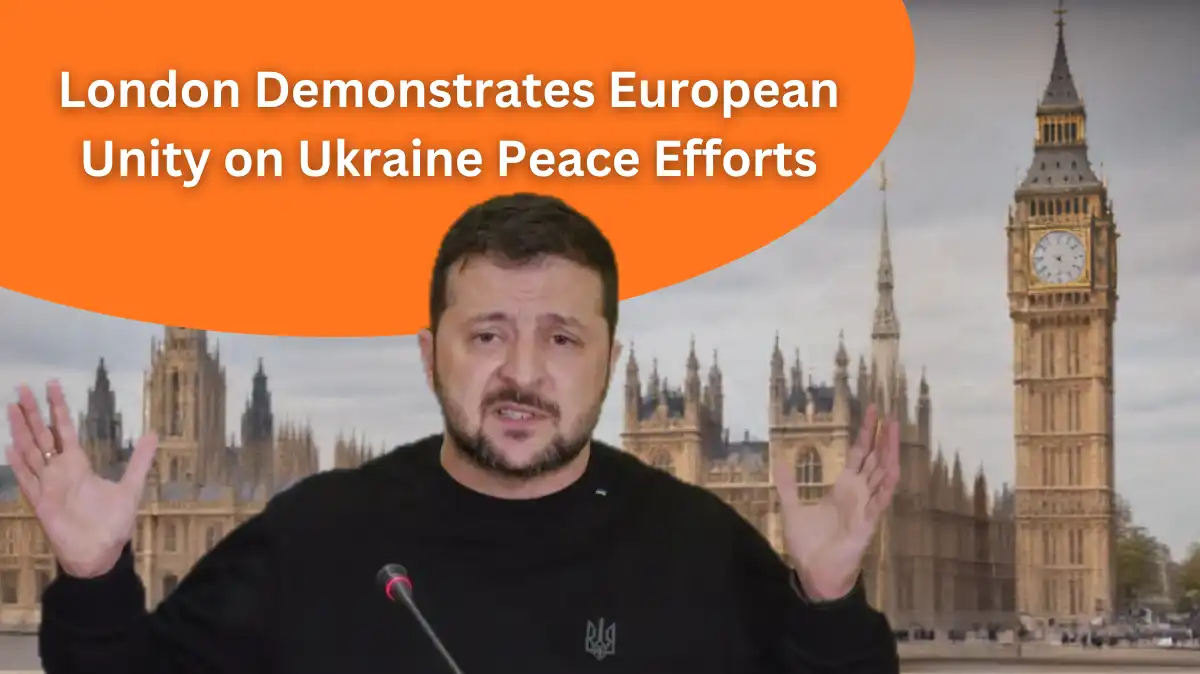
Ukraine Peace: Diplomatic momentum to end the Ukraine war has accelerated. On December 8, a significant meeting took place at the historic 10 Downing Street in London, where Ukrainian President Volodymyr Zelensky engaged in in-depth discussions with top leaders from the UK, France, and Germany regarding the peace proposal put forward by US President Donald Trump. The meeting highlighted that European nations are now committed to providing Ukraine long-term support—not only militarily but also politically and economically.
The high-level talks included British Prime Minister Keir Starmer, French President Emmanuel Macron, and German Chancellor Friedrich Merz. The focus was on the Trump administration’s so-called “28-point peace plan,” which has been perceived in European capitals as being Russia-leaning.
Diplomatic Tensions Rise Over Trump’s Proposal
Donald Trump recently proposed a peace plan aiming to bring both Russia and Ukraine to an agreement. However, certain points of the plan are viewed as contrary to Ukraine’s sovereignty and territorial integrity. Trump even claimed that Zelensky “hadn’t read the proposal,” a statement that heightened diplomatic discomfort among American and European envoys.
German Chancellor Merz expressed doubts about “some ambiguous aspects” of the proposal, while French President Macron urged that Ukraine’s territorial integrity must not be compromised. Meanwhile, British Prime Minister Starmer emphasized, “Ukraine will not be left alone,” underscoring the need for Europe to strengthen its security guarantee policies.
According to reports, European leaders agreed on supplying modern air defense systems and long-range weapons to Ukraine. Additionally, the use of approximately €163 billion in frozen Russian assets to provide long-term economic and defense support to Ukraine was also discussed.
European Strategy Focused on Ukraine’s Security Guarantees
After the meeting, President Zelensky told reporters, “Ukraine is ready for any peace agreement, but it will not compromise on sovereignty and a just peace.” He announced that a revised 20-point peace plan is being prepared to be sent to the United States. The revised plan will focus on Ukraine’s security guarantees, border protection, and Russia’s economic responsibilities.
The London meeting was not only a review of the Trump proposal but also aimed at developing a unified European response to send a clear message to Washington that Europe will not accept any “imposed agreement.”
Secret Meetings with NATO and EU Leadership in Brussels
Immediately following the London talks, Zelensky traveled to Brussels, where he held closed-door discussions with NATO Secretary-General Mark Rutte, EU President Ursula von der Leyen, and Council President António Costa. The meetings focused primarily on two issues:
- Immediate supply of air defense systems.
- Using frozen Russian funds for Ukraine’s reconstruction.
European leaders reiterated that at this stage of the war, only tangible military and economic support—not mere paper agreements—can ensure lasting peace. A statement released after the Brussels meetings said, “Europe will not remain idle until Ukraine’s borders are secure and independent.”
Rome Visit: Meeting with the Pope and Humanitarian Focus
On December 9, President Zelensky visited Rome, meeting Pope Leo XIV at the Vatican. The 30-minute discussion covered prospects for ceasefire and dialogue, as well as the return of Ukrainian children reportedly abducted by Russia.
A Vatican spokesperson stated, “The Pope reiterated the need for a just and sustainable peace.” The meeting drew global attention to the humanitarian toll of the conflict in Ukraine.
Following this, Zelensky was scheduled to meet Italian Prime Minister Giorgia Meloni to discuss Italy’s industrial cooperation, arms supply, and energy support.
Complexities of the Trump Plan and Europe’s Response
The 28-point peace proposal from the Trump administration was developed with US representatives Steve Witkoff and Jared Kushner as intermediaries. However, it posed several sensitive challenges for Ukraine, including “permanent solutions” for areas occupied by Russia.
Zelensky strongly opposed this, stating, “Territorial integrity cannot be negotiable in any agreement.” European countries fully supported this stance. British and French envoys jointly asserted, “No peace plan can be implemented without Ukraine’s consent.”
German Chancellor Merz added, “We want peace, but peace that benefits an aggressor will not secure Europe’s safety.”
New Diplomatic Direction Through European Unity
Zelensky’s European tour is seen as a major signal: amid controversial US involvement, Europe now seeks to lead Ukraine’s security. The European plan to use frozen Russian assets for arms procurement and reconstruction—referred to as the “Repair Loan Plan”—is already under discussion.
Analysts suggest that European support conveys not just economic backing but also a political message—to signal to Russia that any attempt to weaken Ukraine will meet unified European resistance. The sequence of visits to London, Brussels, and Rome demonstrates Zelensky’s intent to establish a “joint European security shield” despite US pressures.
Eyes on the Revised Peace Plan
Attention is now on the revised 20-point Ukraine peace proposal that Zelensky plans to submit to the United States. The plan prioritizes Ukraine security guarantees, humanitarian aid in Ukraine, strategic use of frozen Russian assets, and post-war stability in Ukraine.
However, regional disputes—especially over eastern Ukraine and Crimea—remain the biggest challenge. European support for Ukraine peace continues, with Europe playing an active diplomatic role in Ukraine conflict resolution.
Also Read