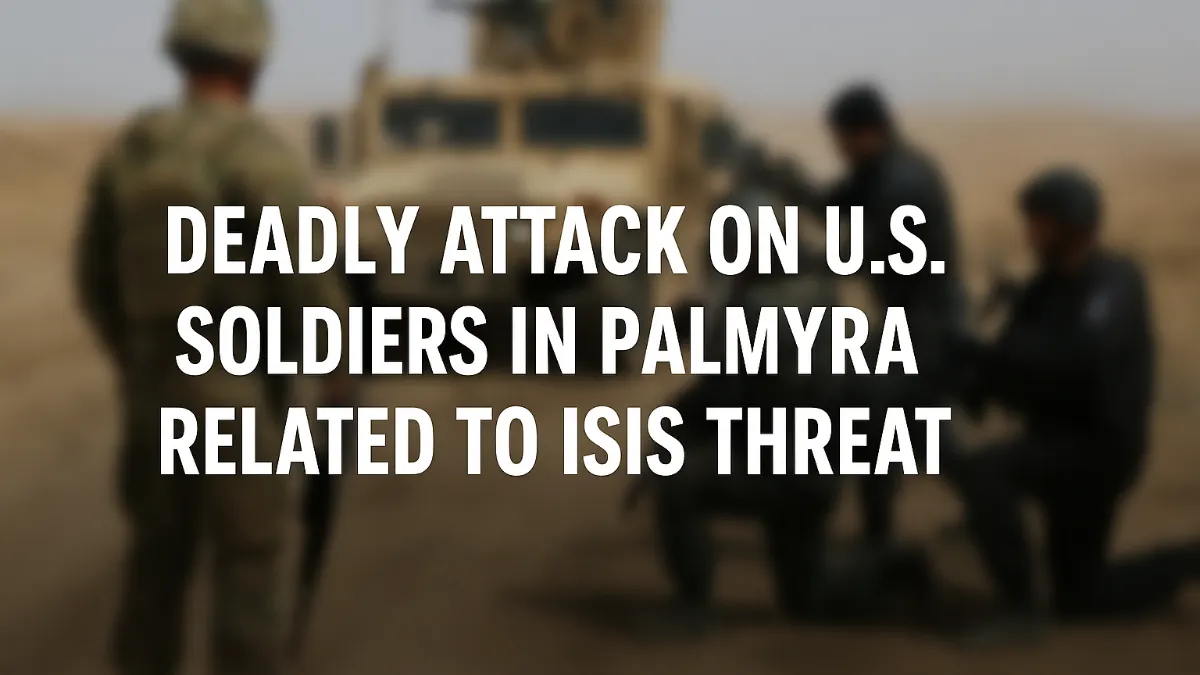
The ancient Syrian city of Palmyra witnessed a deadly attack on U.S. soldiers on Saturday, once again escalating tensions in the Middle East. According to confirmation from U.S. Central Command (CENTCOM), the attack resulted in the deaths of two U.S. soldiers and one civilian interpreter. Three other soldiers were injured and were immediately evacuated by helicopter to the Al-Tanf base.
Preliminary investigations indicate that the attack was carried out by a lone ISIS attacker, who was killed on the spot by Syrian partner forces.
Ambush During Security Patrol
The incident occurred on Saturday morning when a joint security patrol involving U.S. and Syrian forces was underway on the outskirts of Palmyra. The patrol was part of anti-ISIS operations in the region.
Eyewitnesses reported that the U.S. convoy came under sudden fire from armed attackers. In the initial minutes, the intensity of gunfire was so heavy that U.S. soldiers struggled to mount an immediate counter-response.
The Pentagon’s preliminary report stated that the attacker was concealed in rugged terrain and launched the assault in a way that directly targeted patrol vehicles. U.S. forces promptly called in air support, leading to prolonged gunfire and aerial operations across the area.
Confusion in Initial Syrian Media Reports
Syrian state media outlet SANA initially reported that some Syrian security personnel were also injured in the attack. However, subsequent information cited by the agency suggested that the attacker may have been a former member of Syrian security forces who later aligned with ISIS.
This claim remains under investigation, but if confirmed, it could represent a major setback for U.S.–Syrian cooperation—especially at a time when the new administration, following the fall of the Assad regime, is attempting to establish stability in the country.
Major Blow to U.S. and Partner Forces
The attack represents not only a direct strike on the U.S. military presence, but also signals that ISIS may be reorganizing. U.S. Defense Secretary Pete Hegseth described the incident as a “cowardly” attack and said, “The sacrifice of our soldiers will not be in vain. We will work with our partner nations to eliminate the roots of terrorism once again.”
He also confirmed that the Pentagon is conducting a detailed investigation into the incident and that “precise retaliatory action” would be taken if necessary.
Investigation and Security Situation
Following the attack, the Palmyra region was immediately sealed off. Local sources said that roads in surrounding areas were blocked, while U.S. drone and fighter jet activity continued for several hours.
Medical teams at the Al-Tanf base have begun treating all injured personnel. Meanwhile, a joint team of U.S. investigative agencies and Syrian security officials is collecting evidence at the site.
Reports suggest the attack was highly coordinated. The attacker had accurate knowledge of patrol routes, pointing to the possibility of inside information.
ISIS Activity and Regional Indicators
Palmyra has long been associated with ISIS violence. In 2015, ISIS destroyed several historic monuments in the city, triggering global outrage. Although the area returned to Syrian and Russian control in 2017, experts believe ISIS has since shifted to a “shadow strategy”—carrying out small, precise, and unpredictable attacks to signal its presence.
ISIS has not officially claimed responsibility for the attack so far. However, U.S. intelligence agencies believe the incident may be one of several signs of ISIS regrouping.
First Major Attack After Bashar al-Assad
The attack comes as one year has passed since the removal of Bashar al-Assad from power. The interim government that followed has been working with U.S. and coalition forces to stabilize the country.
Pentagon officials have described this incident as the first major attack of the post-Assad period, indicating that the security vacuum has not yet been fully addressed. The United States currently has approximately 900 troops deployed in Syria, primarily tasked with preventing an ISIS resurgence. This attack has raised serious questions about that mission.
Rising Middle East Tensions and Global Attention
Following the incident, the situation in the Middle East has become even more sensitive. U.S. political analysts suggest that the Trump administration’s new hardline military policy may adopt a more aggressive stance in the coming days.
Internationally, institutions such as India, the European Union, and the United Nations are closely monitoring developments. Sources within India’s Ministry of External Affairs said they are “keeping a close watch on the situation” and are concerned about the impact of any unexpected military escalation.
Humanity and Diplomacy
The Palmyra attack raises a broader question—can the United States and its allies establish long-term peace in Syria?
Analysts argue that unless local recruitment and funding networks of groups like ISIS are dismantled, such incidents are likely to recur. This is why the U.S. Department of Defense is now focusing not only on military operations but also on community-based stabilization efforts.
Silence on the Ground, Tension in the Air
In the days following the attack, military patrols and search operations continued across several parts of Palmyra. Local residents reported an atmosphere of fear, with normal life severely disrupted. Shops remain closed, internet services have been restricted, and U.S. drone patrols have been intensified in rural areas as well.
Also Read
- Geopolitical Tremors Triggered by Trump’s ‘C5’ Proposal: US, Russia, China, India and Japan on One Platform?
- Rapid Warming in India–China Relations: US Tariff Pressure Brings New Closeness Between New Delhi and Beijing
(Source – NBC)