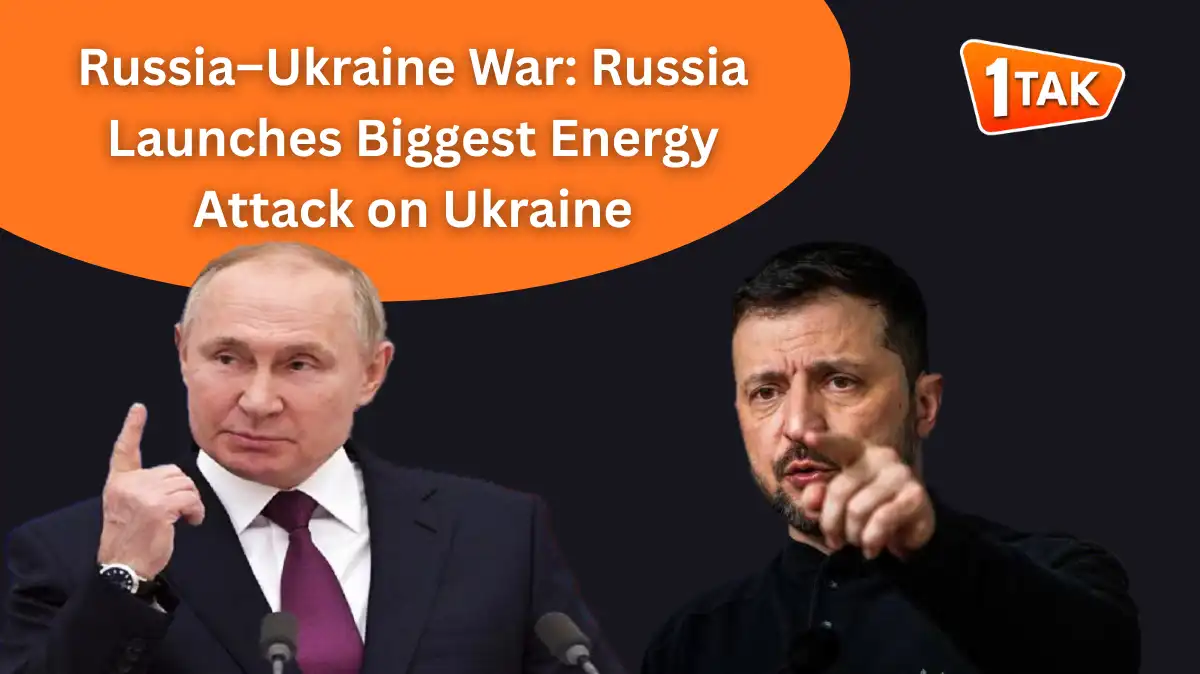
The Russia–Ukraine war has once again taken a dangerous turn. From Friday night into Saturday morning, Russia carried out an unprecedented aerial assault on Ukraine’s energy infrastructure, deploying 465 drones and 30 missiles.
According to the Ukrainian Air Force, the country’s air defense systems successfully intercepted 417 drones and 13 missiles, yet several attacks still managed to reach their targets.
In total, 33 drones and 8 missiles struck 18 different locations, causing severe damage and heavily impacting energy systems across southern and central Ukraine.
Odesa Region Becomes the Primary Target
The attack was most heavily focused on Ukraine’s southern region of Odesa, a key port city and a major energy distribution hub. Local authorities reported extensive damage to energy production, transmission, and distribution networks.
Power plants, substations, and distribution centers in Odesa were hit, leading to widespread power and water outages across several parts of the city.
The Odesa municipal administration said that tram and trolleybus services were temporarily suspended, as traction substations lost power.
Meanwhile, in the Mykolaiv region, at least five people were injured. Authorities said all critical infrastructure there is currently operating on generators to keep hospitals, water facilities, and communication services running.
Widespread Damage Across Multiple Regions
The massive Russian assault was not limited to Odesa alone. Energy-critical regions including Dnipropetrovsk, Chernihiv, Mykolaiv, and Kirovohrad were also affected.
As a result of the strikes, electricity supplies were cut to hundreds of thousands of homes, and several industrial facilities were forced to shut down.
Ukraine’s Ministry of Energy confirmed that more than one million households are without electricity, significantly worsening living conditions as temperatures drop.
Power outages in the middle of winter have disrupted not only daily life but also heating systems, water supply, and public transport networks. Hospitals in several cities are being powered by emergency generators to ensure essential services continue.
President Zelenskyy’s Statement
Ukrainian President Volodymyr Zelenskyy released a detailed video message on social media strongly condemning the attack. He said Russia is deliberately targeting Ukraine’s energy infrastructure to force millions of civilians to suffer in freezing conditions.
Calling the assault an “act of terrorism,” Zelenskyy urged the international community to respond immediately.
“Russia’s real goal is to push Ukraine into cold, darkness, and fear,” he said.
He assured citizens that government agencies, firefighters, and technical teams are working around the clock to restore electricity and water supplies as quickly as possible.
Zelenskyy also stated that Russia, through these attacks, is destroying any indication of “peace talks,” making it clear that Moscow has no interest in dialogue or resolution.
Statement from Ukraine’s Energy Ministry
Ukraine’s Ministry of Energy issued an official statement on Saturday morning, confirming that repair operations have begun nationwide.
Engineering teams are working at damaged facilities in Odesa, Mykolaiv, Dnipropetrovsk, and Kherson.
The national grid operator warned that stabilizing electricity supply could take several days, as some transmission lines have been completely destroyed.
The ministry urged citizens to remain patient and limit electricity consumption to avoid placing additional strain on the power system.
In the meantime, generators and mobile charging stations have been installed across many areas to help residents power essential devices.
Ukraine Moving Toward a Humanitarian Crisis
Following the attacks, temperatures in many cities have dropped below freezing, creating severe hardships for civilians.
In major cities such as Kyiv, Odesa, and Kherson, residents have taken shelter in community relief centers, where heating and food are being provided.
Reports indicate that power and water supplies have also been disrupted in the Kharkiv and Sumy regions.
The government has appealed to international humanitarian organizations and the European Union for assistance. Several Western countries have already announced plans to send energy equipment and generators to Ukraine.
Russia Says Strikes Were a Response to Ukrainian Attacks
While Ukraine has described the strikes as “terrorism against innocent civilians,” Russia claims the operation was carried out in response to recent Ukrainian drone attacks.
According to Russia’s Defense Ministry, Ukrainian drones recently struck Russian border regions, killing two civilians. Moscow says those incidents prompted the latest campaign.
However, Western analysts argue that Russia’s broader strategy is to cripple Ukraine’s energy supply during winter, aiming to undermine civilian morale.
International Reactions to the Russia–Ukraine War
Following the attack, leaders from the United States, the United Kingdom, and the European Union condemned Russia’s actions and pledged humanitarian and energy-related assistance to Ukraine.
The European Energy Commission, based in Brussels, said in a statement that “attacks on energy infrastructure violate international humanitarian law and may constitute war crimes.”
The United Nations Secretary-General also called on both sides to exercise restraint, though no concrete date for direct negotiations has been announced so far.
Also Read