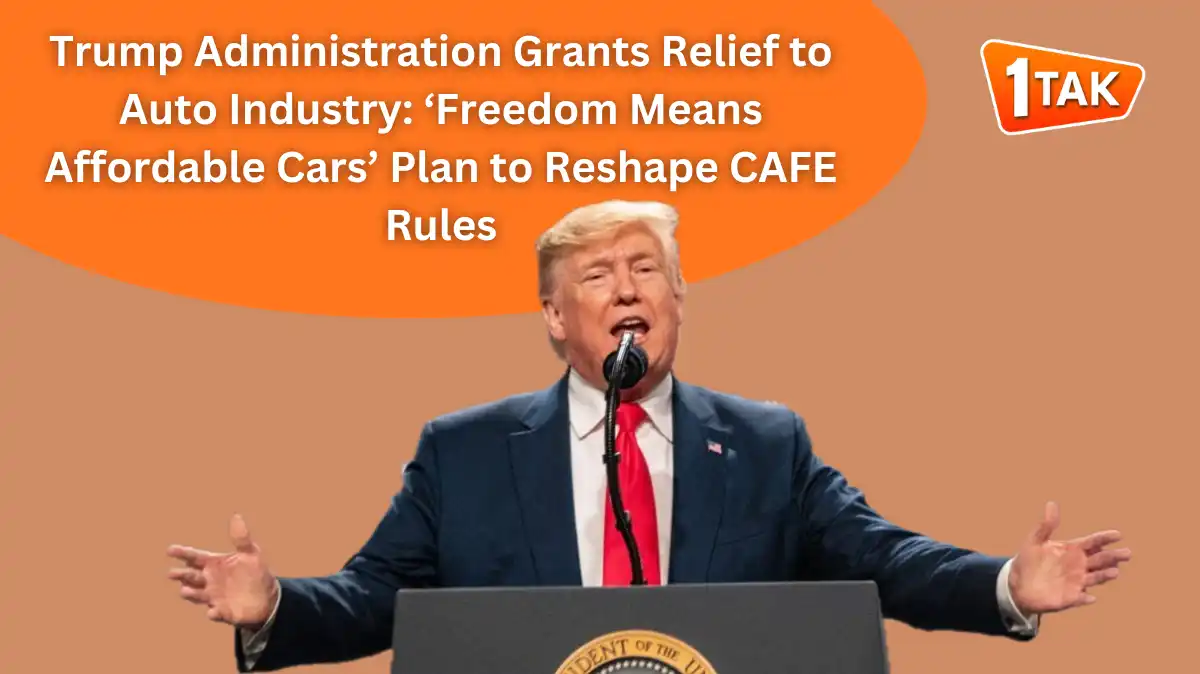
U.S. President Donald J. Trump has announced a major economic and industrial relief initiative that has not only stirred the American auto industry but also reignited debate over environmental policy. Under the initiative titled “Freedom Means Affordable Cars,” the strict fuel-efficiency rules (CAFE standards) introduced during the Biden era are being reset. The Trump administration claims this move will prove decisive in bringing back affordable and safer vehicles for American families.
Major Announcement from the White House
During a press conference held at the Oval Office on December 2–3, 2025, President Trump, alongside Transportation Secretary Sean P. Duffy, announced this landmark decision. He stated,
“We are ending Joe Biden’s extremely burdensome CAFE standards, which imposed costly restrictions on automakers.”
Under this plan, the government aims to simplify and make more realistic the fuel economy standards applicable to model years 2022 through 2031. The Trump administration claims that this step will result in $109 billion in cumulative savings for American families over the next five years, making each new vehicle up to $1,000 cheaper on average.
End of the Biden-Era “EV Pressure”
Trump described the new policy as the end of what he called an “illegal backdoor electric vehicle (EV) mandate.” According to him, previous policies were forcing automakers to become overly dependent on electric vehicles, while American consumers still largely prefer traditional gasoline and diesel vehicles.
The new CAFE policy is centered on market demand, affordability, and safety. The administration claims that when vehicles become more affordable, families will be able to purchase newer and safer models, which could save up to 1,500 lives and prevent 250,000 serious injuries by 2031.
Stellantis Announces Largest-Ever U.S. Investment
Soon after the policy announcement, global auto giant Stellantis—the group behind brands such as Chrysler, Jeep, Ram, and Fiat—declared a historic $13 billion investment in the United States.
On December 3, CEO Antonio Filosa met President Trump at the Oval Office and stated that the investment would increase production by up to 50%, launch five new vehicle models, and create 5,000 new jobs across Illinois, Ohio, Michigan, and Indiana.
Filosa said,
“This is a historic partnership for both our company and the American economy. We will continue to focus on hybrid, ICE, and EV technologies alike, ensuring better choices for consumers across every segment.”
Stellantis had previously paid $773.5 million in CAFE penalties. The new policy represents not only financial relief for the company but also a major operational reset.
Boost to the Reshoring Agenda
This investment aligns with the Trump administration’s reshoring strategy and its “Made in America” vision. President Trump clarified that by imposing tariffs of up to 25% on imported auto parts, domestic manufacturing would be strengthened.
The objective of this strategy is to free the U.S. auto sector from global supply dependence, particularly on imports from countries such as China and Mexico. Over the next four years, the administration aims to increase U.S.-based auto parts manufacturing by 35%.
Setback for California, Legal Clash Likely
One of the most controversial aspects of the new policy is the revocation of California’s emissions waiver. This waiver, granted under the Clean Air Act, allowed California to impose stricter vehicle emission standards than federal rules.
However, the Trump administration argues that the waiver was “not a state-specific right but a discriminatory practice that conflicted with federal policy.”
Alongside this decision, three Congressional Review Act resolutions passed by Congress in June 2025 have also eliminated the 35% zero-emission vehicle sales mandate and diesel engine restrictions that were set to take effect in 2026.
California Governor Gavin Newsom has called the decision an “attack on the environment” and has warned of a legal challenge. The Trump administration, however, maintains that the move is consistent with the original intent of Congress and that similar waivers will be prevented in the future.
New CAFE Framework – Changes in Numbers
Under the revised policy, the fleet average fuel economy has been set at 34.5 miles per gallon by 2031.
- 2023–2026: Annual increase of 0.5%
- 2027: Increase of 0.35%
- 2029–2031: Increase of 0.25%
The rules will apply to both passenger cars and light trucks. Additionally, crossovers and small SUVs will now be classified as passenger cars to ensure regulatory consistency.
It has also been decided that the credit trading mechanism will be discontinued from 2028, requiring companies to achieve real fuel-efficiency improvements rather than relying on paper credits for compliance.
Strong Opposition from Environmental Groups
While the auto industry and market analysts have described the move as a pro-industry reform, environmental groups have labeled it a step backward.
Organizations such as Greenpeace and the Sierra Club argue that the policy will lead to an increase in carbon emissions and weaken America’s climate commitments. They also warn that U.S. vehicle technology could fall behind globally, as Europe and Asia continue to move rapidly toward electric vehicle infrastructure.
The Trump administration, however, insists that the policy frees the industry from “EV compulsion” and allows growth based on genuine consumer demand.
Economic and Consumer Impact
According to analysts, the policy will deliver direct benefits to American families. As new vehicles become more affordable, consumers will be encouraged to replace older, more polluting vehicles, which could indirectly contribute to lower emissions as well.
The auto sector estimates that vehicle sales could rise by 7–9% over the next six years, potentially creating more than 200,000 direct and indirect jobs.
In addition, the policy aligns with America’s energy security strategy, as it helps stabilize domestic fuel consumption and reduces reliance on foreign oil.
Also Read