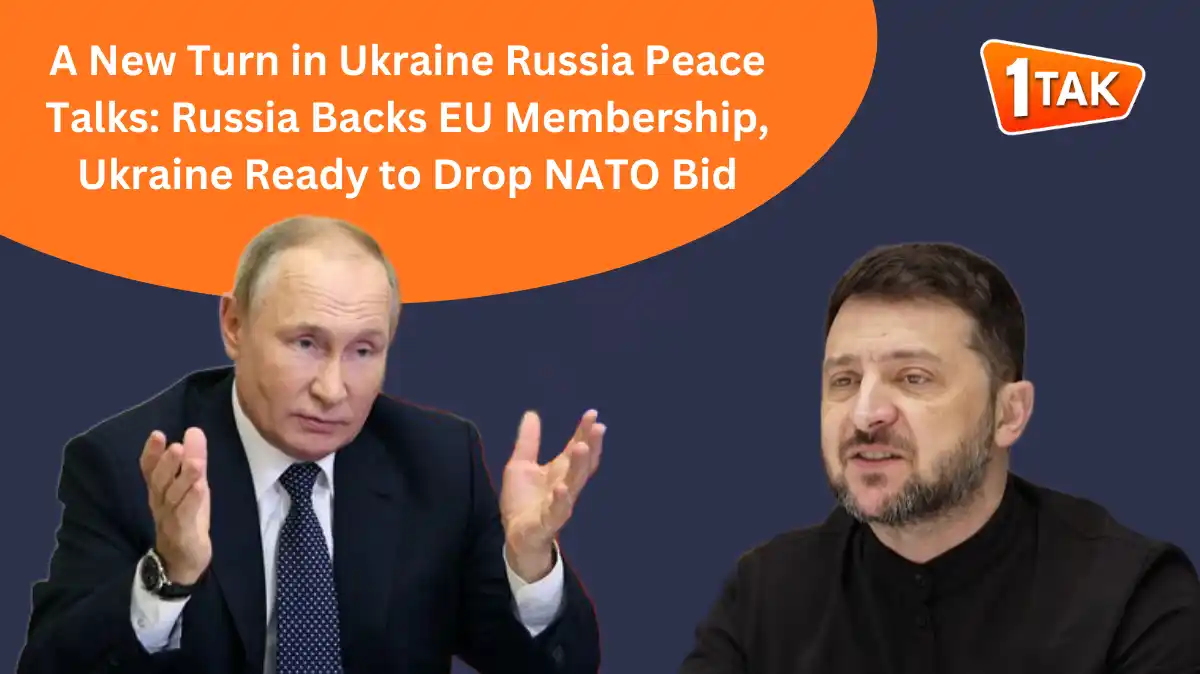
Ukraine Russia Peace Talks: After more than three years of the Ukraine–Russia war, a historic turning point now appears to be emerging. During recent peace discussions held in Berlin between US officials and Ukrainian President Volodymyr Zelenskyy, Russia has, for the first time, agreed not to oppose Ukraine’s membership in the European Union (EU). This is being seen as a major concession from Moscow, which for years strongly resisted the expansion of Western alliances.
At the same time, a significant signal has come from Kyiv — President Zelenskyy has proposed dropping Ukraine’s demand for NATO (North Atlantic Treaty Organization) membership, provided that the United States and Europe offer strong and binding security guarantees. This proposal has become the foundation of the current peace framework, which US diplomats have described as “90 percent ready.”
Details of the Berlin Talks
The talks held in Berlin on December 14 and 15 saw key involvement from US envoy Steve Witkoff and former President Donald Trump’s advisor Jared Kushner. The discussions lasted nearly five hours, with Zelenskyy, European officials, and US representatives deliberating on a common peace framework.
According to American sources, the meeting was described as “the most constructive and positive so far.” The main points of discussion included:
- Ukraine’s EU membership,
- The status of the Donbas region,
- Security guarantees, and
- The timeline for a ceasefire.
The most critical moment came when Russian representatives indicated that Moscow would no longer block Ukraine’s path to EU membership. This marked a significant shift for the same Russia that, after annexing Crimea in 2014, had aggressively sought to prevent Western influence from moving closer to its borders.
Zelenskyy’s Firm Stand
Despite the cooperative atmosphere, Ukraine remains unwavering on its territorial integrity. Speaking to journalists, Zelenskyy said:
We will not give up our territory at any cost. Our land is our identity, and it will neither be surrendered under pressure nor traded in negotiations.
Sources said Russia has still shown no flexibility regarding the status of eastern regions such as Donbas and Luhansk. For this reason, Zelenskyy has clearly rejected any form of “territorial concession.”
Ukraine’s chief negotiator Rustem Umerov also posted on social media that real progress has been made, but a long road still lies ahead.
Russia’s Position
Russian Deputy Foreign Minister Sergei Ryabkov, in an interview on December 14, said, “Russia and Ukraine are now on the brink of a deal.”
Ryabkov emphasized that Moscow prefers a diplomatic solution, but its “national security demands remain unchanged.”
He added that Russia no longer views EU membership as a primary threat, but is not prepared to compromise on control over Donbas and southern regions.
His remarks came at a time when the Trump administration’s ‘Peace Restoration Initiative’ is gaining momentum, aiming to achieve a ceasefire within 50 days.
Ukraine Seeks Real Security Guarantees Instead of NATO
Ukraine’s bid for NATO membership has long been a central source of tension between Moscow and Kyiv. However, Zelenskyy has now offered to abandon this aspiration, surprising the international community. He stated, “We want real security guarantees instead of NATO. If the US and Europe provide firm security commitments, this would be the biggest step toward peace.”
The US administration has described this as “strategic flexibility.” A senior Trump administration official said, “Zelenskyy stepping back from NATO is a realistic approach — it also gives Russia a face-saving exit.”
Zelenskyy, however, added that concrete documentation and an implementation framework for these guarantees would be finalized only afterward.
The World Will See Reconstruction, Not War, in 2026
Both the United States and Europe have made this peace process their top diplomatic priority. The United Kingdom, France, and Germany have also welcomed the initiative.
US President Donald Trump has remained in constant contact with both Zelenskyy and President Vladimir Putin, stating that “the world will see reconstruction, not war, in 2026.”
Talks Continue Amid Ongoing Tensions
As of midnight on December 16, work on the “Ukraine–Russia peace talks” agreement is still underway.
Russia has signaled a limited reduction in military activity, while Ukraine has halted the expansion of new supply lines along the border.
European diplomats believe that “it is now only a matter of time,” as consensus has been reached on major issues such as EU membership and abandoning NATO ambitions.
However, conditions on the ground remain tense. Russian forces have carried out several attacks in eastern cities in recent days, while Ukraine has responded with counteractions along the southern border. Despite this, both governments appear more serious than ever about pursuing a diplomatic solution.
Also Read