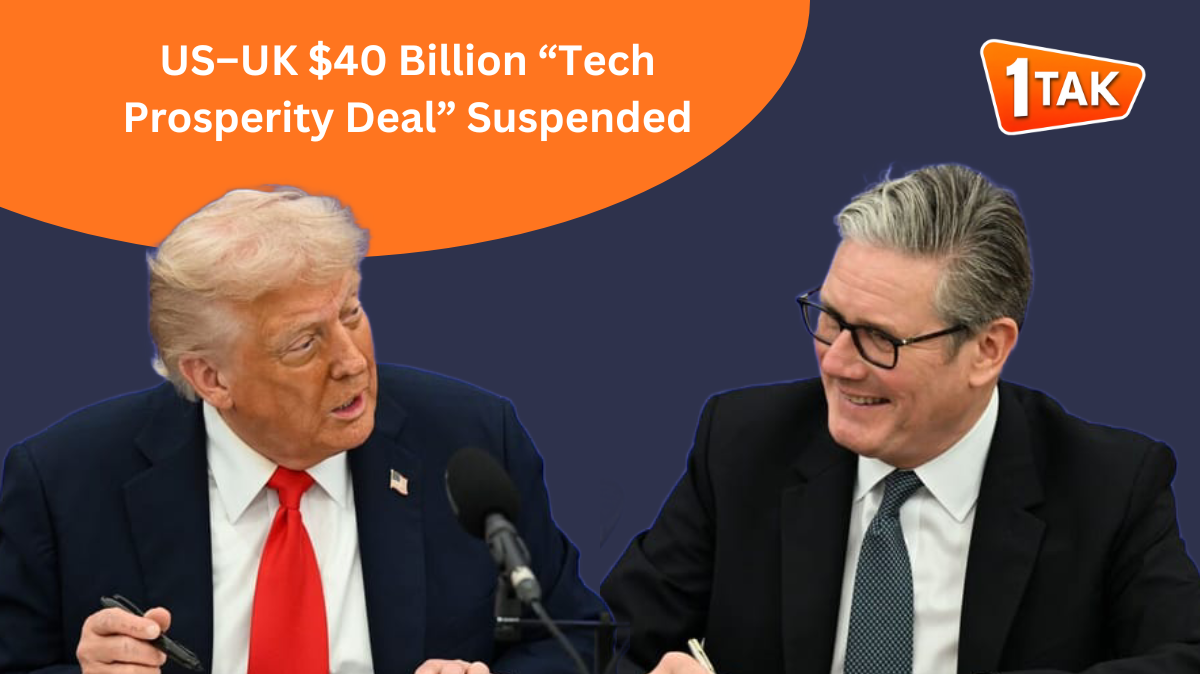
The United States has abruptly suspended the ambitious $40 billion (around £31 billion) “Tech Prosperity Deal” with the United Kingdom. The agreement was designed to strengthen cooperation between the two countries in future-shaping sectors such as Artificial Intelligence (AI), quantum computing, and nuclear energy. However, the deal has now fallen victim to political and trade disagreements.
According to sources, the decision was taken by the Trump administration over disagreements related to certain UK “non-tariff barriers,” including online safety laws, the digital services tax, and food standards. Experts say this move goes beyond a technology partnership and reflects a broader pressure strategy being employed by the United States in trade negotiations.
Historic Announcement Made in September 2025
The “Tech Prosperity Deal” was announced in September 2025 during former US President Donald Trump’s visit to the UK. The agreement aimed to boost large-scale investments in AI supercomputer infrastructure, quantum machinery, and nuclear fusion research.
Under the deal, major technology companies such as Microsoft (£22 billion), Google (£5 billion), Nvidia, and OpenAI had committed to investing in the UK. It was estimated that around $40–41 billion would be invested over the next five years, creating thousands of jobs and positioning the UK as a “global AI hub.”
The British government had described it as a deal that would “reshape the future for millions.” Prime Minister Keir Starmer had said at the time that the partnership would take the US–UK “special relationship” to new heights. That historic agreement has now been put on hold.
Roots of the Dispute
The biggest reason behind the US decision is reported to be the Trump administration’s dissatisfaction with certain UK policies.
- Online Safety Bill: The UK has recently implemented the Online Safety Act, imposing strict content-moderation rules on social media and technology companies. US firms see this as a threat to their business models.
- Digital Services Tax: British Chancellor Rachel Reeves increased the digital services tax from 2% to 4% in the recent budget, raising operating costs for US tech companies.
- Food Standards Dispute: The UK continues to ban imports of US “chlorinated chicken” and certain other food products. The US views this as a trade barrier.
According to a Financial Times report, the Trump administration is using these issues as leverage in broader trade negotiations.
First Crack in the “Special Relationship”?
The British government has confirmed that the suspension came into effect last week. However, London said in its statement that the “special relationship” between the US and the UK remains strong and that both sides are keen to continue dialogue.
A senior British official told Reuters, “We are concerned about the situation, but channels of communication remain open. We hope this technical pause will be temporary.”
In Washington, the White House has not issued any official comment so far. A spokesperson for the US Trade Department only said that “all agreements are being reviewed with national interests in mind.”
A Major Setback for the UK
The suspension is expected to have its biggest impact on the UK’s tech economy. The deal had projected the creation of more than 8,000 high-tech jobs.
With work on AI supercomputer projects, data centres, and GPU clusters halted, several partnerships between universities and private labs have been left in limbo. It is estimated that a massive AI infrastructure equipped with around 23,000 GPUs (graphics processing units) has now stalled.
Tech analysts believe this pause represents a step backward for the UK in its digital industrial transformation. CNBC reported that “this will weaken the UK’s position in the global AI race, especially at a time when China and the United States are advancing rapidly.”
Stock Market Reaction
News of the suspension of the US–UK deal also triggered movement in the stock markets. Shares of technology companies such as Microsoft, Nvidia, and Alphabet saw a slight decline.
Market watchers say investors are now reassessing new risk factors, particularly as the Trump administration adopts a tougher stance on US–Europe relations. The British pound also slipped marginally, signalling reduced investor confidence.
Global Impact: Opportunities May Open for India and Europe
Experts say this is not just a US–UK issue—it will have implications for the global technology ecosystem. As the UK’s AI investment pipeline slows, capital may shift toward countries such as those in Europe, Canada, and India.
What Next? Can the Deal Be Revived?
The key question is whether the deal has been shelved permanently or could be revived. Analysts believe the Trump administration may keep the door open for talks, provided the UK offers certain policy concessions.
If Britain relaxes its digital tax regime or shows flexibility on food standards, the deal could be restarted. However, under Trump’s “America First” policy, the likelihood of this happening in the near term appears low.
Also Read