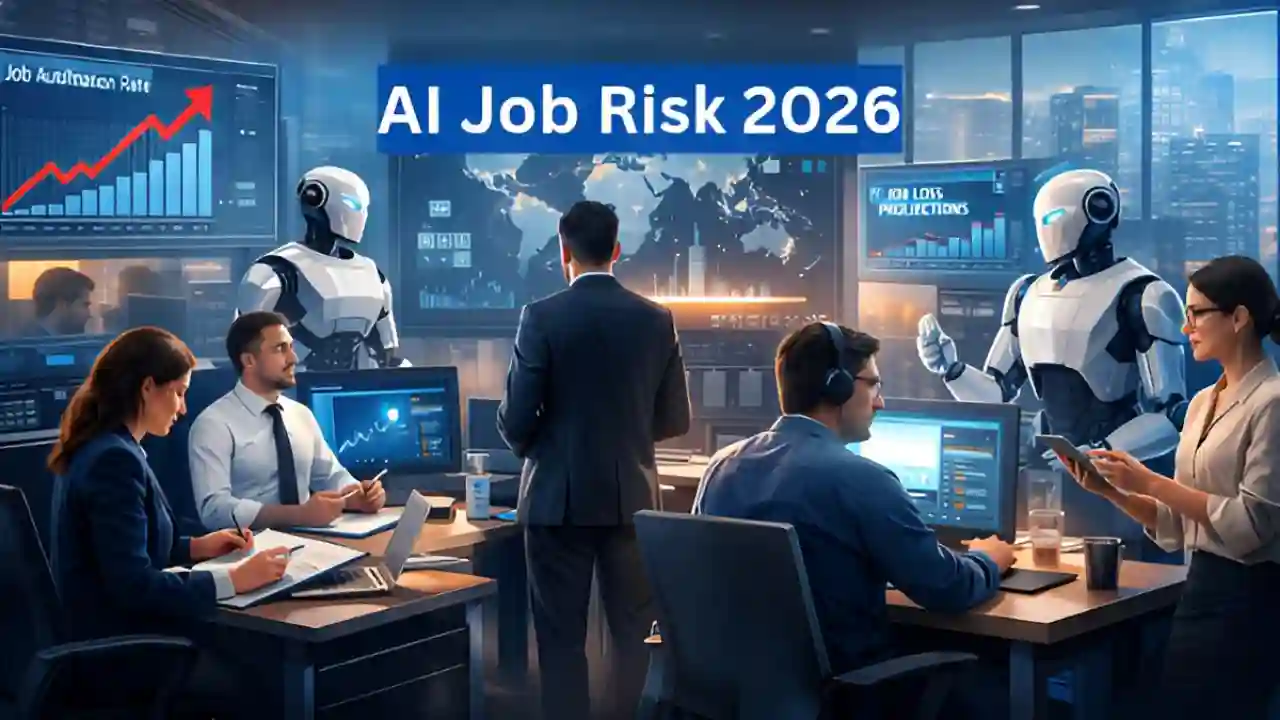
Artificial Intelligence (AI) is no longer just a technological trend; it has become the biggest factor shaping the direction of the global job market. Companies are rapidly moving toward AI automation to reduce costs and increase productivity. Along with this shift, AI job risk 2026 has emerged as a serious concern.
Microsoft’s recent report has deepened this concern further. According to the report, by 2026 nearly 40 job roles could be most impacted by AI. This report serves as a wake-up call not only for the corporate world but also for students, professionals, and policymakers.
What does the Microsoft AI Report 2025 say?
In its New Future of Work Report 2025, Microsoft analyzed more than 200,000 real-world interactions of the Copilot AI chatbot. Based on this study, a special metric called the AI applicability score was developed.
This score indicates how easily AI can perform the core tasks of a job—especially activities related to language processing, data analysis, content generation, and communication.
According to Microsoft, by the end of 2025 alone, around 55,000 jobs globally have already been affected due to AI automation, including roles in major companies such as Amazon and Microsoft.
For more details, you can check Microsoft’s official insights here: Microsoft Official Website
Which jobs face the highest AI job risk by 2026?
According to the report, jobs that are heavily based on information gathering, writing, analysis, and repetitive communication are at the highest risk.
- Interpreter / Translator (around 98% of tasks AI-compatible)
- Content Writers & Authors
- Journalists & News Analysts
- Customer Service Representatives
- Sales Representatives
- Technical Writers
- Proofreaders & Editors
- Market Research Analysts
- Account Clerks
- Web Developers (basic & repetitive work)
- Financial Advisors (basic advisory roles)
- PR & Communication Executives
- Library & Economics Teachers
All these roles are largely office-based, where AI tools are already being used extensively for content creation, data processing, and customer interaction.
What are experts and industry leaders warning about?
Geoffrey Hinton, known as the “Godfather of AI,” has called 2026 the “Job Shock Year.” Meanwhile, Microsoft CEO Satya Nadella warned on LinkedIn that AI could create a new “AI-disabled class”—people who fail to adapt to the technology.
According to the World Economic Forum (WEF) report:
- 40% of employers are planning to reduce their workforce
- 37% of companies are considering replacing workers with AI
- IT, Banking, and Retail sectors will be the most affected
An AIResumeBuilder survey suggests that by 2026, the largest job cuts could occur in customer service, administrative, and IT support roles.
Which jobs are relatively safe from AI?
Although AI’s impact is significant, some jobs still require human presence and physical skills.
- Nursing Assistants
- Healthcare Technicians
- Dishwashers & Cleaning Staff
- Phlebotomists
- Ship Engineers
- Tire Repair Technicians
The Microsoft report clearly states that AI will not eliminate jobs entirely; instead, it will transform them. Human–AI collaboration will be the core model of the future.
How to stay safe from AI job risk? Which skills will be essential?
To survive in the job market of 2026 and beyond, a degree alone will not be enough. You must focus on future-ready skills.
- AI literacy (understanding tools like ChatGPT and Copilot)
- Creative thinking and problem-solving
- Human judgment & emotional intelligence
- AI-assisted productivity workflows
- Prompt engineering & AI supervision
According to a Microsoft survey, 82% of employers believe AI skills are now essential, yet 60% of workers feel under-skilled.
In emerging markets, web developers, marketers, and content professionals must upgrade themselves with AI tools—especially in SEO, data analysis, and optimization.
AI: Threat or Opportunity?
AI job risk 2026 is a real challenge, but it is not entirely negative. History shows that every technological revolution also creates new roles and opportunities.
Those who embrace upskilling, reskilling, and human–AI collaboration today will be part of the future workforce. The 2026 job market may change everything—but with the right preparation, this change can become an opportunity for you.
Also Read
- Is ChatGPT tracking your every conversation? Change these 4 secret privacy settings from 2026 today!
- NASA’s historic announcement: The image of the ISS will change in 2026, with the world’s eyes fixed on these two major missions.
- Google Aluminium OS: Google’s new Android-based operating system will replace ChromeOS—learn about its features and launch date