
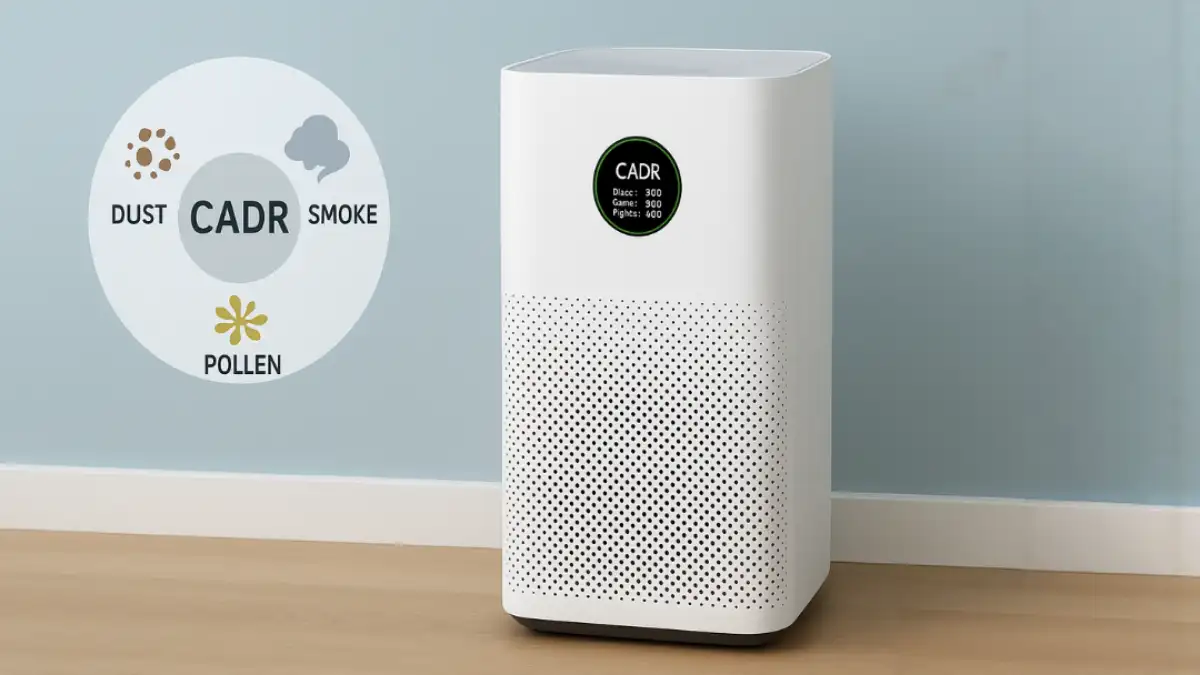
In today’s era of rising urban pollution, people are increasingly relying on air purifiers to keep the air in their homes and offices clean. However, very few know that the true measure of an air purifier is not its design or brand, but its “CADR rating.” Purchasing an air purifier without checking this rating may result in ineffective air cleaning while your money goes to waste.
What is CADR Rating and Why is It Important?
CADR stands for Clean Air Delivery Rate, which indicates how much clean air an air purifier can deliver per minute. It is measured in CFM (cubic feet per minute). Simply put, the higher the CADR, the faster the purifier can remove dust, smoke, and allergy-causing particles from a room.
This rating not only reflects the machine’s power but also determines how many times the air in your room can be completely cleaned in an hour. Many consumers buy purifiers based solely on brand or design, but the actual performance depends on the CADR.
Three Types of CADR: Smoke, Dust, and Pollen
CADR ratings are categorized into three main types: Smoke CADR, Dust CADR, and Pollen CADR.
- Smoke CADR indicates how quickly the purifier removes fine pollutants like smoke, smog, or gas particles.
- Dust CADR measures the purifier’s efficiency in removing dust and small particulate matter.
- Pollen CADR shows how fast it can eliminate allergy-causing pollen from plants and flowers.
A high-quality air purifier typically has balanced ratings across all three CADR types to provide comprehensive relief from different kinds of pollution.
How to Choose CADR According to Room Size
Many people overlook room size when buying an air purifier, even though it’s a crucial factor. To select the right CADR, you first need to calculate the room’s total cubic feet using the formula: length × width × height.
For example, a room measuring 200 sq. ft. with a height of 10 ft. has a total volume of 2000 cubic feet. For this space, an air purifier with a CADR between 130 and 150 CFM is suitable, ensuring the air is cleaned 4–5 times per hour.
A smaller room does not require a very high CADR, as it may increase power consumption and noise. Conversely, a large hall or office space will take longer to clean if the CADR is too low.
Who Determines CADR Ratings?
CADR is not an estimated figure; it is certified by the Association of Home Appliance Manufacturers (AHAM) in the United States. AHAM conducts standardized tests to measure an air purifier’s actual capability.
Units certified by AHAM carry the “AHAM Verified” or “AHAM Verifide” label, indicating that the performance claimed by the manufacturer has been independently verified.
Recently, AHAM also introduced the “AHAM Verifide Filter Performance” program, which tests the quality and efficiency of replacement filters. This is particularly useful for consumers who regularly change filters and want to maintain genuine performance.
Risks of Buying an Air Purifier Without CADR
Ignoring CADR ratings can lead to several issues:
- Slow air cleaning, delaying improvement in room air quality.
- Prolonged machine operation, increasing electricity usage and noise.
- Filters may wear out faster due to excessive strain.
- Fine allergens and particles may remain in the air, posing health risks.
In short, a low CADR may run the purifier, but it won’t deliver real benefits.
Global Significance of CADR
Globally, CADR is considered the standard for measuring air purifier effectiveness. Countries like the U.S., Canada, and Japan require this rating on every product. Consumers are advised to make decisions based on CADR rather than marketing claims.
In India, awareness is growing rapidly. Major brands such as Dyson, Philips, Honeywell, and Mi are now launching models with AHAM certification to ensure consumers can trust the actual performance of the purifier.
Pollution and the Air Purifier Market in India
In major cities like Delhi, Mumbai, and Bengaluru, air quality frequently reaches hazardous levels. Consequently, the air purifier market in India is growing at over 20% annually. However, many products in the market lack authentic CADR ratings.
While cheap, uncertified products may provide temporary psychological satisfaction, they fail to clean the air effectively. Experts recommend that consumers always check CADR and AHAM certification before purchasing.
Why AHAM Verifide Matters
The AHAM Verifide program is a consumer safety initiative aimed at providing transparent and reliable information. Certified products are tested in controlled lab environments for dust, smoke, and pollen. The results are impartial, helping consumers understand which product is genuinely suitable for their room.
Conclusion
Installing an air purifier in today’s polluted environment is not just a modern convenience—it’s a health necessity. However, buying a purifier with the wrong rating can result in neither clean air nor a worthwhile investment.
Next time you shop for an air purifier, don’t just look at the brand or features. Always check the CADR rating and AHAM certification. Remember, only purifiers with certified CADR can truly clean the air—otherwise, the pollution remains, and your money goes up in smoke.
Also Read
- Keeping Your Laptop Plugged In Constantly Can Harm Its Battery Life, Here’s Why
- Are Your iPhone Apps Spying on You? Here’s How to Stay Safe from This Digital Threat
- Samsung Galaxy S26 Ultra: The Technical Logic Behind Switching from Titanium to Aluminum Frame
- New Trend in Erasing Your Digital Identity: Know the Most Effective Ways