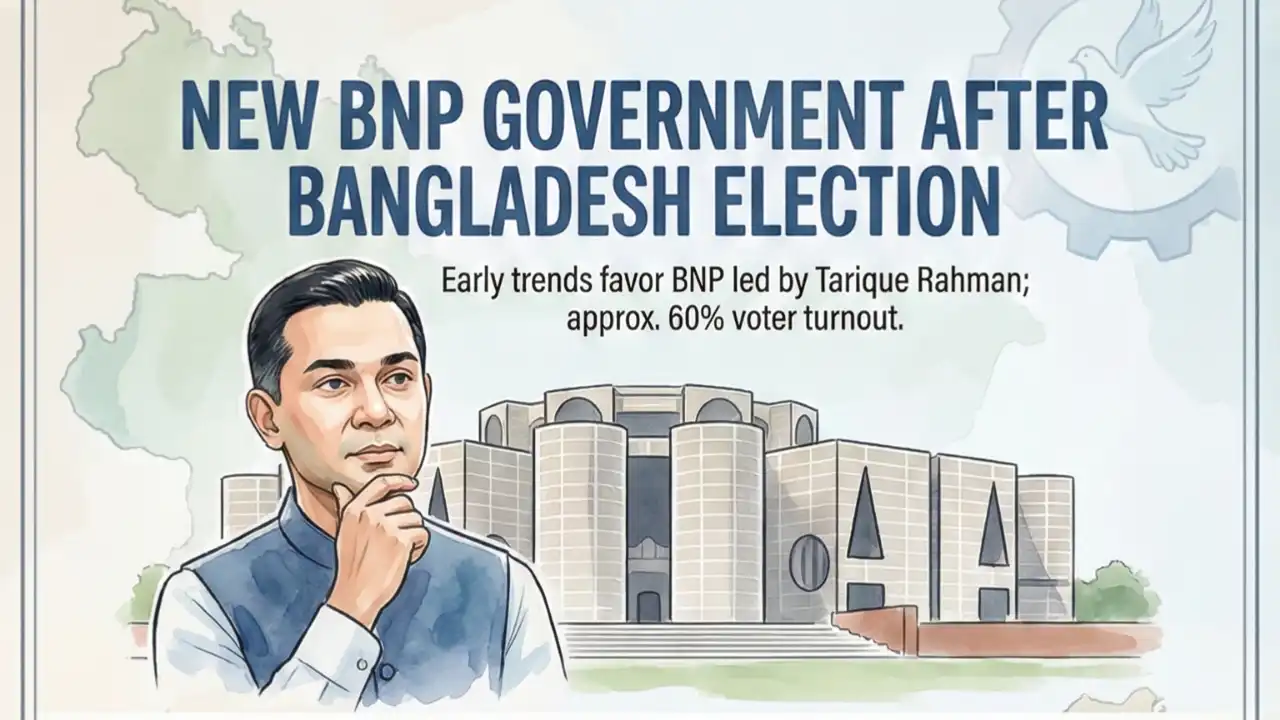
Bangladesh election: In the general election held about one and a half years after Sheikh Hasina stepped down from the post of Prime Minister in Bangladesh, around 60 percent voting was recorded. Despite the boycott by the Awami League, large-scale participation of people has indicated the beginning of a new phase in the country’s politics. According to early trends, the BNP under the leadership of Tarique Rahman is in a position to form the government.
These elections, held after the upheaval and political instability of 2024, were being considered an important test for the country. Barring isolated incidents, voting remained peaceful in most areas. The active participation of youth, especially the generation voting for the first time, gave a new direction to the electoral process.
What has changed in the political picture?
South Asia affairs expert Dr. Shreesh Pathak says that this is not the first time in Bangladesh’s history that a major party has stayed away from elections. However, this time the voting percentage has been much higher compared to earlier elections marked by boycotts. According to him, it can be seen not just as a normal election but also as public opinion on the political system. He said that the role of youth in the elections was notable, but before showing excessive enthusiasm about the current situation, one should wait to see how the new government functions.
With whom is the silent voter?
With nearly 20 percent voters staying away from voting, questions are being raised whether this is the traditional support base of the Awami League. On this, experts believe that electoral behavior is not always direct and clear. In any democracy, along with committed supporters, there are also a large number of voters who decide based on circumstances.
Questions over the position of the Awami League
Political analysts say that in the past, when a major party boycotted elections, the voting percentage had fallen significantly. This time, relatively higher voting indicates that political equations are changing. However, in the absence of leadership, it is also not considered appropriate to assume that a party’s support base has completely ended.
How big an achievement is holding elections after instability?
After the events of 2024, the international community had kept its focus on Bangladesh. Especially regarding the safety of minorities and political stability, there was external pressure. In such an environment, relatively peaceful voting is being seen as a test of administrative and institutional capacity.
What impact on India-Bangladesh relations?

There is also growing discussion about India’s relations with a possible BNP government. Experts believe that India’s foreign policy is now based on institutional relations rather than individuals or parties. Several channels of communication remain active between the two countries at official and informal levels.
Due to geographical and economic linkages, stable relations are necessary for both countries. Experts say that in recent years India has made it clear that instead of depending on one political faction, it will maintain practical and balanced relations with whichever government is in power.
After the formation of the new government in Bangladesh, the coming months will make it clear in which direction bilateral cooperation moves forward. For now, peaceful elections and change of power are being seen as an important step from the perspective of regional stability.