
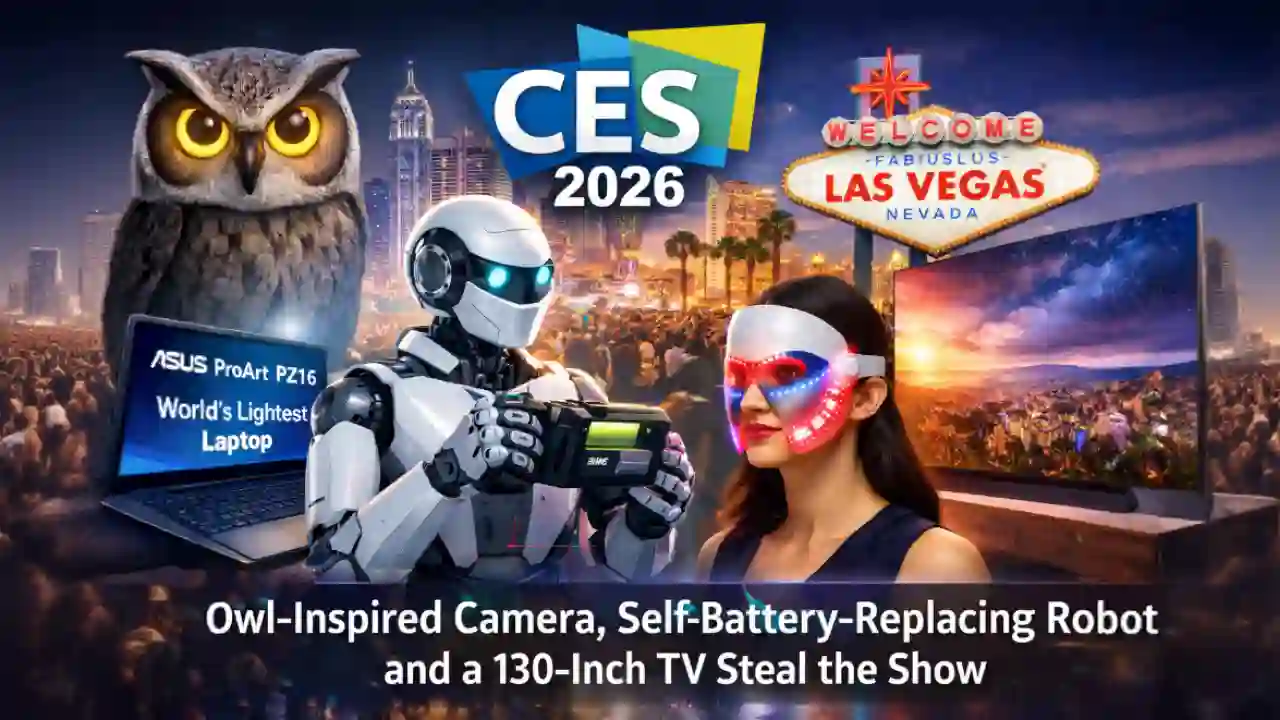
Las Vegas, USA — CES 2026 (Consumer Electronics Show) has once again proven that the future is no longer limited to imagination. Held from January 6 to January 9, this grand event saw leading global companies showcasing their technological prowess. This year’s spotlight was firmly on Artificial Intelligence (AI), humanoid robotics, and ultra-premium display technologies.
We have thoroughly analyzed the highlights of CES 2026. Whether it’s Hyundai’s self-charging robot or LG’s astonishingly thin television — every innovation tells a new story. In this detailed report, we present an ‘Analytical Review’ of those products that are set to redefine our lifestyle in the near future.
Lockly OwlGuard IPC100: The ‘Smart’ Face of Home Security
In the field of smart home security, Lockly has introduced a gadget that brilliantly balances both design and functionality. The Lockly OwlGuard IPC100, also called the “Owl Camera” for its unique look, is not just visually appealing but also highly advanced in terms of technology.
Design and AI Capabilities
Unlike conventional security cameras, the OwlGuard’s design resembles an owl’s eyes, allowing it to blend seamlessly into home décor. But its true strength lies in its AI Detection System. This system is so advanced that it can differentiate between swaying tree branches and an actual intruder.
- Smart Recognition: The camera distinguishes between humans, pets, and vehicles, and sends alerts accordingly.
- Night Vision Technology: Its sensor can record color video even in complete darkness — a major leap forward in security tech.
Technical Specifications (Breakdown)
| Feature | Specification |
|---|---|
| Resolution | 2K HD with HDR |
| Battery Life | 10,000mAh (Up to 6 Months) |
| Connectivity | Dual-band Wi-Fi & Bluetooth 5.4 |
| Display | 1.54-inch IPS Info Screen |
| Launch Timeline | Q2 2026 ($99 approx) |
Lockly deserves praise for its work on battery optimization. Where most wireless cameras need monthly charging, this 6-month battery performance makes the OwlGuard an “install-and-forget” security device.
Hyundai Atlas: A New Era of Robotic Independence
Among all the robots that caught attention at CES 2026, Hyundai Motor Group and Boston Dynamics’ joint marvel — the Atlas Humanoid Robot — stood out. This isn’t just a machine; it represents the future of industrial automation.
Self-Swapping Battery Technology: Why It’s a Game Changer
The biggest challenge in robotics has always been ‘downtime.’ Traditional robots often required operations to pause for lengthy charging times. Hyundai Atlas eliminates this issue entirely. When its battery runs low, the robot autonomously moves to a charging station, removes the discharged battery, and replaces it with a fresh one — all by itself.
Industrial Capability and AI Learning
Atlas is designed for heavy manufacturing environments. Its body features 56 Degrees of Freedom (DoF), meaning it can bend and rotate with even greater flexibility than a human body.
| Capability | Description |
|---|---|
| Payload Capacity | 50 Kilograms (Heavy Lifting) |
| Operational Time | 4 Hours per charge (Continuous with swapping) |
| Learning Model | Shared AI Learning (Fleet Intelligence) |
| Deployment | Hyundai Smart Factories by 2028 |
Hyundai claims that Atlas robots share their learned experiences with others in the network. If one Atlas learns to handle a new component, all others in the same factory instantly gain that knowledge. This is a perfect example of Collective AI Intelligence in action.
ASUS ProArt PZ14: The Lightweight Powerhouse for Creators
In the laptop space, ASUS has directly challenged Apple’s MacBook Air with its new ProArt PZ14. For creators tired of lugging heavy devices, this laptop feels like a blessing.
Balancing Weight and Performance
Weighing just 790 grams and measuring only 9 mm in thickness, it’s among the most portable laptops ever made. But its compact size hides serious power — the Qualcomm Snapdragon X2 Elite chipset drives it, specifically tuned for AI workloads.
- NPU Power: The 80 TOPS (Trillion Operations Per Second) NPU delivers blazing performance for AI features in intensive apps like Adobe Premiere and Photoshop.
- Display Quality: For creators, color accuracy is critical, and its 3K OLED panel supports 100% DCI-P3 color gamut.
| Specification | Details |
|---|---|
| Processor | Snapdragon X2 Elite (18-Core CPU) |
| Durability | MIL-STD 810H Certified & IP52 Rating |
| Battery | 75Wh (All-day battery life) |
LG OLED evo W6: A TV That Merges With the Wall
In television tech, LG has turned the “Wallpaper TV” concept into reality. The LG OLED evo W6 isn’t just a display — it’s an art piece. With a mere 3mm thickness, it’s even slimmer than most smartphones.
Wireless Architecture and AI Processor
The highlight of this TV is its Zero Connect Box. Except for the power cable, no wires connect to the screen itself — all HDMI and USB ports are located in a separate box that wirelessly communicates with the TV.
Powered by the α11 AI Processor Gen3, the TV uses deep learning to enhance visuals. It not only upscales content but also adjusts brightness based on ambient lighting. Its “Hyper Radiant Color” technology delivers 3.9 times higher brightness compared to previous models.
Samsung Micro LED TV: The Ultimate Home Cinema Experience
While LG focused on design, Samsung went all-in on scale. At CES 2026, Samsung unveiled its 130-inch Micro RGB LED TV (Model R95H), dubbed the “Rolls Royce” of display technology.
Why Micro LED Technology Stands Out
Unlike OLED, Micro LED panels don’t use organic materials, which eliminates ‘burn-in’ issues and greatly extends lifespan. It offers pixel-perfect blacks and extraordinary brightness levels.
- AI Vision Companion: The TV intelligently recognizes the content you’re watching. For example, during a football match, it automatically switches to Sports Mode for smoother motion.
- Live Translate: This feature generates real-time subtitles for foreign-language films.
L’Oreal Beauty Tech: Where Science Meets Skincare
The beauty industry is no longer confined to creams and lotions. L’Oreal showcased at CES 2026 how technology is revolutionizing skincare routines.
Their new LED Face Mask uses Red Light Therapy and NIR (Near-Infrared) technology, both scientifically proven to stimulate collagen production deep within the skin. Developed in collaboration with iSmart Labs, it offers dermatologist-level results right from the comfort of your home.
Also Read
- CES 2026: A 3-screen phone and a magic knife with no edge, the future revealed on day one!
- 9mm thin TVs and 130-inch cinemas! Samsung and LG make a splash at CES 2026
- Elon Musk’s AI: Grok Free vs Paid Version – Should You Upgrade?
- Is the distinction between real and fake over? Adam Mosseri issues a new decree regarding ‘AI Slop’!