
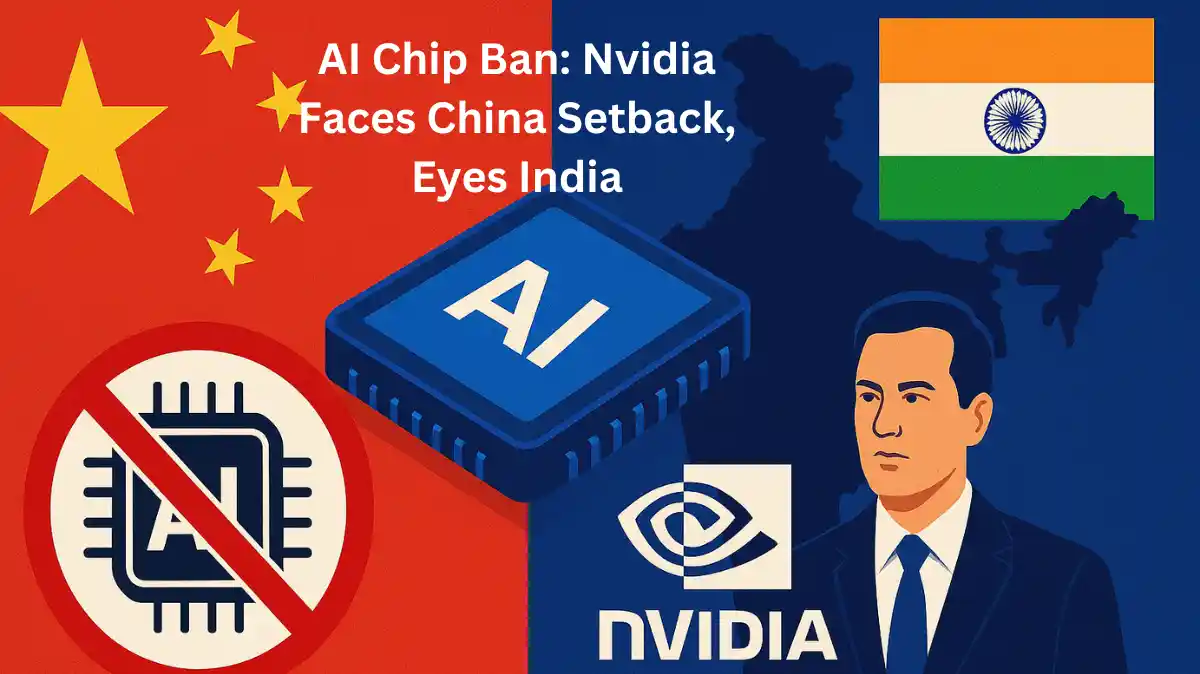
The global race in artificial intelligence (AI) has reached a new turning point. China has announced a complete AI chip ban on the use of foreign AI chips in government-supported new data center projects. Projects that are less than 30% complete have been ordered to either remove foreign chips or cancel their purchases. This decision not only intensifies the technological tensions between the U.S. and China but also delivers a significant economic blow to one of the world’s largest AI chip manufacturers — Nvidia.
China’s “Domestic Technology Self-Reliance” Strategy
Experts say this policy is part of China’s ongoing technological self-reliance strategy. Beijing has long been working to reduce dependence on foreign technology and strengthen its domestic semiconductor companies. Through these restrictions, China aims to ensure that its data infrastructure and AI capabilities are powered entirely by domestically developed chips.
However, this move is a major setback for American companies. Nvidia, Intel, and AMD will now be completely excluded from China’s government projects. Among them, Nvidia is in the most critical position, as it once held nearly 95% of the AI chip market in China. By 2022, Nvidia GPUs were present in almost every major data center in China, but the situation has now reversed entirely.
Nvidia’s Shift to “Zero Business” in China
Nvidia CEO Jensen Huang recently acknowledged in a public discussion that their business in China has now reached “almost zero.” This marks a historic shift for the company, which had earned billions of dollars from the Chinese market over the past decade. U.S. export restrictions, combined with China’s domestic policy, have effectively pushed the company out of this key market.
China began restricting U.S. AI chips in 2023. The new “total ban” represents the culmination of that process. Analysts suggest that China will now fully favor local chip makers such as Hygon, Cambricon, Inspur, and Huawei for government projects, increasing the likelihood of achieving self-reliance in new semiconductor technologies.
Nvidia Turns Focus Toward India
With China’s doors closing, India has opened new opportunities for Nvidia. The company has shifted its strategy to partner with a new alliance called the “India Deep Tech Alliance.” This coalition consists of major India-U.S. investors and venture capital firms, aiming to provide funding and technical support to deep-tech startups.
The alliance was launched in September 2025 with a funding target of $1 billion and has already raised $850 million, reflecting the growing interest in India’s deep-tech ecosystem. Members include Qualcomm Ventures, Activate AI, InfoEdge Ventures, Chirate Ventures, and Kalaari Capital.
Boost for India’s Deep-Tech Startups
Nvidia’s move is set to provide unprecedented technological support to India’s startups. The company will offer advanced AI supercomputing tools, training, and developer support to Indian deep-tech ventures. The goal is to position India as a major hub in the global AI ecosystem.
This initiative aligns with India’s $12 billion national R&D program, which focuses on promoting research and innovation. Under this program, India aims to achieve self-reliance in technology, chip design, and AI products by 2030.
Rapidly Growing Deep-Tech Market in India
Over the past two years, deep-tech funding in India has surged significantly. In 2024, funding in the sector grew nearly 78% to reach $1.6 billion. This indicates that India has moved beyond just software services and is now playing a key role in advanced AI, robotics, semiconductor design, and quantum computing.
Nvidia’s presence will provide Indian startups not only with capital but also access to world-class hardware, libraries, and developer environments. This will enable Indian companies to compete globally, particularly as Western and Chinese firms remain entangled in their own strategic conflicts.
New Global Tech Triangle: U.S.–China–India
Analysts say these developments are laying the foundation for a new “technological triangle” among the U.S., China, and India. While China races toward domestic self-reliance, the U.S. strengthens partners like India to maintain its technological edge.
India currently holds a strategic position — receiving cutting-edge technology and investments from U.S. companies while also bolstering its domestic industries to maintain regional balance. Nvidia’s growing investments are rapidly maturing India’s AI ecosystem.
Why India Has Become a Key Market for Nvidia
India’s rapidly expanding digital economy, large data user base, and government R&D initiatives make it an attractive market for Nvidia. Strong demand is emerging for AI training, startup acceleration, and cloud-based GPU services. Nvidia has already expanded its development teams in Indian cities such as Bengaluru, Hyderabad, and Pune.
Additionally, several Indian startups are innovating in AI-based applications across healthcare, agricultural technology, financial systems, and cybersecurity. Nvidia’s technical expertise will help these innovations become globally competitive.
Conclusion
China’s AI chip ban marks a decisive turning point in the global market. While it strengthens local Chinese companies, American firms like Nvidia are seeking alternative markets.
Nvidia’s growing investments in India are accelerating, and India is taking steps to strengthen its deep-tech sector.
Also Read