
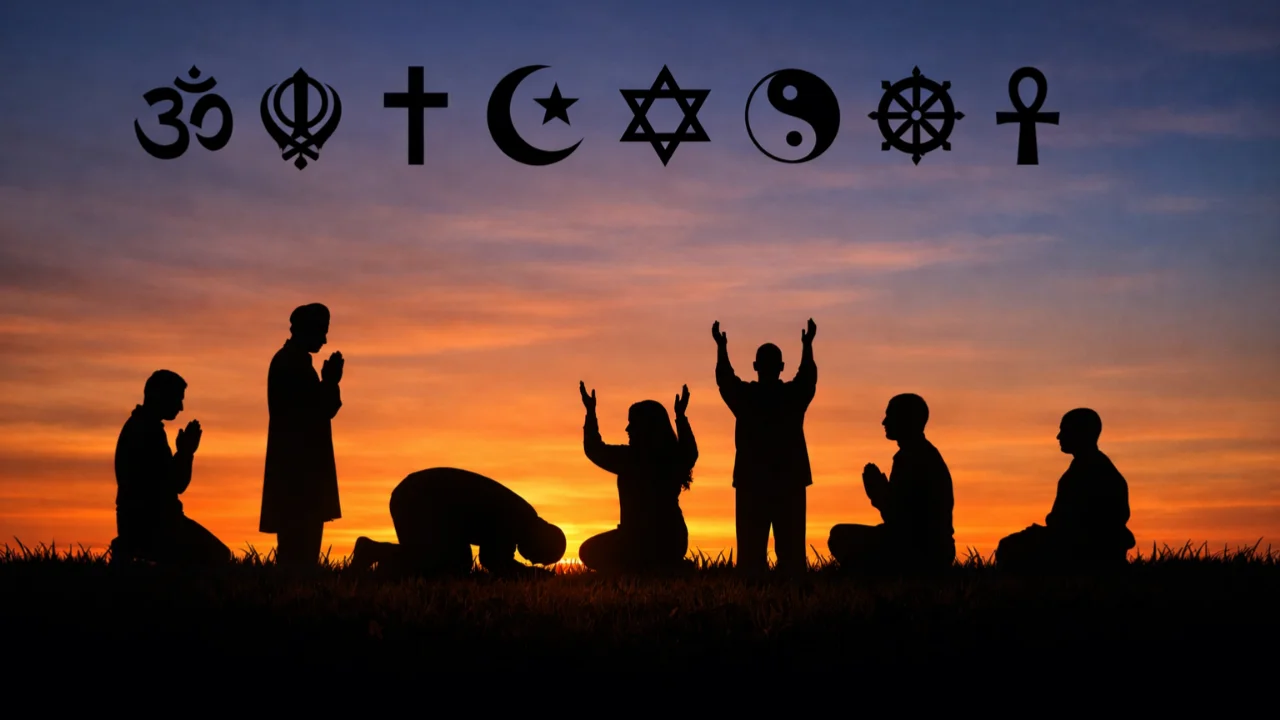
Global religious demographics: Significant changes have been recorded in the world’s religious structure over the past decade. According to a recent global study report by the Pew Research Center, between 2010 and 2020 the global share of the Christian community has declined, while the proportion of the Hindu population has remained almost stable. This study is based on the analysis of more than 2,700 censuses and surveys across 201 countries and territories.
The report states that in 2010 Christians accounted for 31 percent of the global population, which declined to 28.8 percent by 2020. However, during this period the total number of Christians increased from 2.1 billion to 2.3 billion, but compared to the 15 percent growth in the world’s total population, this increase was relatively slower, which led to a decline in their percentage share.
Birth rate and religious switching
The study has identified two major reasons for the decline — falling birth rates and people moving away from religious identity. In developed countries, where the Christian population has traditionally been higher, the average fertility rate has been recorded between 1.5 and 1.8, which is much lower than the global average of 2.3.
Along with this, the rate of leaving the religion has also been found to be significant. According to the data, out of every 100 Christians, about 17.1 people changed their religious identity or moved away from religion, while during the same period around 5.5 new followers joined.
The report also states that in 41 countries, a change of more than five percent in the share of the Christian population was recorded. In most of these cases, a decline was seen. Regions such as Europe and North America, which have long been viewed as centers of Christian tradition, have shown this change most clearly.
The study shows that more people are distancing themselves from Christianity than those who are joining it. On average, for every one person joining the religion, about 3.1 people are separating themselves from any religious identity. A large number among them are those who describe themselves as atheists or do not associate with any religion.
This change is particularly more visible among the younger generation. According to the report, around 40 percent of those leaving religion are young adults. Experts believe that the expanding reach of education, easy access to digital platforms, and rapid social changes are playing an important role behind this trend.
Shift toward Africa
The geographical center of the Christian community is now moving from Europe and North America toward sub-Saharan Africa. By 2020, the number of Christians in Africa reached 690 million, which shows nearly 31 percent growth over the past decade. In contrast, in Europe the number declined by nine percent to around 500 million. In North America, the Christian population was recorded at about 230 million.
In Latin America and the Caribbean, Christians hold 24 percent of the global share, and in North America around 10 percent. In Asia, the share of Christians is about 8 percent, mainly concentrated in countries such as the Philippines and Taiwan.
The study also mentions that while in 2010 there were 124 countries where Christians were in the majority, by 2020 this number declined to 120. In four countries, the Christian community shifted from majority to minority status.
No major change in the Hindu population
In the global context, the share of the Hindu population has been reported as stable at 14.9 percent. The main basis of this stability is India, where around 1.2 billion Hindus reside. In India, the Hindu community constitutes 79.8 percent of the total population, while the Muslim community accounts for 14.2 percent.
According to the report, the rate of religious conversion in Hindu society is relatively low and the fertility rate remains balanced, due to which their global share has remained stable.
The Muslim population is growing the fastest worldwide
The study also shows that the Muslim community remains the fastest-growing religious group at the global level. By 2020, their share in the world population was estimated at around 25.6 percent, while recent estimates suggest that this figure has reached close to 26 percent.
According to recent assessments, the main center of this growth has been Africa, where the Muslim population has recorded an increase of about 33 percent.
What is the situation of other religions?
The global share of people who keep themselves separate from religious identity or describe themselves as atheists has been estimated at around 24.2 percent. However, in some regions, especially in China, limited changes in faith-related identity have been recorded within this group. According to the same assessment, the share of the Buddhist community is about 4.1 percent. The proportion of the Jewish population has also remained almost stable without major change. Meanwhile, the combined global participation of relatively smaller religious groups such as Sikhs and Jains remains around 2 percent.
Migration and related social challenges
The study has also highlighted migration as an important factor. The flow of the Christian population from African countries toward Europe has increased, but the rapidly spreading secular thinking in Western societies appears to be affecting their religious engagement.
The social and political impact of changes taking place in religious demography is also becoming clear. In Europe, new debates are emerging over identity-based politics. In the United States, the issue of religious polarization remains part of public discourse. In India as well, discussions regarding religious identity and social structure are taking place at a broad level.
The report also indicates that in 198 countries, restrictions on religious freedom have been recorded in one form or another. This is being seen as a serious signal for policymakers.