

The tech world is evolving rapidly, and Google has now stepped into a direction that could completely redefine the future of computing infrastructure. Through its new space project, ‘Suncatcher,’ the company aims to go beyond the limitations of traditional data centers by creating a solar-powered AI data network directly in space.
This is not just an ordinary experiment but a technological initiative that charts a roadmap to elevate artificial intelligence (AI) while conserving Earth’s resources.
First Satellites to Launch in 2027
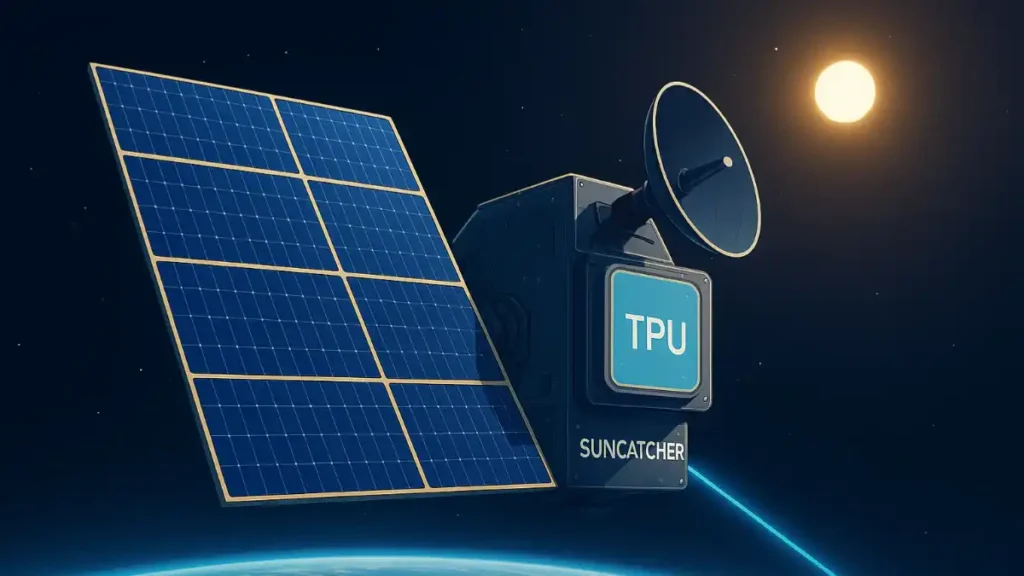
Google plans to kick off this project in 2027 with the launch of two prototype satellites into space. These satellites will be equipped with specially designed Trillium Tensor Processing Units (TPUs), representing the most advanced version of Google’s AI training infrastructure.
The company has stated that these satellites will be positioned in Low-Earth Orbit (LEO) or Sun-synchronous Orbit, where they can receive continuous sunlight. The solar energy harvested from this sunlight will power the satellites, ensuring a sustainable, continuous, and environmentally friendly system.
Experts suggest that the 2027 phase will serve as a testing period. If successful, Google plans to launch a cluster of over 80 satellites, collectively forming a massive space-based data center network.
Why Google Is Targeting Space Data Centers
Training AI models requires vast amounts of energy, data bandwidth, and cooling systems. Currently, Earth-based data centers consume enormous electricity and have a significant environmental impact.
In space, this challenge can be greatly mitigated. Continuous and uninterrupted solar energy is available, making it not only cost-efficient but also environmentally cleaner.
Google believes that by 2030, satellite launch costs will decrease enough to make space-based data centers as economical and practical as those on Earth.
How the Space Data Center Cluster Will Work
Each satellite deployed under the ‘Suncatcher’ project will feature ultra-high-efficiency solar panels, approximately eight times more effective than terrestrial counterparts. All satellites will be interconnected using free-space optical link technology, which transmits data via laser light. This technology has been tested at speeds up to 1.6 terabits per second.
The network of 80 satellites spanning a radius of about one kilometer will operate in coordination, ensuring extremely fast and stable data transfer. To make Trillium TPUs resilient against space radiation, Google has subjected them to 67 MeV proton beam tests, simulating the harsh conditions satellites face in Earth’s orbit.
Technical Challenges
Like any space project, the ‘Suncatcher’ mission faces several scientific challenges. The biggest hurdles are space radiation and maintaining optical link stability. Google is addressing these issues using specialized mathematical models and equations, with Hill–Clohessy–Wiltshire dynamics playing a central role. The company is also using JAX-based real-time models to ensure precise satellite positioning and stable link signals.
To overcome challenges related to continuous solar power supply, high-bandwidth memory sensitivity, and thermal management, Google is developing radiation-hardened designs and optical micro-link interfaces.
Partnership with Planet Labs
During the testing phase, Google will collaborate with Planet Labs, experts in Earth observation and satellite management. Together, both companies will ensure that the prototypes launching in 2027 remain stable in orbit and successfully execute AI processing operations.
If the initial mission proves feasible, a massive cluster of 81 satellites will be deployed, supporting Earth’s network traffic while handling large-scale AI training processes directly from space.
Energy Savings from Space-Based AI Data Centers
Earth-based AI data centers have historically consumed a significant portion of global electricity. As AI models continue to grow in size, energy demands are rising at a similar pace. If Google’s project succeeds as planned, it will not only reduce terrestrial energy consumption but also mark a significant step against global warming.
Experts believe that space-based AI infrastructure could become a vital direction for the future, reducing carbon emissions and alleviating the heat and energy burden of Earth-bound data centers. By 2035, if launch costs and satellite reuse technology reach expected levels, such space data centers could operate commercially.
The Future of AI Training in Space
The ‘Suncatcher’ project is not just a milestone for Google but a symbol of a new technological direction for humanity. By leveraging sustainable energy resources beyond Earth for AI training, shifting operations to space is a step that could provide new stability to humanity’s digital existence.
This is a time when data, energy, and space converge to lay the foundation for the next technological revolution. If the mission succeeds, in the coming decade, “space data centers” will no longer be a concept but a reality — where AI training, processing, and potential are powered not from Earth, but from space.
Also Read