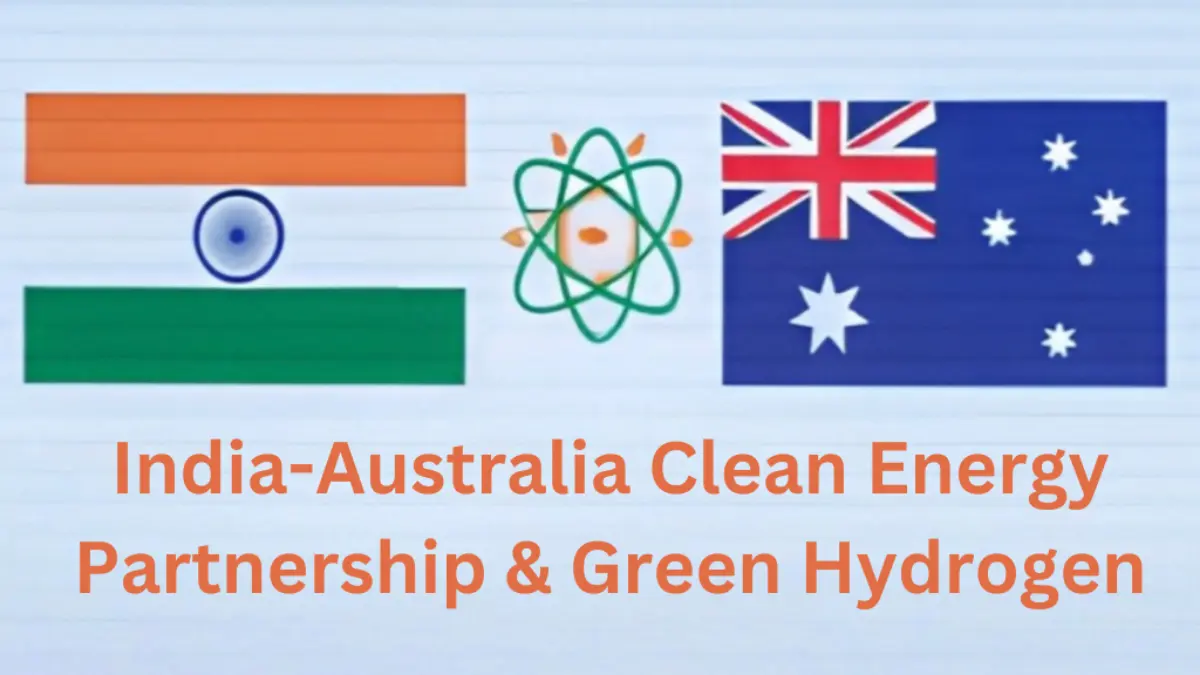
India and Australia have taken a significant step to elevate their collaboration in the clean energy sector. Both countries have presented a shared vision, agreeing to work together in manufacturing, technology sharing, and innovation. This partnership is set to not only strengthen energy security but also accelerate progress toward global sustainable development goals.
Historic Meeting in New Delhi
Union Minister for New and Renewable Energy, Prahlad Joshi, met with Australia’s Minister for Climate Change and Energy, Chris Bowen, in New Delhi. The meeting reviewed ongoing clean energy cooperation and discussed new dimensions for future collaboration.
Minister Joshi stated after the meeting that India and Australia are now moving toward a “shared technological future,” which will guide the global energy transition in the coming years.
Launch of the ‘India-Australia Green Hydrogen Taskforce’ Report
A key highlight of the meeting was the launch of the ‘India-Australia Green Hydrogen Taskforce’ report. This report establishes a concrete framework for energy collaboration between the two nations, presenting a strategic roadmap for green hydrogen production, storage, transportation, and commercial utilization.
The initiative aligns with India’s Green Hydrogen Mission strategy, aiming to position India as a leading global producer of green hydrogen by 2030.
Chris Bowen remarked that “India and Australia are natural partners in the clean energy sector.” He added that the expertise of both countries can deliver mutually beneficial outcomes—India offers a vast technological base and skilled workforce, while Australia brings advanced research, innovation, and top-tier academic networks.
Warm Messages on Social Media
Minister Joshi shared on X (formerly Twitter) that Chris Bowen described India as Australia’s “best friend,” especially in the journey toward energy transition. He added, “India and Australia are both committed to clean energy, and this cooperation will open new opportunities for the future.”
Joshi further noted that the partnership will accelerate innovation in the energy sector while creating new opportunities for employment, investment, and technical training.
Emphasis on Manufacturing and Technology Sharing
Under the new partnership, both countries have decided to promote domestic manufacturing and technology sharing. This will strengthen India’s production of solar panels, energy storage equipment, and hydrogen-based infrastructure.
India aims to meet a substantial portion of its energy needs from non-fossil sources by 2030, and this partnership is a decisive step in that direction.
Australia, through this collaboration, will contribute its expertise in energy innovation, lithium-based batteries, and grid storage solutions to the Indian market. High-level technology exchange between the two countries is expected to significantly accelerate green transformation.
Shared Vision in Energy, Education, and R&D
Australia’s clean energy sector is highly advanced in research and education, with its universities and research institutions playing a leading global role in green technology. This expertise will now reach Indian institutions and industries.
India, with its robust startup ecosystem, digital infrastructure, and skilled workforce, will translate this knowledge into practical development projects.
Both countries also discussed launching joint research programs, enhancing university collaborations, and initiating joint industrial promotion schemes.
Special Meeting with Power Minister Manohar Lal
Australia’s Energy Minister Chris Bowen also held a formal meeting with India’s Power Minister Manohar Lal. The discussion focused on energy infrastructure, smart grid technology, and power system modernization. Both sides agreed to make energy distribution more efficient and environmentally sustainable.
The meeting also covered future joint projects, investment promotion, and policy reforms.
Shared Vision of PM Modi and Anthony Albanese
The partnership was initially established during the meeting between Prime Minister Narendra Modi and Australian Prime Minister Anthony Albanese in November 2024. At that time, both leaders laid the foundation for the “India-Australia Clean Energy Framework.” The cooperation is now rapidly expanding into new areas, including solar, wind, biofuels, and hydrogen.
Shared Green Energy Goals
Both India and Australia are committed to achieving high renewable energy targets by 2030. India aims to reach 500 GW of renewable energy capacity, while Australia is progressing toward net-zero emissions. This collaboration will provide mutual support for their respective strategies.
Additionally, both countries agreed to provide policy support to the private sector to encourage investment and innovation, boosting employment and production capacity in both economies.
Regional and Global Impact
This partnership will set a new model for clean energy collaboration in the Asia-Pacific region. The India-Australia strategic initiative could serve as an inspiration for other nations. Both countries are also exploring the establishment of a ‘green supply chain’ and ‘technology co-creation hub,’ which will provide new direction to the global clean energy economy.
India-Australia Partnership
The new chapter between India and Australia goes beyond energy. It symbolizes innovation, research, investment, and policy integration. This collaboration will strengthen not only commercial ties but also send a global message of environmental responsibility.
Both Joshi and Bowen described the initiative as “not just an agreement, but the beginning of a future energy revolution.”
For India, this partnership represents a major step toward self-reliance, a green economy, and global collaboration. Australia views it as an opportunity to deepen Asia ties and diversify energy investments.
Also Read