India China Relations: The long-standing shadow of tension and mistrust between India and China now appears to be gradually lifting. There was a time when the Galwan Valley clash had pushed bilateral ties into a near–Cold War-like freeze. However, fresh signals now suggest that South Asia’s two largest economies are returning to a path of economic cooperation and dialogue.
A Reuters report dated December 12, 2025, officially confirmed this shift, stating that the Indian government has fast-tracked the business visa process for Chinese professionals. The government has removed an additional administrative layer that earlier caused prolonged scrutiny and delays. The objective is now clear — to issue visas to Chinese business professionals within four weeks, in order to bridge the shortage of technical expertise in electronics, manufacturing, and other industrial sectors.
From Galwan to a Push for “Peace Along the Border”
The Galwan Valley clash in 2020 created a deep rupture in India–China relations. Since then, tensions along the Line of Actual Control (LAC) had remained persistently high. However, a significant shift was seen after the 22nd Corps Commander-level talks in 2024.
During these talks, complete disengagement was achieved in disputed areas such as Depsang and Demchok. Patrolling mechanisms were restored, tents and temporary structures were removed, and both sides agreed to revert to the pre-2020 status quo. This peaceful process continued into 2025, signaling a strategic improvement in mutual understanding between the two countries.
High-Level Engagement and Restoration of “Travel Channels”
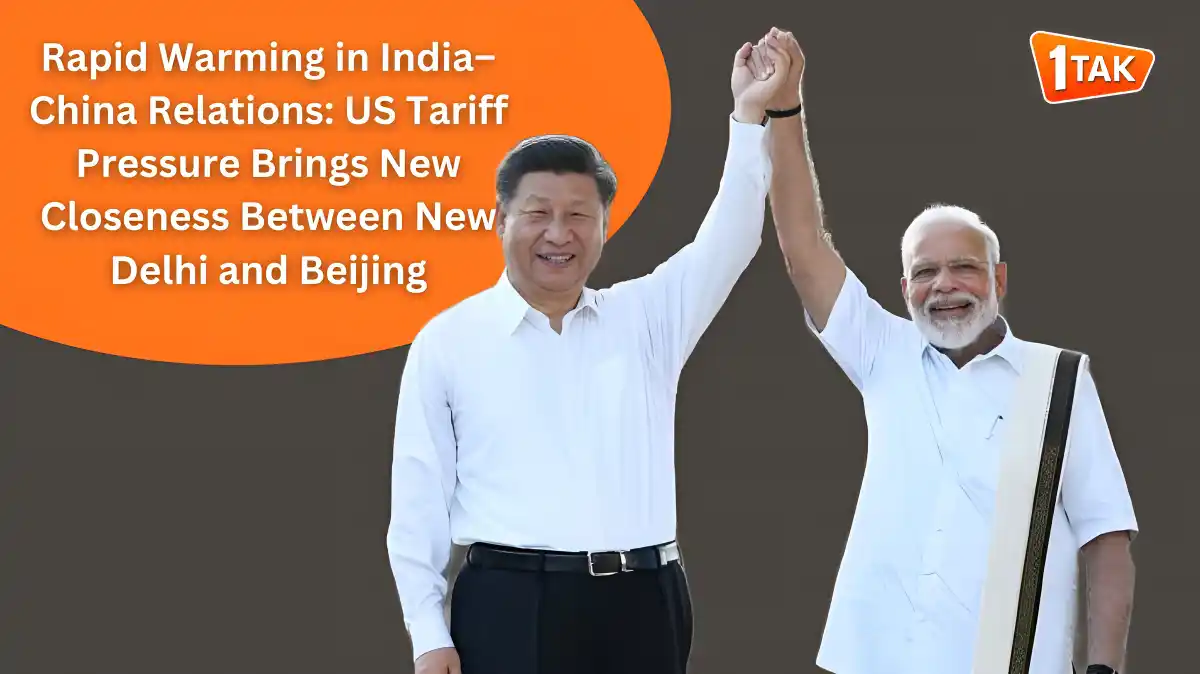
Another major indicator of improving ties was the historic meeting held in September 2025 in Tianjin, where Prime Minister Narendra Modi and Chinese President Xi Jinping engaged in direct dialogue. This interaction was seen as crucial not only diplomatically but also from a practical standpoint.
Following the meeting, several concrete decisions were taken — including the resumption of direct flights, reopening of tourist visas, and the revival of the Kailash Mansarovar pilgrimage. These steps were widely viewed as restoring vital cultural and religious linkages between the two nations.
In continuation of this process, senior officials from the foreign ministries of both countries met in Beijing on December 11, 2025, to review the implementation of these agreements. China’s foreign ministry described India’s steps as a “sincere and positive move,” calling them an important initiative toward strengthening people-to-people contact between the two countries.
US Tariff Pressure Brings India and China Closer
Global economic pressures have also played a critical role in driving this growing proximity. Between August 2024 and 2025, import tariffs of up to 50 percent imposed by the United States on Indian goods forced New Delhi to actively search for alternative markets.
President Trump’s new trade policy posed significant challenges for India in the US market, prompting New Delhi to once again view China as a pragmatic trading partner. Strategically, India appears to be balancing US and European dominance while working to strengthen Asian supply chains.
After higher tariffs were imposed on Russian crude oil, India had limited options other than pursuing fresh economic arrangements and increased investment with China. This was a decision driven by economic pragmatism — one that is now beginning to deliver tangible outcomes.
Trade Takes Off: Bilateral Volume Hits Record High
In financial year 2025, India–China bilateral trade reached a new record. The figure of $127.7 billion surpassed the previous year’s $118.4 billion. Between April and July 2025 (the first four months of FY2026), India’s exports to China rose by 19.97 percent to nearly $5.76 billion.
During the same period, imports from China jumped by 13 percent to $40.65 billion. From April to October 2025, India’s total exports to China increased by 24.7 percent to $10.03 billion, driven largely by petroleum products, electronics, and marine goods.
While India’s trade deficit with China remains high at $99.2 billion, sustained growth in exports and policy measures such as visa liberalisation are being seen as positive signals. Industry experts estimate that since 2021, India suffered losses of nearly $15 billion due to shortages of Chinese machinery and technical professionals — a gap the new visa policy is expected to narrow.
Investment Momentum Grows With Policy Easing
Alongside relaxed visa norms, the Indian government has also introduced certain relaxations in investment-related approvals. According to sources, approval processes for imports of high-tech machinery, electronic components, and energy equipment are now being expedited through digital platforms in select cases.
This has provided relief to India’s electronics industry and injected fresh momentum into production across sectors such as mobile phones, solar panels, and auto components. Several Chinese technology firms are now reconsidering reinvestment in the Indian market.
Trade bodies and chambers of commerce are describing this realignment as a “recovery phase” for Indian industry — one in which competition and foreign collaboration are being carefully balanced.
The Road Ahead: Cooperation or Caution?
The evolving India–China relationship now points to a “recalibrated engagement” — a framework that places economic pragmatism at its core, allowing for limited but meaningful cooperation.
Strategic mistrust between the two countries has not entirely disappeared. Issues such as border management, Tibet policy, and security dynamics in the Indo-Pacific region continue to demand caution. Yet, by the end of 2025, it would not be inaccurate to say that India–China ties have reached a decisive shift from “confrontation” toward “dialogue.”
Both nations are now keen to improve coordination on multilateral platforms such as BRICS, the Shanghai Cooperation Organisation, and the Asian Infrastructure Investment Bank. This engagement could influence not only bilateral trade but also the broader economic trajectory of the Global South.
Conclusion
This renewed dialogue between India and China is unlikely to remain confined to bilateral gains alone; it has the potential to reshape the economic architecture of the wider Asian region, marking a significant shift in India China Relations.
Easier business visas, reduced border tensions, and rising export figures all indicate that Asia’s two giants are moving toward partnership rather than rivalry. This direction could prove beneficial for both — provided that trust grows at the same pace as trade numbers.
Also Read