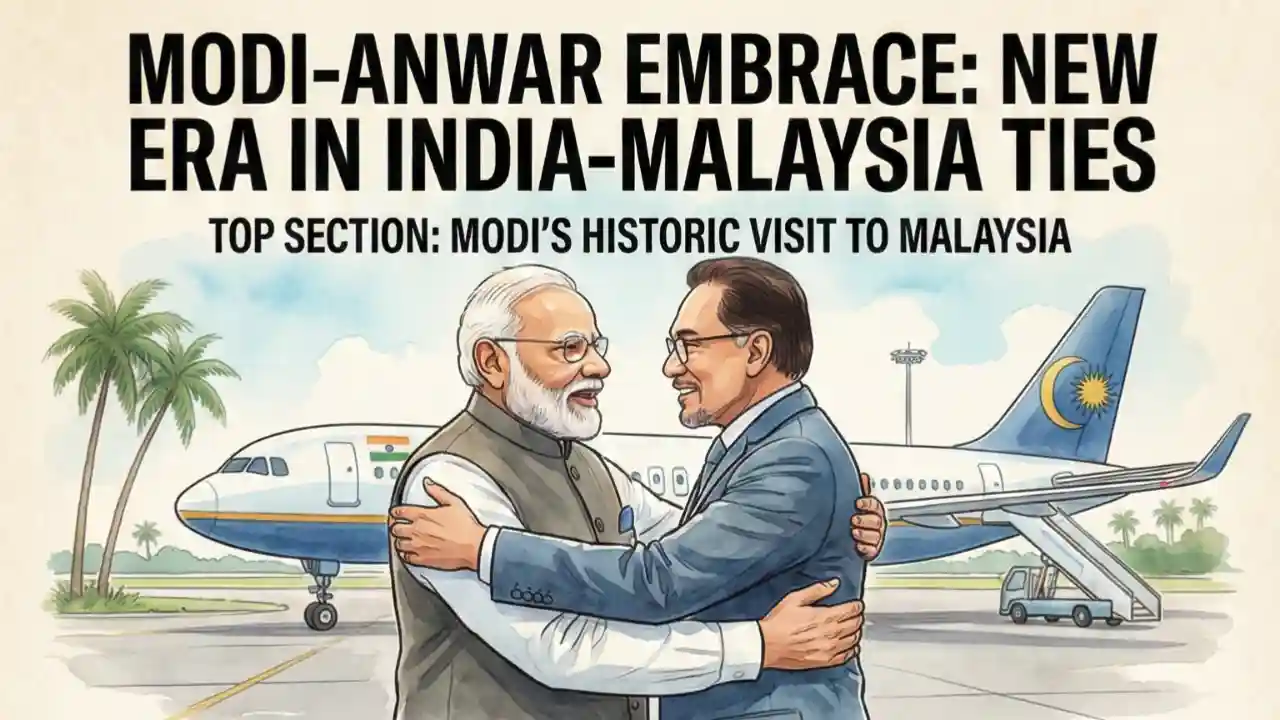
India–Malaysia Relations: Prime Minister Narendra Modi was on a visit to Malaysia on 7–8 February. This was his first foreign trip in 2026 and the first visit to Kuala Lumpur by an Indian Prime Minister after a gap of seven years. Making the occasion more special, Malaysia’s Prime Minister Anwar Ibrahim himself reached the airport to receive him. The two leaders warmly embraced each other.
This visit took place at a time when new alignments are emerging in the politics of Southeast Asia and India is moving forward to further strengthen partnerships with ASEAN countries under its ‘Act East’ policy.
A new beginning after differences
During the ASEAN Summit in October 2025, a pause was seen in relations between the two countries. After the Pahalgam attack and the situation that arose from it, New Delhi had expressed discomfort over Malaysia’s offer to mediate in India–Pakistan tensions. Although Malaysia had condemned that attack, public statements had affected relations for some time.
Mention of cross-border terrorism in joint statement
In the joint statement issued after bilateral talks, condemnation of terrorism in all its forms was reiterated. For the first time, a clear mention of “cross-border terrorism” was included. Prime Minister Modi said that no double standards will be adopted in matters of terrorism and no kind of compromise is possible on it.
Former diplomat Ashok Sajjanhar says that the inclusion of this terminology is being seen as a diplomatic success for India. According to him, this will make it easier for India to raise the issue of terrorism more strongly on Southeast Asian platforms.
Presence of Pakistan’s Naval Chief Admiral Naveed Ashraf
During the visit, Pakistan’s Naval Chief Admiral Naveed Ashraf was also present in Malaysia. He met the chief of the Royal Malaysian Navy. In this meeting, issues such as maritime security, joint exercises and counter-terrorism cooperation were discussed in detail.
Looking at history, defense and diplomatic ties between Malaysia and Pakistan have long been close. During the tenure of former Prime Minister Mahathir Mohamad, issues such as Kashmir and the citizenship law had also led to strain in India–Malaysia relations. However, under the current leadership, Malaysia’s stance appears more balanced and focused on economic interests compared to earlier.
Emphasis on economic and technological cooperation along with defense
During the visit, a total of 11 agreements and MoUs were signed. These include areas such as defense cooperation, sharing of intelligence, health, digital technology and the semiconductor industry. Malaysia is counted among the leading countries globally in semiconductor exports. In the joint statement, the strategic importance of this industry was underlined and there was talk of increasing technological coordination. In recent years, India has been trying to attract investment in the field of chip manufacturing, so this cooperation is being considered important from an industrial perspective.

On the trade front as well, signs of expansion possibilities were seen. At present, bilateral trade stands at the level of billions of dollars. Both sides agreed to move forward on transactions in local currencies, the rupee and the ringgit. India imports palm oil and electronics from Malaysia, while it exports aluminium and petroleum products.
India–Malaysia relations in a changing geopolitical environment
India and Malaysia have had diplomatic relations since 1957. In August 2024, these were given the status of a comprehensive strategic partnership. In the current period, this relationship is not limited only to the bilateral sphere, but also holds importance within the broader ASEAN framework. Amid growing competition between China and the United States in Southeast Asia, Malaysia is trying to adopt a balanced diplomacy. In such an environment, increasing economic and security cooperation with India is also an expansion of options for it.
What is the real impact on Pakistan?
Analysts do not have a uniform view on this entire development. Some experts believe that the language of the joint statement and growing coordination on ASEAN platforms may create a situation of diplomatic pressure for Pakistan.
On the other hand, other experts say that Malaysia will not move on a path of completely ignoring its traditional relations. They believe that Kuala Lumpur will try to maintain balance while carrying forward both its old ties and its current economic priorities.