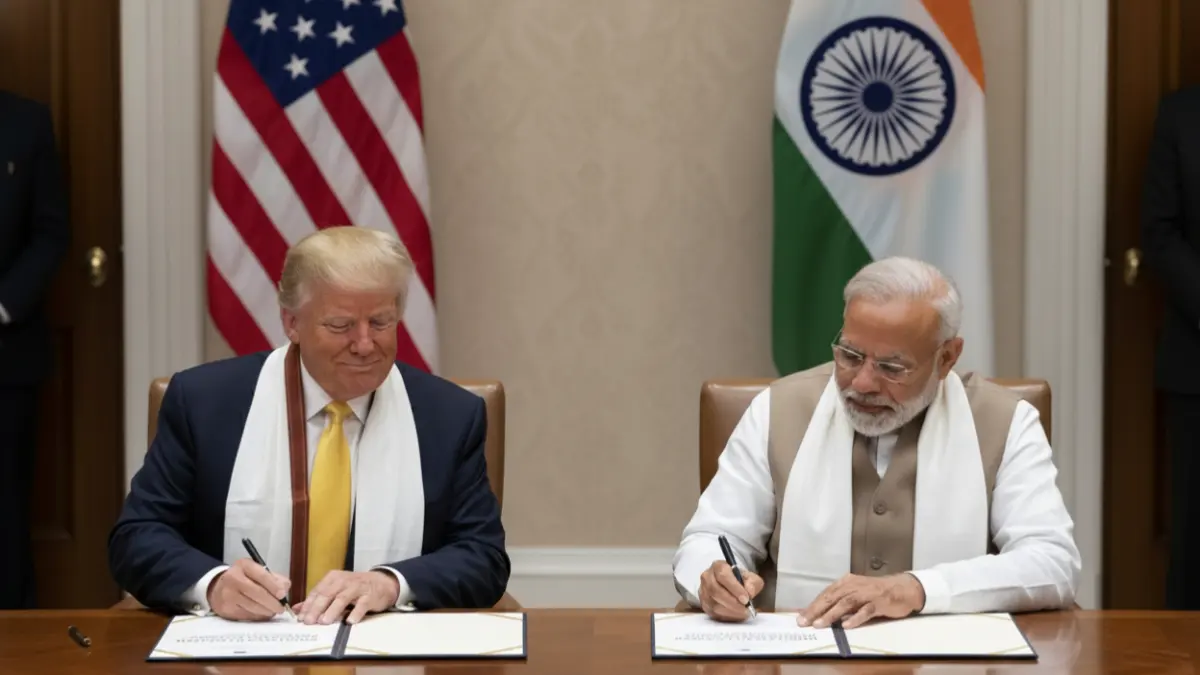
India has strengthened its energy security by signing its first long-term and structured LPG supply agreement with the United States. The announcement was made by Union Petroleum and Natural Gas Minister Hardeep Singh Puri. He confirmed that the agreement will come into effect in 2026, under which India will receive approximately 2.2 million tonnes of LPG annually from the US Gulf Coast. This volume will account for nearly 10 percent of India’s total LPG import requirements.
This agreement marks a major step forward in India’s energy import strategy and is expected to play a significant role in bringing stability to the domestic LPG (Liquefied Petroleum Gas) distribution network.
India’s Largest LPG Import Agreement to Date
Until now, India has been importing LPG from various supplier countries under spot and short-term contracts. However, this marks the first time India has signed a long-term strategic LPG supply agreement with the United States. Hardeep Singh Puri described it as “a historic achievement in India’s journey towards energy self-sufficiency.”
The agreement will be based on the Mont Belvieu pricing benchmark, which is considered the standard for global LPG price evaluation. This pricing structure will ensure a stable and transparent procurement system for India, even during fluctuations in the global energy market.
Companies Involved
Three major public sector fuel companies of India have jointly participated in this agreement:
- Indian Oil Corporation (IOC)
- Bharat Petroleum Corporation Limited (BPCL)
- Hindustan Petroleum Corporation Limited (HPCL)
These companies held extensive technical and price negotiations with American fuel producers and exporters before finalising the deal. The objective is not only to secure a long-term gas supply, but also to build a dependable and sustainable energy partnership. All three companies are pivotal to India’s LPG distribution network, supplying cooking gas to millions of households across the country.
Relief Expected for Domestic Market
In India, LPG is not merely a fuel — it is an essential part of daily living for millions of households. Under the Pradhan Mantri Ujjwala Yojana, millions of economically weaker families have been provided LPG connections either free of cost or at subsidised rates. However, a sharp rise in international LPG prices in the past few years has increased the government’s subsidy burden.
Last year, international LPG prices rose by more than 60 percent. Despite this, the government kept the retail price of domestic cylinders limited to ₹500–₹550, while the actual cost was nearly twice that amount. To offset the price gap, the central government provided a subsidy of over ₹40,000 crore.
This new supply agreement with the United States is expected to help reduce this burden in the future. It will ensure consistent LPG availability and help stabilise prices.
Energy Security and Source Diversification
India’s energy demand continues to rise. The country consumes approximately 25 to 27 million tonnes of LPG annually, out of which nearly half is met through imports. Currently, India imports LPG primarily from Saudi Arabia, Qatar, the UAE and Kuwait.
The new agreement with the United States adds a strong alternative source to India’s LPG supply portfolio. This diversification will prevent overdependence on any single region. In times of global uncertainty — especially during geopolitical tensions in West Asia — this agreement will act as a safeguard for India’s supply chain.
Hardeep Singh Puri stated, “Energy security is at the core of a nation’s economic strength. A long-term supply arrangement with a trusted partner like the United States will provide us both stability and resilience.”
Negotiations Began in July 2025
Preparations for this agreement had been underway for several months. In July 2025, an Indian delegation began discussions with American energy producers. The discussions focused on supply diversification, long-term price stability and transparent contractual terms.
After several rounds of technical meetings and pricing evaluations, the agreement was finalised in November 2025. The government described it as “a new chapter in strategic energy cooperation.”
India–US Energy Relations
This agreement will elevate bilateral energy relations between India and the United States to a new level. The US already exports crude oil and natural gas to India, and with this development, it will now emerge as a key LPG supplier as well.
The partnership is moving beyond commercial trade and evolving into a strategic collaboration. Both nations are also holding discussions on LNG and clean energy technologies. This cooperation will support India’s target of achieving “Net Zero by 2070.”
When Will Consumers Benefit?
According to experts, the real impact of this deal will be visible from mid-2026. As the contracted volumes begin reaching India, domestic market supply will strengthen.
This is expected to reduce LPG availability challenges and bring price stability to retail cylinders. Rural and economically weaker households — particularly beneficiaries of the Ujjwala Yojana — stand to benefit the most.
Government’s Long-Term Plan
The government is working towards enhancing LPG imports, storage capacity and logistics infrastructure over the coming years. Construction of large LPG terminals in coastal states and expansion of the pipeline network are key components of this plan.
Additionally, research and investments are being encouraged in bio-LPG and green energy alternatives, with the aim of gradually reducing dependence on imports.
Conclusion
The new LPG supply agreement between India and the United States is a significant step forward in safeguarding India’s energy security. It is also expected to provide long-term relief to consumers. In the coming months, the impact of this agreement will be visible in the domestic LPG market, contributing to stable pricing, reliable supply and more flexible policy planning.
This agreement marks another firm step toward India’s goal of energy security and will indirectly benefit millions of families while strengthening bilateral cooperation between India and the United States.
Also Read