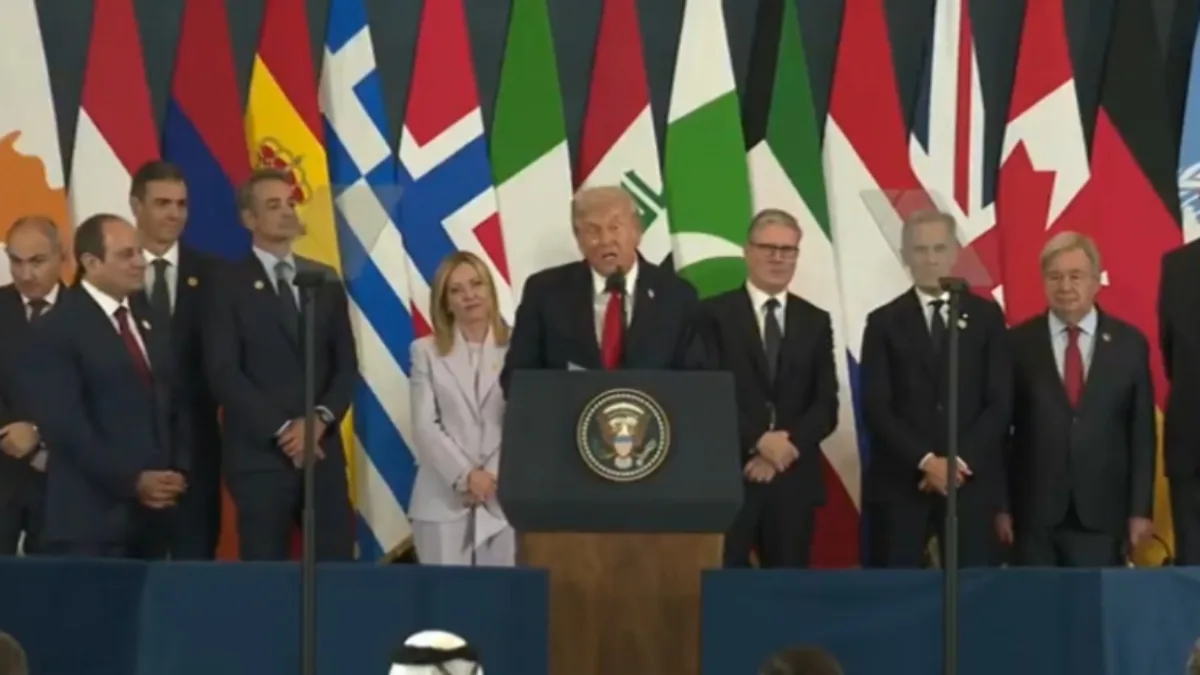
After two years of devastating conflict, a significant Israel Gaza Ceasefire agreement was signed on 9 October 2025 at a historic peace summit held in Sharm El-Sheikh, Egypt. The Israel Gaza Ceasefire accord marks a major step towards restoring lasting peace in the region. Egyptian President Abdel Fattah el-Sisi, U.S. President Donald Trump, Turkish President Recep Tayyip Erdoğan, and Qatar’s Emir Sheikh Tamim bin Hamad Al Thani played decisive roles in facilitating the agreement. The summit represented a joint initiative to end the two-year-long Israel Gaza conflict and was attended by leaders and representatives from over 20 countries and international organisations, though neither Israel nor Hamas were present at the table.
Key Provisions of the Agreement
The ceasefire agreement aims to ensure the stability of the truce, facilitate the exchange of hostages, enable the withdrawal of Israeli forces from Gaza, and deliver humanitarian aid to the territory. In the first phase, Israeli troops will fully withdraw from Gaza City, Rafah, Khan Younis, and the northern parts of the enclave. Five humanitarian relief checkpoints have been opened, and the process of prisoner release has already begun.
Under the agreement, not only will immediate humanitarian assistance reach Gaza, but health and food supplies for residents will also be ensured. The reconstruction of war-affected areas will be prioritised to help Gaza return to normal life and resume development.
Release of Hostages and Prisoners
Following the agreement, Hamas released 20 living hostages who had been captured during the 7 October 2023 attack. Meanwhile, Israel began releasing around 2,000 Palestinian prisoners, including both political and security detainees. The exchange is being viewed as a symbolic step towards rebuilding mutual trust. Although prisoner exchanges had taken place earlier, this one is considered the largest, signalling a shift towards reconciliation between the two sides.
Among the released Palestinians are individuals accused of attacks and killings, as well as political prisoners who had been held for years without formal charges. Celebrations erupted across Gaza and the West Bank as families reunited with their loved ones.
The Devastating Picture of Gaza
The two-year conflict left Gaza in ruins. More than 67,000 people are estimated to have been killed, most of them civilians and children. The region suffered from famine, healthcare collapse, and severe shortages of essential supplies, deepening the humanitarian crisis. Hundreds of thousands were displaced, struggling to survive amid widespread destruction.
The war began on 7 October 2023 with Hamas’s surprise assault that killed over 1,250 Israelis and led to 251 people being taken hostage. The attack triggered a massive Israeli military response, resulting in widespread devastation across most parts of Gaza.
Current Status of the Ceasefire
The ceasefire is now fully in effect, with all humanitarian checkpoints operating smoothly. International organisations and mediating nations are closely monitoring the situation to ensure continuous aid delivery and the maintenance of peace. With the reopening of aid crossings, medical supplies, food, and essential materials are reaching Gaza, providing immediate relief to civilians.
Mediating nations have emphasised their commitment to making the ceasefire sustainable and guiding both Israel and Hamas towards a long-term peace process. The focus now lies on political dialogue, security arrangements, and social reconstruction to bring stability to the war-torn region.
The Decisive Role of Mediating Nations
Egypt, the United States, Turkey, and Qatar played crucial roles in achieving the ceasefire. Egypt hosted the summit and fulfilled its responsibility for regional stability. U.S. President Donald Trump reinforced diplomatic efforts, while Turkey and Qatar made significant contributions in advancing negotiations and finding common ground between the parties.
The success of this accord is largely attributed to the diplomatic acumen, mediation skills, and regional influence of these four countries. Their initiative has not only brought hope for Gaza but also renewed optimism for lasting peace across the Middle East.
Future Challenges and Hopes
Despite being a historic achievement, the Israel Gaza Ceasefire agreement still faces major challenges in implementation. These include the complete reconstruction of Gaza, ensuring transparent governance, preventing extremist activities, and maintaining political stability. Israel’s focus remains on fully withdrawing its forces and limiting Hamas’s military capabilities, while the Palestinians continue to demand freedom and security guarantees.
The agreement has brought an end to active fighting, but long-term peace will require sustained dialogue. Experts believe this ceasefire marks the first ray of relief for both Gaza and Israel, paving the way for cooperation and stability in the future.
Also Read