
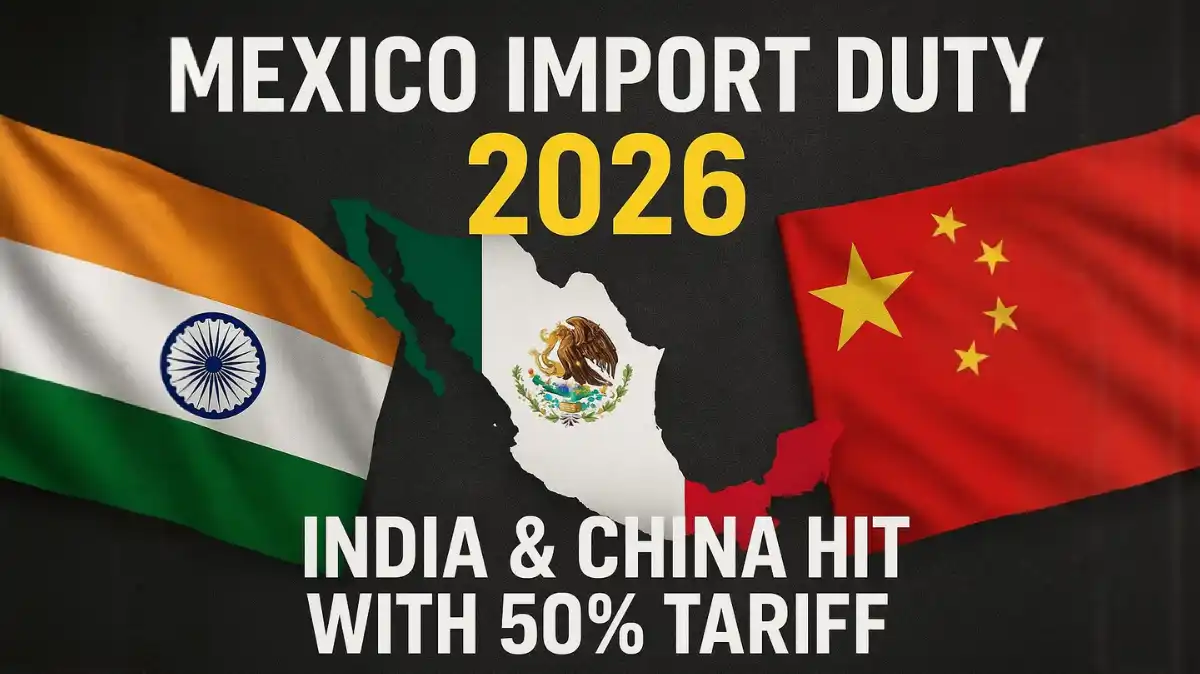
Mexico Import Duty: A major economic development from Mexico City has created a stir in global trade circles. On 10 December 2025, Mexico’s Parliament passed a significant Mexico Import Duty bill imposing import duties of up to 50% on thousands of products coming from non-FTA countries such as India, China, South Korea, Thailand and Indonesia. The law will come into effect on 1 January 2026, and is being seen as the biggest economic move yet by President Claudia Sheinbaum’s administration.
How the Bill Was Passed: Heated Debate in Parliament
On Wednesday, 10 December, after extensive discussions in Mexico’s lower house – the Chamber of Deputies, the bill was approved. 281 members voted in favour, 24 opposed, while 149 were absent. The proposal then moved to the Senate, where it was cleared with 76 votes in support, only 5 against, and 35 absentees.
This is the same bill initially introduced by President Sheinbaum in September 2025. At that time, diplomatic objections from countries like India and China, along with pressure from domestic trade groups, delayed its progress. Eventually, a softer, revised version was passed, covering around 1,400 product categories. Roughly two-thirds of these items will face relatively lower duties.
Which Countries and Products Will Be Affected
These tariffs apply only to nations that do not have a Free Trade Agreement (FTA) with Mexico — such as India, China, South Korea, Thailand, Indonesia and Malaysia.
The automobile and auto parts sector will face the largest impact, with duties going up to 50%. Other affected items include textiles, garments, steel, plastics, footwear, home appliances, toys and electronics. According to the government’s latest data, most products will see duties of up to 35%, while some fall in the 5% to 50% range.
The policy clearly indicates that China is a primary target, as Chinese companies had captured nearly 20% of Mexico’s automobile market by 2025.
Mexico Government’s Stand
Mexico’s finance and industry ministries have described the move as being in the “national interest”. The government says the step will shield domestic industries, protect jobs and boost local production.
According to the finance ministry, this policy is expected to generate 52 billion pesos (approximately USD 2.8 billion) in additional revenue for the government in 2026 — an amount that will help reduce Mexico’s fiscal deficit.
This decision also comes at a time when preparations are underway for the 2026 review of the USMCA (US-Mexico-Canada Agreement). Several analysts see this as an attempt to maintain smooth relations with the United States, especially the Trump administration, and avoid any strict trade measures during the review.
Wave of Criticism
While automobile groups and local manufacturers have supported the move, several industrial associations and retail bodies have warned of rising inflation and supply chain disruptions.
The president of the Mexican Business Council for Trade said,
“High tariffs will increase local production costs, directly affecting consumers. This policy could raise inflation in the long run.”
Opposition lawmakers have accused the government of acting under US pressure, arguing that the decision could weaken Mexico’s image as an independent supporter of open global trade.
India to Face the Most Serious Impact
For India, this decision is being viewed as a major economic setback. Mexico is among the key Latin American markets where Indian automobile companies have strong export numbers. Firms such as Tata Motors, Bajaj Auto and Mahindra have maintained a steady presence in Mexico for years.
With duties rising to 50%, the competitiveness of Indian vehicles and auto parts may decline. Exports of textiles, steel and plastic goods may also be affected.
Interestingly, the decision comes shortly after the United States accused India of rice dumping, making analysts describe this as India’s “second major shock” in a short span.
While the Indian government has not yet issued an official response, it is expected that the matter will surface in upcoming India–Mexico trade discussions.
China’s Strong Objection
China has sharply criticised the move, calling it an “unfair step that disrupts the global supply chain.” According to China’s Ministry of Commerce, Mexico’s decision goes against the spirit of World Trade Organization (WTO) rules.
In response, Mexico clarified that the step has been taken to protect domestic production, not to target any particular country, though analysts say it could significantly affect China-Mexico trade.
Analysis: Is a New Phase of Tariff Conflict Beginning?
Economic analysts say the move reflects a domino effect of Trump-era tariff strategies. They believe that just as the U.S. triggered trade tensions by imposing duties on China, Mexico too has now taken a similar path to safeguard its economic interests.
Professor Jorge Morales of the University of Los Angeles stated,
“This is not just an economic measure; it signals that global trade has entered a fresh era of protectionism. Other Latin American countries may soon adopt similar tariff policies.”
What Changes From 2026
With the bill now signed into law, the effects of the Mexico Import Duty will become visible early in 2026:
- Imported vehicles and electronics will become more expensive.
- Local industries are expected to see fresh investment and increased production.
- Consumers will face higher prices.
As of 12 December 2025, no amendments have been made. This confirms that Mexico’s new tariff law will take effect on 1 January 2026, marking the beginning of a new chapter in global trade dynamics.
Also Read