
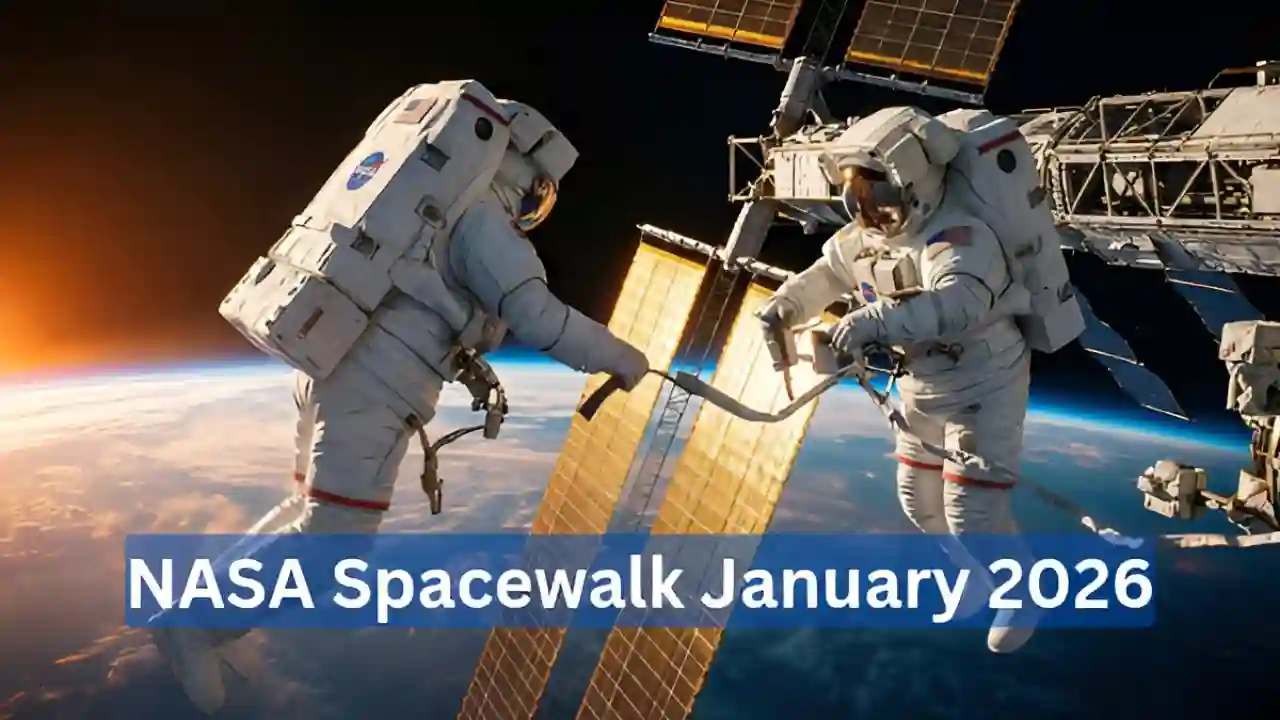
NASA Spacewalk January 2026: The new year 2026 is set to add a golden chapter to the history of space science. The International Space Station (ISS), which is celebrating 25 years of continuous human presence in space, is now entering a phase of major technological transformation. NASA has confirmed that two critical spacewalks are scheduled for the upcoming month of January.
These missions are not just routine maintenance tasks; they will lay a strong foundation for future missions such as the Artemis Program and eventual Mars expeditions. Under NASA Spacewalk January 2026, these operations will significantly upgrade the station’s power systems and navigation capabilities. Let’s take an in-depth look at every technical and strategic aspect of this mission.
NASA’s ‘Mega Plan’: January 2026 Schedule and Strategy
According to an official update released by NASA on December 30, 2025, the agency has decided to kick off the new year in a spectacular manner. For NASA Spacewalk January 2026, the dates January 8 and January 15 have been finalized. The primary objective of these missions is to modernize the aging infrastructure of the ISS.
To provide detailed information about this historic development, NASA has scheduled a special media briefing on January 6, 2026, at the Johnson Space Center in Houston.
- Briefing Date: January 6, 2026
- Time: 12:30 AM IST
- Platform: Live streaming on NASA TV and YouTube
- Special Initiative: The public can directly ask questions to scientists via #AskNASA on social media.
First Spacewalk (January 8): A Major Transformation of the Power Grid
The first mission is scheduled for January 8 and is considered technically complex and extremely important. Command of this mission will be in the hands of two exceptional astronauts.
Mission Commanders and Their Roles
For this Extravehicular Activity (EVA), NASA has selected some of its most experienced and promising astronauts:
- Mike Fincke: A veteran of space exploration who has completed nine spacewalks so far. With this mission, he will tie the record held by Peggy Whitson and Michael López-Alegría.
- Zena Cardman: This will be her first EVA. The combination of an experienced astronaut with fresh enthusiasm is crucial for mission success.
iROSA: A New Lifeline for the ISS
The primary objective of the January 8 spacewalk is to modify the ‘2A Power Channel.’ This is a preparatory step for the installation of iROSA (ISS Roll-Out Solar Array).
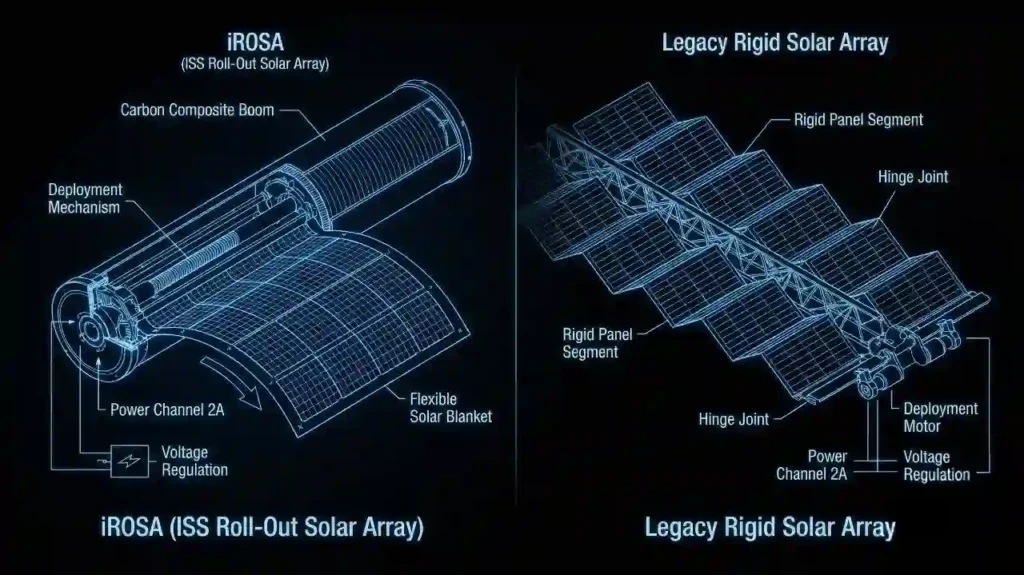
“The iROSA technology is replacing older, heavier solar panels. These new panels are lighter, occupy less space, and operate using a roll-out mechanism (unfolding like a mat). This upgrade will increase the station’s power generation capacity by nearly 30%.”
This upgrade is essential to keep the ISS operational until 2030 and to ensure a safe de-orbit afterward, as a stable and powerful energy source is critical.
Second Spacewalk (January 15): Upgrading ‘Vision’ and ‘Docking’ Systems
While the first mission focuses on power, the second NASA Spacewalk January 2026 on January 15 will concentrate on enhancing the station’s “eyes” and navigation systems. This mission is expected to last approximately six hours and has three major technical objectives:
1. High-Definition Camera Replacement
An outdated camera installed at Camera Port-3 will be removed and replaced with a modern HD Camera. This will enable better Earth observation and provide clearer scientific imagery of external experiments.
2. Navigation Aid: ‘Planar Reflector’
With increased traffic of commercial spacecraft to the ISS in the future, a new ‘Planar Reflector’ will be installed on the Harmony Module. This device will assist spacecraft such as SpaceX Dragon and Boeing Starliner with precise navigation during docking.
3. Thermal Regulation and Ammonia Servicer
The third task involves relocating an ‘Ammonia Fluid Connecting Hose’ on the S6 and S4 Truss sections. This is critical for maintaining the ISS’s thermal regulation system.
Technical Challenges and Safety Measures
Working in space is never without risk. In 2024 and 2025, several missions had to be postponed due to coolant leak issues. However, NASA has confirmed that all Extravehicular Mobility Units (EMU), or spacesuits, have undergone thorough inspections and are completely safe.
During the mission, three key officials at the Mission Control Center will closely monitor every activity:
- Bill Spetch: ISS Operations Integration Manager (Coordination Specialist)
- Diana Trujillo: Flight Director (Mission Control)
- Heidi Brewer: Spacewalk Flight Director (Technical Lead)
Also Read