
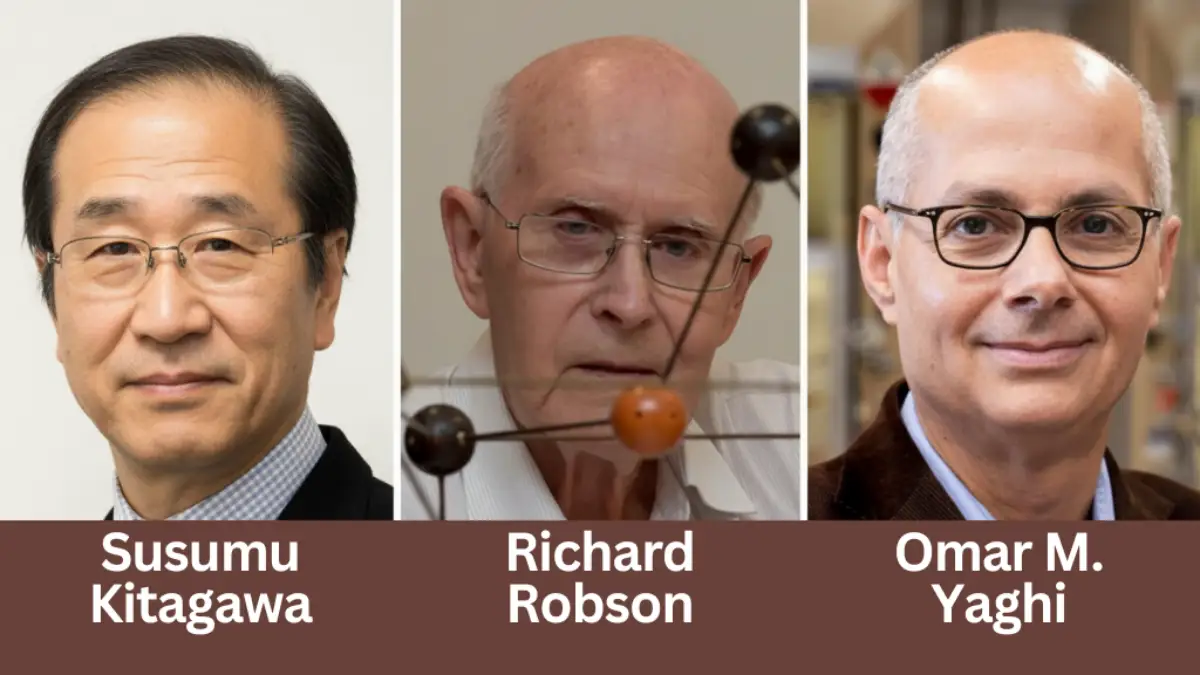
Nobel Prize Chemistry 2025: On 8 October 2025, the Royal Swedish Academy of Sciences in Stockholm announced the prestigious Nobel Prize in Chemistry. This year, three scientists—Susumu Kitagawa (Kyoto University, Japan), Richard Robson (University of Melbourne, Australia), and Omar M. Yaghi (University of California, Berkeley, USA)—were jointly honoured for their groundbreaking discovery of “Metal-Organic Frameworks” (MOFs). These scientists are regarded as pioneers who have turned visionary ideas into reality for the future of our planet.
What are Metal-Organic Frameworks (MOFs)?
MOFs are extraordinary nano-structured materials with a highly porous design. These pores are engineered in such a way that they can capture, store, or separate gases and water molecules present in the atmosphere. Scientists have developed MOFs with such precision that molecules can enter and exit effortlessly. Their industrial design can be imagined as a massive “molecular studio apartment,” where every molecule has its own dedicated space.
Finding Water in the Desert: How MOF Technology Works
The most celebrated achievement of MOFs is their ability to generate drinking water from dry desert air. This breakthrough is a boon for regions suffering from acute water scarcity. Under the leadership of Omar M. Yaghi, field trials in extremely arid locations like Death Valley (California, USA) demonstrated that MOF-based devices could harvest 114–210 grams of water per day per kilogram of MOF material—using only sunlight as the energy source. No external power was required, making the process entirely sustainable.
Why is this Technology So Transformative?
The structural design of MOFs has unlocked countless new possibilities for scientists worldwide:
- Extracting water from desert air
- Capturing carbon dioxide from the atmosphere
- Storing hazardous gases
- Removing pollutants and PFAS chemicals from water
- Efficient storage of hydrogen gas
The discovery of MOFs has not only paved new paths in environmental and water conservation but has also provided a promising foundation for clean energy solutions and combating climate change.
Contributions to Energy, Environment, and Humanity
Experts believe that MOF technology could offer effective solutions to future climate-related challenges. Providing safe drinking water in desert regions, reducing air and water pollution, and storing hydrogen securely have now become far more feasible. MOFs can also help remove pharmaceutical pollutants, plastic residues, and other harmful chemicals from water. Moreover, by selectively separating gases used in food packaging, they can extend the freshness of perishable food items.
The Shared Journey of the Three Scientists
- Richard Robson laid the foundation of MOFs in 1989 by creating the first porous structure through specific chemical bonding.
- Susumu Kitagawa demonstrated around 1992 how gases could flow through MOFs and proved their structural flexibility.
- Omar M. Yaghi between 1995 and 2003 designed the strongest, most durable, and highly tunable MOFs, making them practical for water harvesting, pollution control, and energy storage.
Prize Money, Medal, and Ceremony
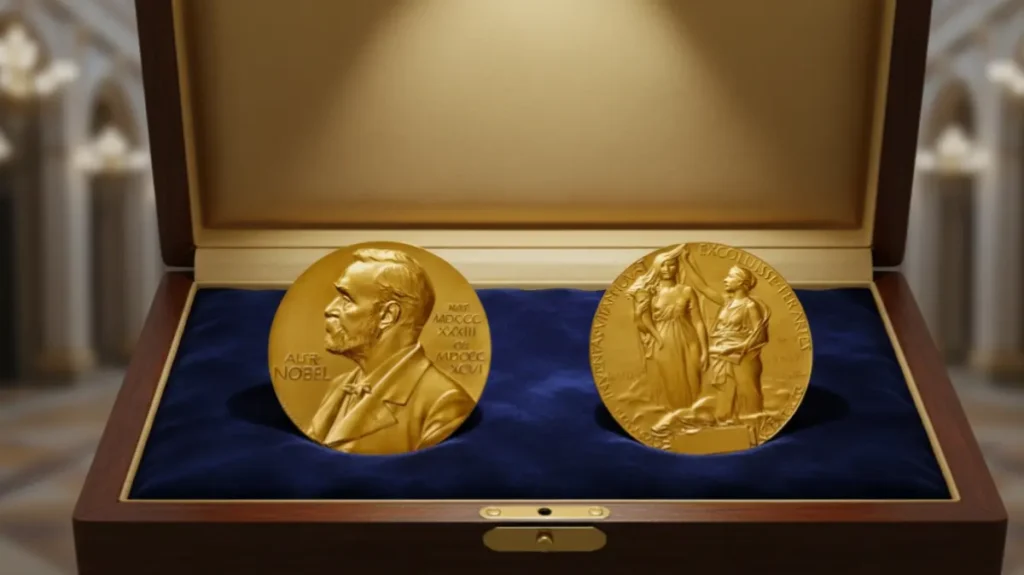
The Nobel laureates will receive 11 million Swedish kronor (approximately ₹10.3 crore), a specially designed gold Nobel medal, and a diploma. These will be formally awarded at a grand ceremony on 10 December 2025 in Stockholm, attended by scientists and dignitaries from around the world.
A Message of Science for the World
As every year, the 2025 Nobel Prize once again underscored that knowledge and innovation can transcend borders to provide decisive solutions to the world’s greatest challenges. Discoveries like MOFs have offered humanity a new perspective on energy, water, and environmental security. In the coming decades, their benefits will be evident across drought-stricken and vulnerable regions of the world—an invaluable gift of science to humanity.
Conclusion
The 2025 Chemistry Nobel has become a testament to the transformative power of science. MOF technology has proven that scientific vision, innovation, and dedicated research can reshape human life, safeguard the environment, and secure the future of our planet. Today, turning desert air into drinking water is no longer a dream but a remarkable example of Nobel-winning perseverance and the heights of scientific achievement.
Also Read