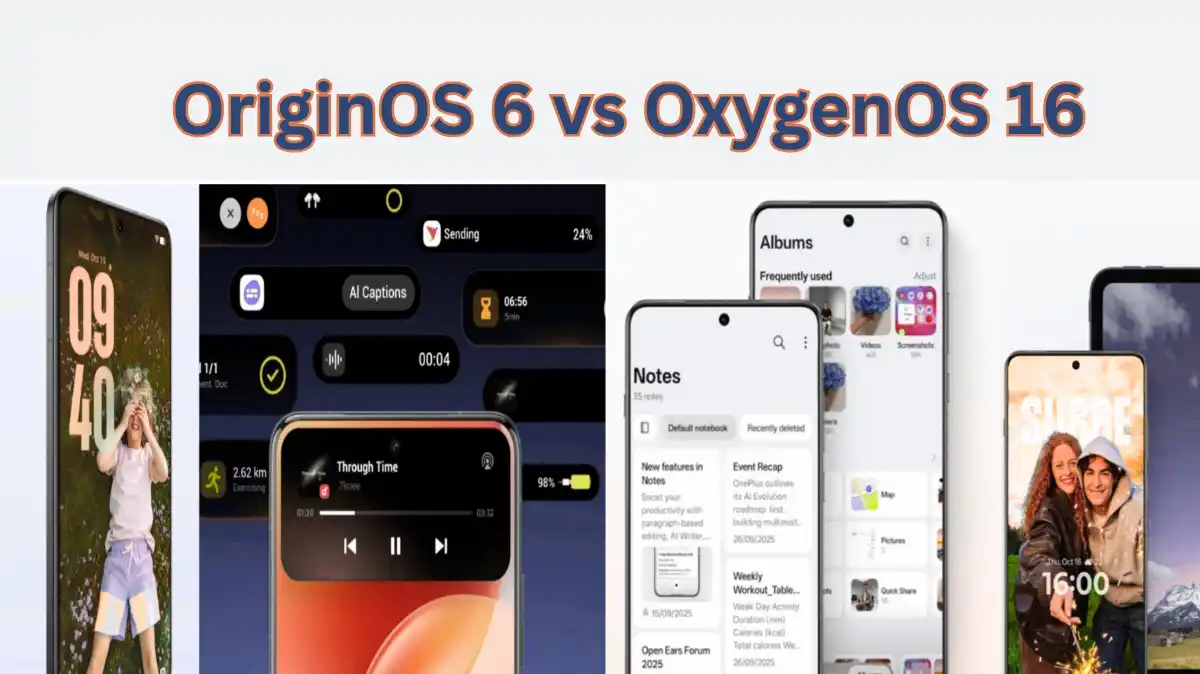
OxygenOS 16 vs OriginOS 6: The competition among smartphone user interfaces (UI) continues to intensify. In 2025, when users are focusing as much on software experience as on hardware, the comparison between OnePlus’s OxygenOS 16 and Vivo’s OriginOS 6 has become one of the most discussed topics in the tech world.
Based on the latest updates till October 2025, user feedback from beta testers, and expert reviews, it has become clear that both companies have taken performance, customisation, and visual experience to a new level in their own unique ways. However, in the overall experience, OnePlus’s OxygenOS 16 appears to take a slight lead on several key fronts.
Animations and Transitions: Smooth vs Speed
Animations and transitions directly affect the user experience in any UI design. OxygenOS 16 delivers natural and fluid motion in every swipe and animation, with app switching so smooth that it feels seamless.
On the other hand, OriginOS 6 has enhanced its animation speed to improve response time — a feature that will appeal to users who prioritise speed. Yet, in terms of visual fluidity and natural motion effects, OxygenOS 16 feels more refined and comfortable for daily use.
Lock Screen and Always-on Display (AOD)
OxygenOS 16 completely redefines the lock screen experience. It offers live photo support, depth effects, and several customisation tools for AOD design. Users can easily adjust the clock style, background animation, and visual appearance of notifications.
Meanwhile, OriginOS 6 introduces a more artistic approach with its “tilt-based transitions” and visually dynamic photo layouts. Though creative, it lacks the flexibility of OxygenOS, which appears more balanced and user-friendly.
Home Screen Customisation
Customisation has become the hallmark of modern smartphones, and OxygenOS 16 takes it seriously. Users can modify icon size, apply different icon packs, experiment with layout styles, and use dynamic widgets. Its “Material You” design system adapts the colour palette dynamically to match the user’s personal preferences.
OriginOS 6 offers basic personalisation options, but they’re not as in-depth. However, its clean grid layout and subtle wallpaper animations bring simplicity that some users may prefer. Still, in terms of control and depth, OxygenOS clearly holds the upper hand.
Dynamic Island and iOS-inspired Features
By 2025, nearly every Android manufacturer has adopted iOS-inspired interactive features. OxygenOS 16 implements this concept more professionally. Its “Dynamic Island-like” feature reacts instantly to user actions — such as charging, call alerts, or music controls — with smooth animations at the top of the screen.
OriginOS 6 also embraces the idea with creative visual experiments, but the response speed occasionally feels inconsistent, whereas OxygenOS offers a more polished and natural experience.
Unique Features
The biggest highlight of OxygenOS 16 is its AI integration. It now includes features like Plus Mind and Gemini AI, making the phone not just smart but predictive. For instance, it learns app usage patterns, prioritises notifications, and automates time-based tasks.
OriginOS 6, known for its creativity, introduces a “Super Dragging” feature that simplifies media sharing — allowing users to drag and drop media, links, or files between apps effortlessly. It’s useful for multitasking, but OxygenOS still leads in smart intelligence and automation.
Security and Privacy
In today’s digital age, security is every user’s top priority. OxygenOS 16 comes with a Secure Keyboard that prevents data leaks while typing passwords. Additionally, system-level encryption and the Face Unlock Security layer offer extra protection for user information.
OriginOS 6 features “Private Space,” which allows users to store apps, media, and data securely in a separate area. While this concept is practical, OxygenOS 16 is still considered more reliable in terms of overall safety and privacy management.
Connectivity and Ecosystem Integration
In terms of connectivity, OxygenOS 16 makes a big leap with the “O+ Connect” feature, which seamlessly links phones, tablets, and laptops for quick file transfers, clipboard syncing, and note sharing.
OriginOS 6 also enhances its ecosystem with the “VO Office Kit,” but its user interface feels slightly complex. In contrast, OxygenOS’s clean design and Google-supported ecosystem make it more convenient and efficient.
OxygenOS vs OriginOS 6: A Clean Software Experience
Many users often get frustrated with ads and pre-installed apps within the software experience. OxygenOS 16 remains completely clean — no ads, no bloatware, and no unnecessary notifications — keeping the interface light and smooth.
In contrast, OriginOS 6 includes some pre-installed apps and occasional ads, making the system feel slightly heavier. This is why users seeking a neat and professional interface tend to prefer OxygenOS 16.
OxygenOS 16 vs OriginOS 6: The Smart Android UI of 2025
| Feature / Aspect | OxygenOS 16 | OriginOS 6 |
|---|---|---|
| Smoothness & Fluidity | Extremely smooth, natural animations | Fast but slightly snappy transitions |
| Lock Screen /AOD | Live photo, depth effect, flexible options | Creative transitions, limited customisation |
| Home Screen | Deep customisation (icons, packs, sizes) | Basic yet visually clean |
| Dynamic Feature | Well-integrated Dynamic Island | Creative but less refined |
| AI & Smart Features | Plus Mind, Gemini AI, advanced haptics | Super Dragging, media sharing |
| Security | Secure Keyboard, strong data safety | Private Space, basic security |
| Ecosystem | O+ Connect, seamless syncing | VO Office Kit, limited integration |
| Ads/ Bloatware | Ad-free and clean interface | Some pre-installed apps and ads |
Conclusion
Considering the reviews, user feedback, and performance reports as of October 2025, OxygenOS 16 has set a new benchmark with its balanced, fast, and simplified experience. Its strong AI integration, deep customisation, and focus on security make it a practical and modern UI.
Meanwhile, OriginOS 6 stands out for its creative layouts, visual aesthetics, and artistic features. However, in terms of usability, flexibility, and consistency, it falls slightly behind.
For users seeking a fast, intelligent, and lightweight Android experience, OxygenOS 16 remains the superior choice. On the other hand, for those who value creativity and visual experimentation, OriginOS 6 still holds strong appeal.
Also Read