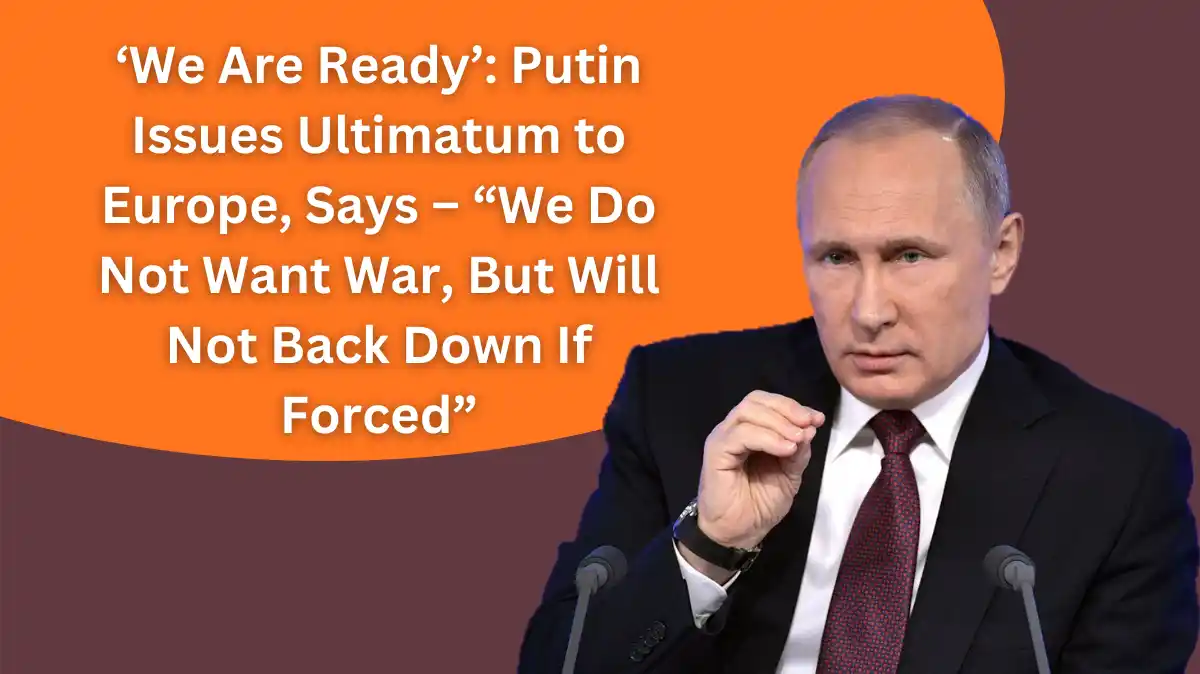
Putin warns Europe: At an investment forum held in Moscow on December 2, 2025, Russian President Vladimir Putin delivered a statement regarding Europe and the United States that has sent ripples through global political circles. He made it clear that Russia does not intend to start a war with Europe, but if Europe desires conflict, Russia is “fully prepared.”
Putin’s tone was firm, and the message was clear – Russia will no longer yield to any threats or pressure. The statement came ahead of a scheduled meeting with U.S. envoy Steve Witkoff and former advisor Jared Kushner to discuss a revised U.S. peace proposal aimed at ending the war in Ukraine.
Russia’s Discontent with the U.S. Peace Plan
In his address, Putin emphasized the importance of dialogue between the U.S. and Russia but accused European nations of deliberately complicating the process. He claimed that European governments were obstructing U.S. efforts and had no genuine agenda for peace.
Putin’s frustration stems from the “revised peace plan,” which shortened the original 28-point U.S. proposal to 19 points. The revisions included demands from Europe and Ukraine that Russia deemed “unacceptable.”
The plan outlines de facto borders for disputed regions like Donbas and asks Ukraine to cede some territories. This proposal is highly sensitive for the Ukrainian leadership, as it could mean Kyiv permanently losing control over certain areas.
Key Talks in Moscow
On the same day, a closed-door meeting took place at the Kremlin, attended by U.S. envoy Steve Witkoff and Jared Kushner, along with Russia’s senior advisor Yuri Ushakov and investment fund head Kirill Dmitriev.
This meeting marked the sixth attempt by the Trump administration to broker an end to the Ukraine conflict. During the talks, Putin reiterated that Russia wants to exclude European countries from the negotiations, arguing that Europe seeks to escalate tensions rather than achieve peace.
Putin stated, “European politics is no longer independent. They make decisions under U.S. pressure and attempt to weaken Russia at every step.” His remarks underscored growing Russian distrust toward Europe.
Ukraine’s Response and European Reactions
War-torn Ukraine strongly rejected Putin’s comments. During a press conference in Dublin, Ukrainian President Volodymyr Zelensky said they would meet with U.S. representatives immediately after Putin’s talks to review the points of the proposal.
“Peace must be based on justice, not conditions set by anyone,” Zelensky asserted.
Meanwhile, French President Emmanuel Macron contacted the White House to signal enhanced cooperation on security guarantees. Several European countries – including Germany, Poland, and the Baltic states – are increasingly viewing Russia as an imperial threat. They warned that if Russia succeeds in Ukraine, it would not remain a limited conflict but pose a severe shock to European security architecture.
Putin Warns Europe, Calls Its Approach ‘Deluded’
Putin accused Europe of living in a “dangerous illusion,” claiming that European leaders still believe they can strategically defeat Russia, while the reality is the opposite.
He stated, “Our military, our economy, and our people – all are prepared. We do not desire war, but if we must fight, Russia will not back down.”
Analysts suggest that Putin’s remarks were a response to recent Western pressure. In recent weeks, NATO and the European Union have initiated a new round of sanctions against Russia and supplied Ukraine with long-range missiles and drones.
Increasing Diplomatic Activity on the Global Stage
Rising talks between Russia and the U.S. have drawn attention from global powers including the United Nations, China, and India. Beijing has maintained a neutral stance, urging “dialogue and restraint,” while India emphasized that any lasting peace solution must ensure regional balance and security.
Putin’s statement also affected international markets. European stock markets saw minor declines, while oil prices surged again. European concerns over energy security intensified as winter approaches and Russia has already tightened control over gas supplies.
Strategic Calculations: The U.S. Role
The U.S. is currently navigating a complex role. The White House aims to prevent a prolonged conflict and seeks a “political solution” through the Trump administration’s new mediation plan. However, European support for the plan has been limited.
Analysts believe that any U.S.-Russia agreement could exclude Europe, representing a significant strategic setback for the European Union.
Kushner and Witkoff’s visit has been described as ‘Trump Diplomacy 2.0,’ relying on personal relationships and unconventional approaches. However, Putin’s statement makes it clear that Russia will accept nothing less than full equality in any deal.
Growing Security Concerns in Europe
European intelligence agencies are already concerned about Russia’s alleged “hybrid warfare” tactics, including cyberattacks, drone intrusions, and digital sabotage. Several nations warned that Moscow is now focusing more on psychological warfare than conventional battlefield operations.
A British defense review noted that Russia now has the capability to convert any regional conflict into “global strategic gains.” Meanwhile, Russia has reiterated its claim over areas in eastern Ukraine, such as Pokrovsk, raising unease in both Kyiv and Europe.
Conclusion
The message from Moscow on December 2, where Putin warns Europe, is being seen as a warning not just to Europe, but to the world. On one hand, he asserts that Russia does not want war, while on the other, he claims Russia is “prepared for any eventuality.”
The coming weeks could determine the direction of this crisis – whether the U.S. and Russia will reach a shared framework for peace, or Europe will find itself on the brink of a new Cold War remains to be seen.
Also Read
- Questions Raised Over Pakistan Aid kits to Sri Lanka, Citizens Say – “Insult to Humanity”
- Israeli General’s Major Revelation: Preparing for Clash with Iran, High-Tech Weapons to Dominate
- Trump’s ‘America First’ Policy Delivers Heavy Blow to F-35, Export Crisis Deepens
- 2026 G20 Summit: South Africa Not Invited, Trump Takes Hard Line