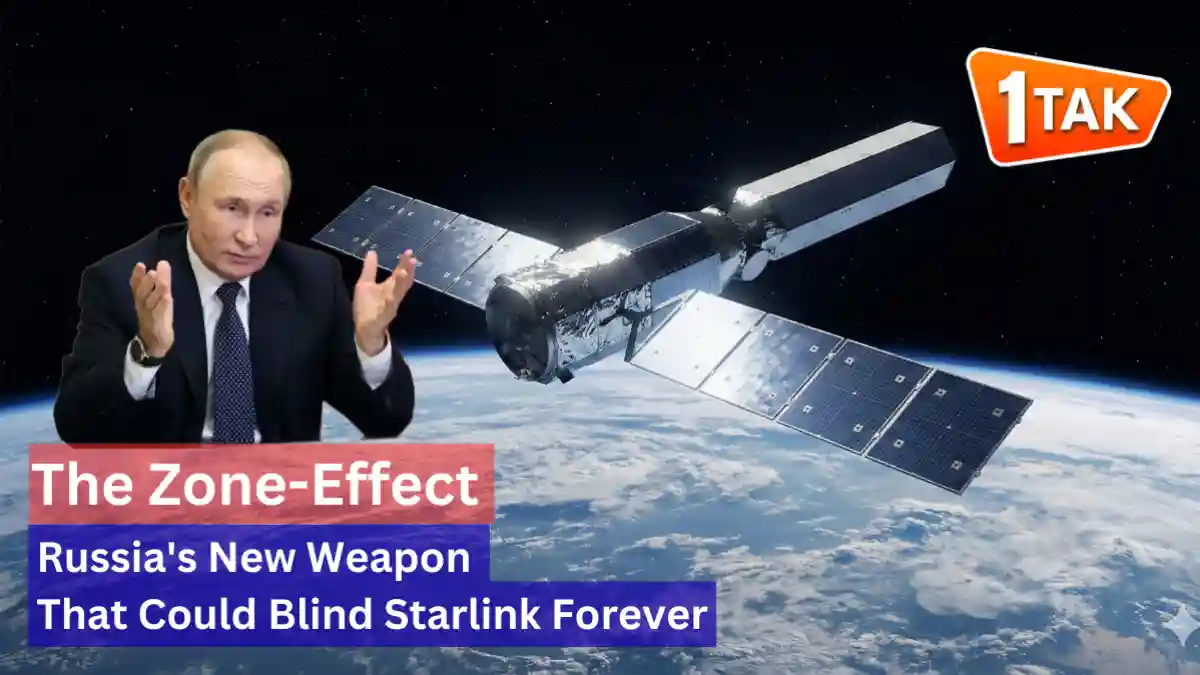
The shadow of global conflict is shifting its gaze from the trenches of Eastern Europe to the silence of the cosmos. A new and unsettling development has sent shockwaves through NATO and the global space industry: reports suggest Russia is developing a sophisticated Anti-Satellite system (ASAT system) designed not just to disable single targets, but to render vast sections of orbit unusable.
According to leaked intelligence reports surfacing in international media, Moscow is working on a “Zone-Effect” weapon. This technology could potentially target Elon Musk’s Starlink satellite constellation, a critical asset in modern digital warfare. If these reports hold true, we are not just looking at a new weapon; we are staring at a future where Low Earth Orbit (LEO) could become a graveyard of debris, impacting global communications for decades.
This article delves into the mechanics of this alleged weapon, why Starlink is the primary target, and the catastrophic risks of space debris that could trap humanity on Earth.
What is the “Zone-Effect” Weapon?
Unlike traditional anti-satellite missiles that rely on a “kinetic kill” (hitting a bullet with a bullet), the rumored Russian system operates on a much more chaotic principle. Intelligence suggests that this system does not aim for a direct hit on a single satellite. Instead, it is designed to detonate or deploy a payload that releases a cloud of hundreds of thousands of micro-pellets or metal shrapnel.
This method creates a “Zone-Effect” in the Low Earth Orbit (LEO). Here is why this is terrifying:
- The Shotgun Approach: Think of it as a shotgun blast in space, but on a massive scale. The high density of these pellets ensures that anything passing through the “zone” suffers catastrophic damage.
- Unstoppable Momentum: In orbit, even a paint fleck can hit with the force of a bowling ball due to hypervelocity. A cloud of metal pellets would shred solar panels, sensors, and fuel tanks of any spacecraft in its path.
- Area Denial: The goal isn’t just destruction; it is area denial. By polluting a specific orbital ring, Russia could theoretically block other nations from operating satellites in that altitude.
According to experts monitoring space safety, this is a blunt-force instrument that lacks the precision of modern warfare but carries the destructive potential of an environmental disaster.
Why Starlink is the Primary Target
The war in Ukraine has fundamentally changed how military strategists view commercial satellites. When Russian cyberattacks crippled Ukraine’s ground-based Viasat network in the early hours of the invasion, it was SpaceX’s Starlink that brought the country back online.
The Digital Backbone of Ukraine
Starlink has provided vital internet connectivity to Ukrainian civilians, government agencies, and, crucially, the military. It has enabled:
- Real-time drone operations and artillery targeting.
- Secure communication between frontline units and command centers.
- Maintenance of morale by keeping citizens connected to the outside world.
Because of this, NATO intelligence indicates that Moscow no longer views Starlink merely as civilian infrastructure. To Russian strategists, it has become a “legitimate military target” and a symbol of Western interference. By neutralizing Starlink, Russia aims to blind the digital eyes of its adversaries.
The “Kessler Syndrome”: A Suicide Mission for Space?
While the tactical advantage of destroying Starlink might seem appealing to Moscow, experts warn that using a “Zone-Effect” weapon is a double-edged sword. It risks triggering a phenomenon known as the Kessler Syndrome—a scenario where space debris collides with satellites, creating more debris, which leads to a cascading chain reaction.
Collateral Damage to Russia and China
Space debris does not recognize national borders or flags. If Russia unleashes a cloud of pellets in LEO, the consequences would be indiscriminate:
- Friendly Fire: Russia and its strategic partner, China, operate hundreds of satellites in similar orbits for weather monitoring, navigation (GLONASS/BeiDou), and surveillance. A debris field would threaten their assets just as much as it threatens Starlink.
- The “Blanket” Effect: Canadian Brigadier-General Christopher Horner, commander of the 3 Canadian Space Division, warned in interviews that releasing “boxes of BBs” would create a blanket of debris. This would make the affected orbital zone uninhabitable for decades, if not centuries.
- Global Economic Impact: A debris-filled orbit puts the entire global economy at risk—from banking transaction timing (which relies on GPS satellites) to disaster management systems.
NATO’s Warning and Strategic Silence
The intelligence regarding this weapon was shared by agencies from two NATO member countries, though the specific nations remain unnamed. The lack of official verification has not stopped the growing anxiety within the alliance.
European security officials and the French Space Command have criticized Russia’s recent behavior in orbit as “irresponsible.” This new development follows 2024 warnings from US Intelligence that Russia was also pursuing a nuclear-capable space-based weapon (EMP device). While the “Zone-Effect” weapon appears to be kinetic (physical pellets) rather than nuclear, it represents a continued pattern of escalation.
“We cannot take these threats lightly. The weaponization of space is not a future concept; it is a current reality that demands immediate diplomatic and defensive responses.” — Defense Analysts
Despite these accusations, the Kremlin, through spokespersons like Dmitry Peskov, has consistently denied plans to deploy nuclear weapons in space. Interestingly, Russia continues to support UN resolutions preventing an arms race in outer space, creating a confusing dichotomy between their diplomatic words and alleged military actions.
Is Space the Next Battlefield?
The question is no longer if space will be weaponized, but how the world will manage it. Currently, reports indicate that the “Zone-Effect” system remains in the development phase. There is no evidence of active deployment yet. Many independent analysts also question the technical feasibility of delivering such a system with precision.
However, the mere existence of the program serves as a strategic lever. It forces NATO and private companies like SpaceX to spend billions on countermeasures and hardening their satellites. It introduces a psychological element to modern warfare: the threat that one nation could turn the lights off for the entire world.
The Road Ahead
If this technology becomes a reality, the implications extend far beyond the Ukraine war. We rely on satellites for:
- GPS Navigation (Google Maps, Logistics).
- ATM and Banking authorizations.
- Weather forecasting and climate change monitoring.
Turning Low Earth Orbit into a minefield of metal pellets is a gamble that risks the technological progress of all humanity.
What We Can Do Next?
Staying informed is the first step in understanding the fragility of our modern infrastructure. Would you like me to analyze how current space treaties (like the 1967 Outer Space Treaty) apply to these new types of non-nuclear weapons?
Also Read