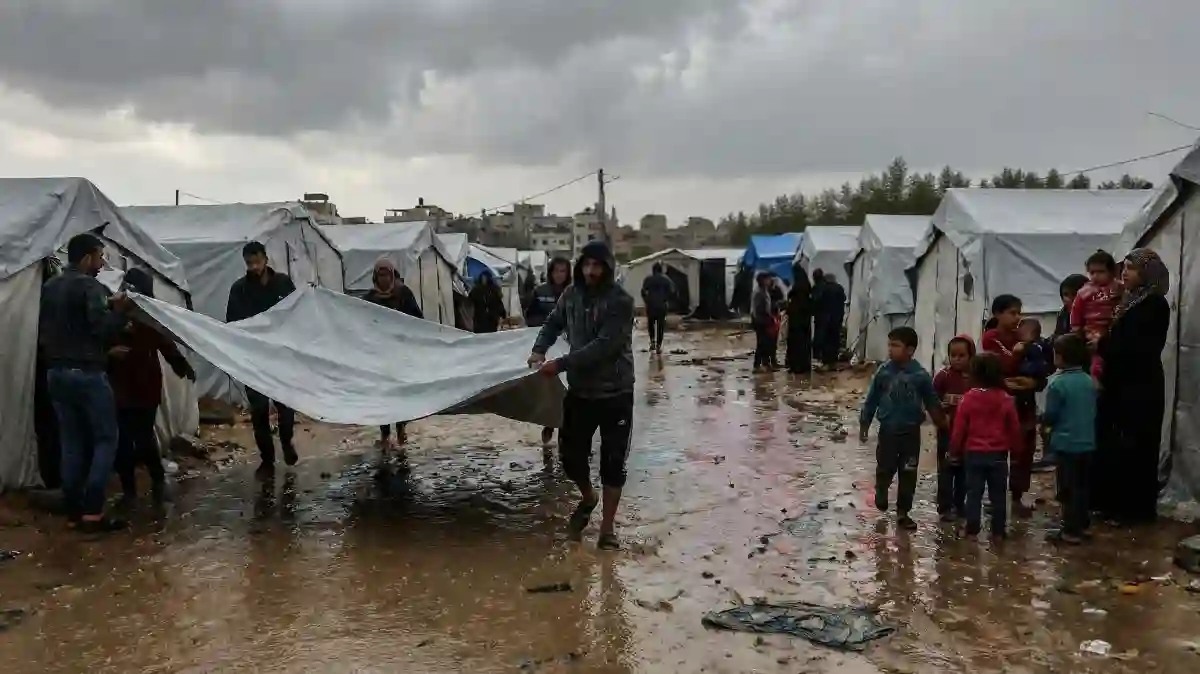
The Gaza Strip is currently caught in a dual crisis. While Israeli strikes continue without pause, a powerful storm system rising from the Mediterranean—Storm Byron—has triggered a fresh alarm for the hundreds of thousands already displaced and living without proper shelter. Families taking refuge in makeshift tents now face not only relentless bombardment, but also fierce winds, heavy rain, and the threat of sudden flooding.
In this tense atmosphere, a new statement from senior Hamas leader Khaled Meshaal has also emerged. While he hinted at the possibility of limiting the nature of Hamas attacks, he made it clear that surrendering weapons or giving up political and military control over Gaza is not an option. With war, diplomacy, and a natural disaster all converging, the next two to three days are expected to be extremely sensitive for the entire region.
Storm ‘Byron’ Signals New Danger for Gaza
The Palestinian Meteorological Department and Gaza’s Government Media Office have issued alerts warning that the impact of Storm Byron may severely affect the Gaza Strip and surrounding areas from Wednesday through at least Friday evening. Forecasts suggest strong winds, intense lightning, heavy rainfall, hail, and the likelihood of flash floods in multiple locations.
Officials warn that coastal regions, low-lying areas, and large displacement camps face serious risks, including waterlogging, tents being blown away, and dangerously high sea waves. Local authorities say that with Gaza’s already fragile infrastructure and damaged sewage networks, the system is incapable of handling such heavy rainfall, raising the risk of contaminated water and mud engulfing entire camps.
Weather experts have described Byron as one of the strongest storm systems to threaten the region in decades. If the storm maintains its projected strength, it could be devastating for Gaza, already crippled by war and blockade.
Hundreds of Thousands Left Exposed Under Open Skies
Due to the ongoing conflict, hundreds of thousands inside Gaza have been forced from their homes into temporary tents, plastic-covered shelters, and unsafe structures. A significant portion of this population is crammed into densely packed camps in southern and coastal areas—especially the coastal zone of Al-Mawasi—where narrow pathways, overcrowded conditions, and limited resources were already making daily life extremely difficult.
With the storm’s early impact, reports have emerged of tents filling with water. Several camps have turned into a mix of mud, dirty water, and debris. Dozens of tents have blown away, and thousands more have been partially or fully submerged. The situation appears particularly dangerous for children, the elderly, and the sick.
Hamas-linked civil defense units have urged residents to dig small trenches and drains around their tents to divert rainwater, but the practical reality of overcrowded camps, saturated soil, and limited space is making such precautions ineffective.
Urgent International Appeal for Assistance
Gaza’s Government Media Office and local officials have renewed their appeal to the global community, urging them to send mobile homes, prefabricated structures, and durable shelters instead of just tents. They emphasize that the current tents cannot withstand freezing temperatures, heavy rainfall, or strong winds.
Relief agencies warn that cold weather, dampness, and cramped living conditions are severely threatening public health. Wet mattresses, polluted water, damaged sanitation facilities, and unsafe drinking water have raised fears of diarrhoea, skin infections, respiratory illnesses, and other contagious diseases. Children and elderly residents—already battling malnutrition and stress—are most at risk.
Several international groups have appealed to Israel to permit the large-scale entry of medicines, stronger tents, heaters, blankets, and hygiene kits to protect civilians from the combined impact of storm and winter. Local authorities caution that if the storm reaches its predicted intensity, “tens of thousands of tents and temporary shelters could be severely damaged or completely destroyed,” further increasing the number of displaced families.
Israel Issues Red Alert Weather Warning
The impact of Storm Byron is not limited to Gaza. Israel’s Meteorological Service has issued a nationwide red alert warning, predicting 100–200 mm of rainfall between December 10 and 12—well above the seasonal average for the month.
Coastal cities, the Tel Aviv corridor, the hills surrounding Jerusalem, and the southern Negev desert all face risks of flash floods, rising rivers, landslides, submerged roads, and strong winds capable of toppling trees and power poles. Israeli media reports say the storm is expected to peak between Wednesday night and Thursday, bringing heavy rainfall within hours and wind speeds reaching 80–100 km/h.
Authorities have cautioned tourists and residents to avoid Dead Sea routes, desert trails, and mountain roads, and to postpone long journeys unless necessary. Rescue teams and municipal departments have been put on high alert to respond quickly to sudden flooding or landslides.
Humanitarian Crisis Deepens as War and Storm Collide
Against the backdrop of ongoing airstrikes, blockade, and destroyed infrastructure, the approaching storm threatens to multiply Gaza’s humanitarian crisis. Thousands of families are already struggling with shortages of food, clean water, medicines, and warm clothing. Now, with tents soaked, shelters damaged, and children exposed to freezing rain, the situation is worsening rapidly.
Rights groups warn that sanitation conditions in flooded camps are deteriorating sharply. Many temporary toilets have collapsed or become submerged, increasing the risk of open defecation mixing with stagnant water—conditions that could trigger a new wave of disease outbreaks. Doctors say that with a shortage of medicines and limited hospital capacity, any rapid spread of infections may become uncontrollable.
Khaled Meshaal Maintains Firm Stance
Amid these developments, a recent statement by Khaled Meshaal—one of Hamas’s top exiled leaders—has intensified political debate. Speaking at a conference in Istanbul, Meshaal indicated that Hamas may consider limiting the range and nature of its attacks on Israel. However, he emphasized that the group will not disarm or relinquish its political and military control over Gaza.
According to media reports, Meshaal also made it clear that Hamas will neither hand over Gaza’s administration to external authorities nor accept international monitoring forces. His remarks are being seen as a direct challenge to proposals calling for neutral governance, international oversight, or multinational security arrangements in Gaza once the war ends.
With U.S.-backed peace frameworks consistently prioritizing Hamas disarmament and a new administrative structure in Gaza, Meshaal’s position appears to complicate diplomatic efforts. Israeli officials have sharply criticized his stance, calling it “contrary to the fundamental principles of peace” and evidence that Hamas continues to place armed resistance above any political process.
The Next 72 Hours: A Crucial Intersection of Weather, War, and Diplomacy
Analysts believe the next 48–72 hours could be decisive for the region. As Storm Byron reaches peak intensity and military operations continue on the ground and in the air, a worsening humanitarian situation in Gaza may intensify global pressure for temporary ceasefires, humanitarian corridors, or short-term agreements.
However, statements like Meshaal’s signal that Hamas continues to prioritize armed resistance over negotiations. The key question now is whether the worsening humanitarian emergency, collapsing camps, and storm-related destruction will force all sides to reassess their positions—or whether Gaza’s civilians will continue to suffer under the combined weight of war and natural disaster.
Also Read