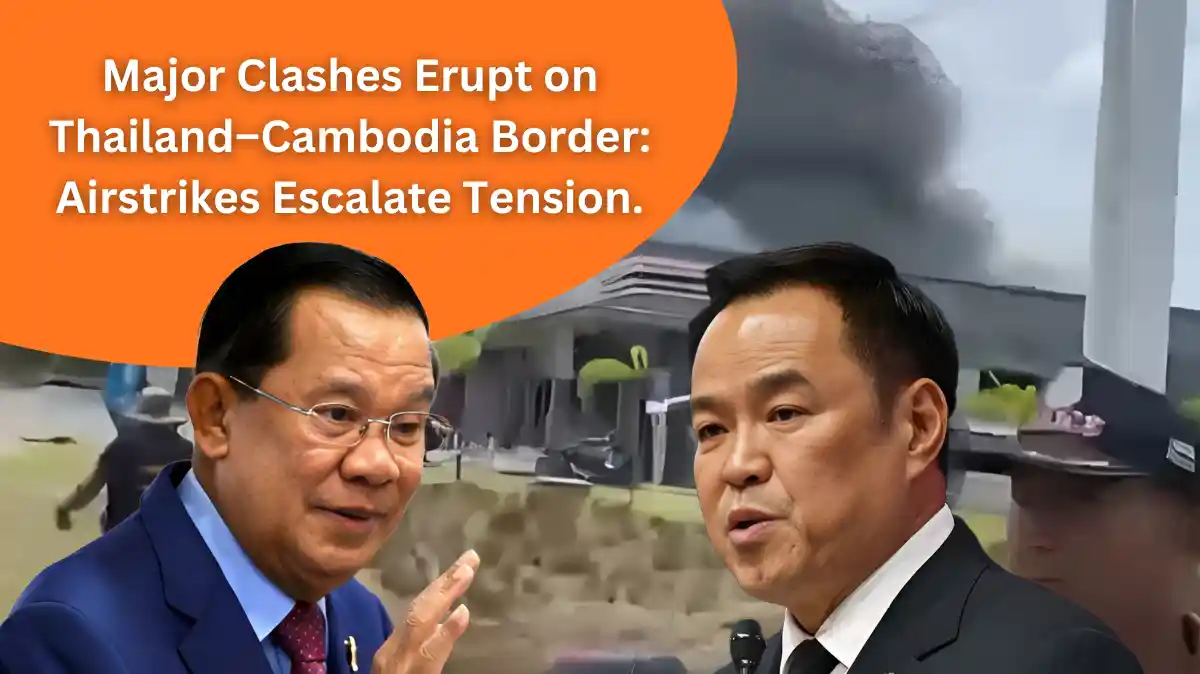
Thailand–Cambodia Conflict: The long-disputed border between Thailand and Cambodia has once again been engulfed in smoke and gunfire. On Monday morning, Thailand launched airstrikes on Cambodia’s contested military positions, calling it a “retaliatory operation.” This came after overnight firing in Ubon Ratchathani province, where one Thai soldier was killed and four others were injured.
Thai Army spokesperson Major General Winthai Suvari said in a statement that “Cambodian troops initiated the attack, and the Thai military had to respond.” In contrast, Cambodia’s Defence Ministry claimed that “at 5:04 a.m., Thai aircraft bombed areas in Preah Vihear and Oddar Meanchey provinces, and Cambodian troops did not retaliate.”
This renewed exchange of accusations marks the most serious confrontation since the July 2025 ceasefire, which was negotiated with direct intervention from U.S. President Donald Trump.
July Fighting and Trump’s Mediation
In July 2025, a five-day deadly confrontation had pushed both nations to the brink of war. Dozens of soldiers were killed, and hundreds of thousands of civilians were forced to flee. During that period, U.S. President Donald Trump personally contacted the leaders of both countries and secured an “immediate ceasefire.”
Later in October, at the ASEAN Summit in Kuala Lumpur, both sides signed a formal peace agreement. Trump described it as “a historic achievement for Southeast Asia.”
However, the deal did not resolve the core issue — the disputed border demarcation.
Experts say the disagreement stems from old French Indochina-era maps from 1904–1907, which marked several boundaries ambiguously. The area around the Preah Vihear Temple has been particularly contentious. Although the International Court of Justice (ICJ) awarded the site to Cambodia in 1962, Thailand has continued to challenge the ruling.
Landmine Disputes Further Erode Trust
In recent months, incidents involving landmines have worsened the situation. Thailand accused Cambodia of violating the Ottawa Treaty by allegedly planting new PMN-2 anti-personnel mines, injuring Thai soldiers in November. Cambodia denied the allegation, calling it “baseless and a ploy to justify territorial claims.”
These tensions have almost entirely shattered trust built during the July ceasefire. Protests took place in border villages throughout September and October, urging both sides to preserve peace. Yet military patrols and troop deployments continued to rise.
Casualties and Displacement in Today’s Attacks
On Monday, Thailand confirmed one soldier dead and four injured in the latest clashes. Cambodian authorities reported three civilians injured on their side. More than 385,000 people across four Thai districts have been evacuated, with nearly 35,000 placed in temporary shelters.
The Royal Thai Air Force said it targeted “military command centers, ammunition depots, and supply routes.” Cambodia, however, claimed that “Thai aircraft struck civilian zones, injuring residents and damaging homes.”
Local media reports indicate that continuous explosions can be heard in border villages, schools have been closed, and thousands of families are fleeing to safer areas.
International Response and ASEAN’s Role
ASEAN has urged both nations to maintain the ceasefire. Malaysia and China have offered to assist with border monitoring, while the United Nations expressed “deep concern” over the escalating situation.
Thai Prime Minister Anutin Charnvirakul stated that “Thailand will not compromise its sovereignty, but we want peace.” Cambodian Prime Minister Hun Manet asserted that “Thai attacks will not break Cambodia’s resolve, and our silence must not be mistaken for weakness.”
Analysts say domestic political pressure in both countries makes it difficult for either leader to appear as if they are backing down.
Regional Instability and Economic Impact
The border conflict is affecting trade, tourism, and regional security across Southeast Asia. Key trade corridors between Thailand and Cambodia have been shut, while tourism hubs like Siem Reap and Ubon Ratchathani are facing booking cancellations.
The Preah Vihear Temple — a UNESCO World Heritage Site — is now directly under threat due to its proximity to the conflict zone. Experts warn that if the situation escalates, cultural heritage sites could also be at risk.
Will Trump Intervene Again?
The biggest question now is whether U.S. President Donald Trump will step in once more. Sources within the Trump administration told American media that “Washington is monitoring developments and may attempt to bring both sides back to the negotiating table.”
However, this time the circumstances are considerably more complicated. Cambodia’s Hun Manet government is pursuing a strongly nationalist platform, while Thailand’s new coalition administration is still attempting to assert control over the military.
Analysts believe that unless both countries conduct a joint survey to determine the precise border, the conflict will continue to resurface.
Conclusion
The Thailand–Cambodia Conflict has once again pushed the region towards a dangerous crossroads, reminding people of the deadly events of July. Tension along the border continues to rise, and both armies remain on high alert. If diplomatic efforts fail, the conflict has the potential to escalate into a much larger confrontation. The role of ASEAN and the United States will be crucial in determining whether Southeast Asia is heading toward another crisis or if negotiations can bring the dispute under control.
Also Read
- Europe’s War Economy” in Europe: Orbán’s Warning Deepens EU Divisionsm
- Asia Sees Devastating Floods and Landslides: Death Toll Crosses 900 in Sumatra
- Russia Launches Largest Drone Missile Strike on Ukraine to Date
- Explosive Statement by Former Pentagon Official on India-US relations: US Must Apologize, Arrest Munir