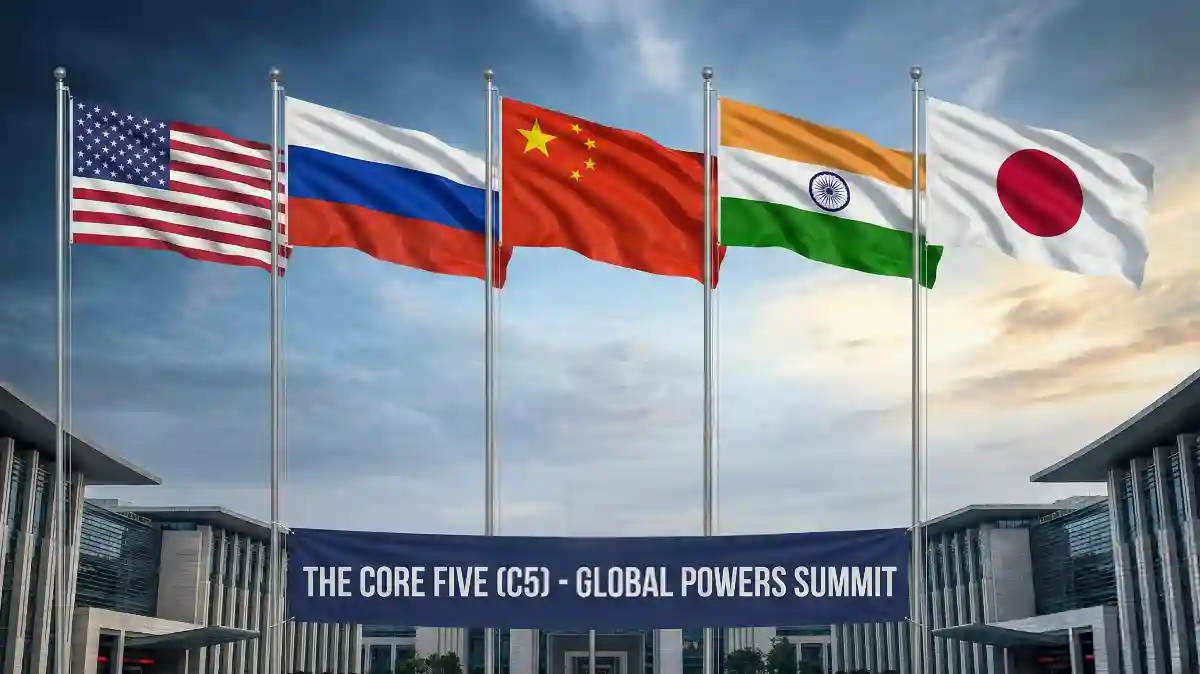
Former US President Donald Trump once again appears ready to reshape the global political direction. According to a recently leaked National Security Strategy (NSS) draft report, the Trump camp is considering the formation of a new power grouping called “C5” or “Core Five.” The proposed forum aims to bring the world’s five most influential countries — the United States, Russia, China, India and Japan — to a single table.
This idea could not only challenge existing groupings such as the G7 and G20, but also signal the emergence of an entirely new axis in global politics.
What is C5 and Why Is It in the Spotlight?
The leaked NSS document states that the proposed C5 platform is intended to coordinate major decisions related to development, security and global power balance among a small group of key nations.
Unlike the G7, which is largely centered on Western democratic countries, the C5 framework would be based not on economic or ideological similarity, but on military strength, population size and economic power. Trump believes that real global decisions should be made by countries that possess “real power,” whether economic or strategic.
According to the report, the forum’s first major agenda could focus on Middle East security and normalization of Israel–Saudi Arabia relations. This aligns closely with Trump’s long-standing priorities, particularly his efforts during his previous administration to reshape Arab–Israeli relations through the Abraham Accords.
Russia’s Return and Trump’s ‘Non-Ideological Diplomacy’
Trump has repeatedly stated that expelling Russia from the G7 in 2014 was a mistake. He argues that had Russia remained within the grouping, the Ukraine war might have been avoided. This view reflects Trump’s diplomatic approach, often described by analysts as “strongman diplomacy” — a policy driven by direct deals with powerful leaders rather than ideological alignment.
In this approach, Trump’s thinking is clear: he believes in deals, not alliances. This is precisely why he envisions bringing China and Russia together on the same platform, despite both being major competitors of the United States in recent years.
India’s Role: From Rising Power to ‘Power Broker’
For India, the proposal is being viewed as a significant recognition. According to reports by The Times of India and India Today, if the group materializes, India could emerge not only as an Asian major power but also as a global power broker.
A recent “warm” phone conversation between Trump and Prime Minister Narendra Modi is being seen as an early signal in this direction. The relationship between the two leaders has historically been positive, with Trump repeatedly praising Modi as a “tough leader.”
However, India’s border tensions and economic competition with China could complicate its position within the forum. Despite this, experts believe that if India manages to play a balancing role between the US and China, it could mark a decisive shift in the 21st-century global power equation.
Growing Unease in Europe: Questions Over G7’s Relevance
The C5 concept has unsettled European nations. The Europe-centric G7 has long served as the cornerstone of Western policymaking, but if the United States itself moves toward a new multipolar grouping, the foundations of NATO and Western unity could weaken.
Politico reported that the proposal signals a potential “marginalization of Europe.” Countries such as France and Germany are concerned that Trump’s initiative could grant international legitimacy to Russia, at a time when Europe is still grappling with the Ukraine war.
RBC Ukraine described the proposal as a “geopolitical shock,” warning that if the US and Russia share a common platform, it could deeply affect Western cohesion on the Ukraine conflict.
Possible Positions of China and Japan
The responses from China and Russia remain unclear for now. However, Trump’s recent decision to approve the sale of Nvidia chips has offered a glimpse of possible cooperation. For Trump, this move is not merely economic, but strategic — especially as he tends to use technological competition as a negotiation lever.
As for Japan, despite being a member of the Quad, it could still become part of this new initiative. Analysts believe Tokyo would be interested in balancing power dynamics between Beijing and Washington to maintain stability in the Asian region.
White House Denial, But Debate Continues
As of December 13, 2025, there has been no official confirmation of the proposal. The White House has dismissed the leaked documents as “false,” while media reports suggest that Trump’s strategic thinking aligns closely with the idea.
Firstpost reported that a shorter version of the NSS has been released, which does not mention C5, but Trump’s broader policy approach appears focused on coalitions of influential nations. This is why political circles and social media have described the issue as a “geopolitical earthquake.”
Analysis: Can C5 Reshape the Global Power Balance?
If realized, this grouping could challenge the influence of post–World War II institutions such as the United Nations, the G7 and even BRICS. Its character would be entirely pragmatic, prioritizing strategic deals and mutual interests over ideals.
C5 could signal the beginning of an era in which global politics is driven by power-based realities rather than Western ideals. However, deep ideological differences, territorial disputes and competing national interests among the five countries could make the initiative extremely difficult to implement.
Conclusion
Although C5 currently exists only as an idea mentioned in a leaked document, its resonance is being felt from Washington to New Delhi, Tokyo and Moscow. The proposal is forcing a rethinking of the Western-centric global order.
If Trump returns to power in 2026, C5 may no longer remain just a proposal, but could evolve into one of the most significant diplomatic strategies of the 21st century, shaping who holds the reins of global power in the decades ahead.
Also Read