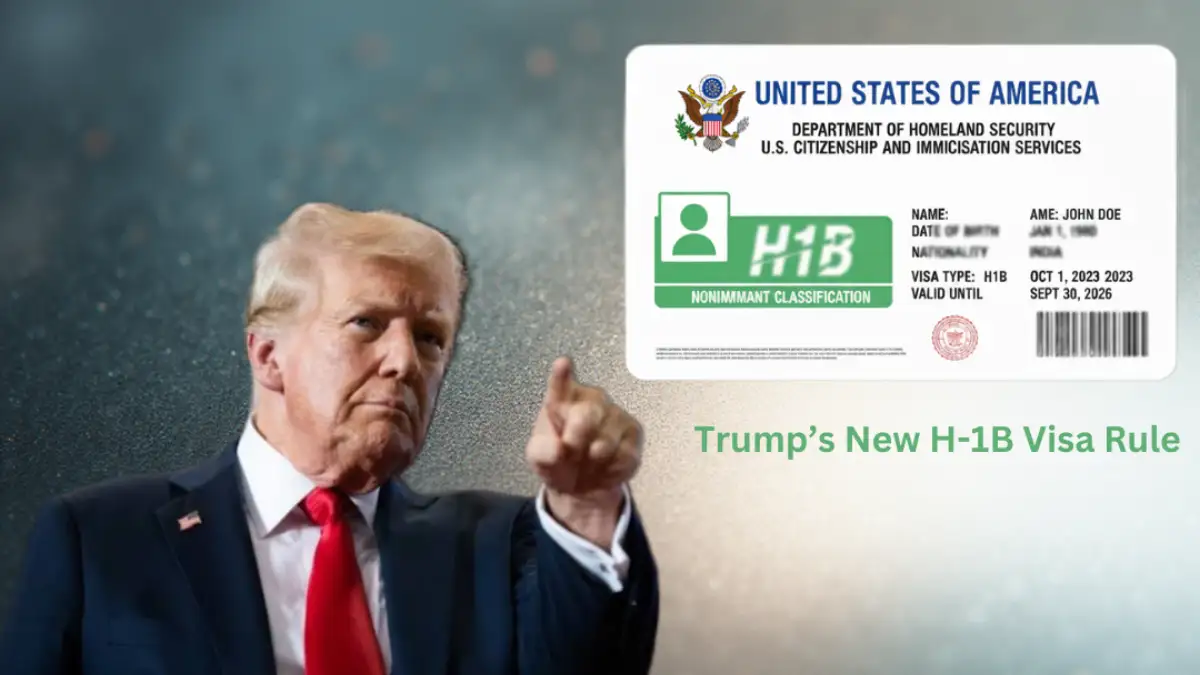
A fresh legal and political dispute over the H-1B visa is rapidly intensifying in the United States. The Trump administration has announced a tougher policy aimed at prioritising American citizens for jobs. Along with this, the government has taken an unprecedented step by introducing a US$100,000 (around ₹83 lakh) application fee for new visa petitions. The move has not only shocked foreign professionals but also triggered unrest across American industry circles.
White House Stance: “American Jobs for American Citizens”
The White House has strongly defended its decision, saying that the administration’s goal is to safeguard jobs for American workers. Press Secretary Karoline Leavitt said during a briefing that the H-1B programme had long been marred by fraud, wage disparity, and misuse.
Leavitt stated, “President Trump wants the U.S. visa system to be transparent, fair, and aligned with the interests of American workers. Over the years, dependence on cheap foreign labour has grown, affecting domestic employment. The President is now focusing on the core principles of the ‘America First’ policy.”
She also added that the administration would “vigorously defend” the new rules in court against all legal challenges.
The New Visa Policy: 0,000 Fee with Limited Exemptions
According to the latest directive issued by the Trump administration, beginning September 2025, every new H-1B visa application filed from outside the United States will require a US$100,000 processing fee. This will directly impact foreign professionals seeking to work in the U.S. for the first time.
However, certain categories are exempted. Those already in the U.S. on F-1 (Student Visa) status converting to H-1B, or applicants seeking an extension of their current visa, will not be affected. The administration clarified that these categories already undergo rigorous verification, hence they are spared the “fee shock.”
The move has sparked serious concern among Indian IT professionals, engineers, and tech experts. India remains the top contributor to H-1B visa applicants globally, with nearly 70% of all visas in this category going to Indian citizens.
Relief for Existing H-1B Holders
The U.S. Citizenship and Immigration Services (USCIS) has clarified that individuals already holding valid H-1B visas will not be required to undergo any additional procedures or make extra payments. They can continue to enter, exit, and work in the U.S. under existing rules.
According to USCIS officials, the new regulation applies only to first-time applicants. Current visa holders can renew contracts or extend visas under the normal provisions.
Although this clarification has provided some relief, industry experts warn that the long-term consequences will still be significant, particularly as the free flow of global talent faces new barriers.
Legal Battle: Trump Administration Faces Court Challenges
The U.S. Chamber of Commerce filed a lawsuit on October 16, 2025, in the federal court of Washington, D.C., challenging the new provisions. As America’s largest business organisation, the Chamber argues that the policy will hinder companies from hiring international talent.
The petition claims that the steep fee could damage the U.S. innovation economy. Several universities, research institutions, tech companies, and labour unions have also joined the legal action, labelling the policy “unlawful and unjust.”
The lawsuit contends that such an excessive financial burden is unreasonable under immigration law and that the policy targets foreign professionals “under the guise of economic nationalism,” ultimately harming America’s technological competitiveness.
Administration’s Response: “A Legal and Necessary Step”
The White House has responded firmly to its critics. Press Secretary Leavitt stated, “It is our legal responsibility to protect American jobs. President Trump’s top priority is ensuring that American citizens get the first opportunity. Reducing dependence on foreign labour is now a national policy priority.”
According to the administration, the heavy fee will apply only to applicants outside the U.S. labour market. The aim, they say, is to encourage local hiring and promote greater transparency in the visa system.
Turmoil and Uncertainty in the Tech Industry
The impact of this move is already being felt in Silicon Valley. Tech giants such as Google and Microsoft have expressed concerns that the new regulations will limit access to global talent.
Industry analysts note that the $100,000 fee creates such a high entry barrier that small and mid-sized companies may completely withdraw from international hiring. As a result, large tech firms might even consider relocating their research centres outside the U.S.
For India’s IT sector, the news is deeply worrying. Companies such as Infosys and Tata Consultancy Services (TCS), which send hundreds of employees to the U.S. each year for various projects, are now reconsidering their recruitment and deployment strategies.
New Rules Expected in December: Stricter Criteria Ahead
The U.S. Department of Homeland Security (DHS) has hinted that a second phase of the policy will be introduced in December 2025. This phase will tighten H-1B eligibility criteria, enhance employer accountability, and impose stricter wage verification requirements.
Under the upcoming regulation, employers will have to certify that American citizens were offered the job opportunity before applying for a foreign worker’s visa. Additionally, the entire visa process is expected to move to a transparent digital platform.
Conclusion
The Trump administration has sent a clear signal that U.S. visa policies will become even more stringent in the coming months. The slogan “American Jobs for American Citizens” has now transformed into concrete administrative action.
However, business groups and experts caution that such measures could hurt technological innovation, international collaboration, and the long-term competitiveness of the U.S. economy.
Also Read