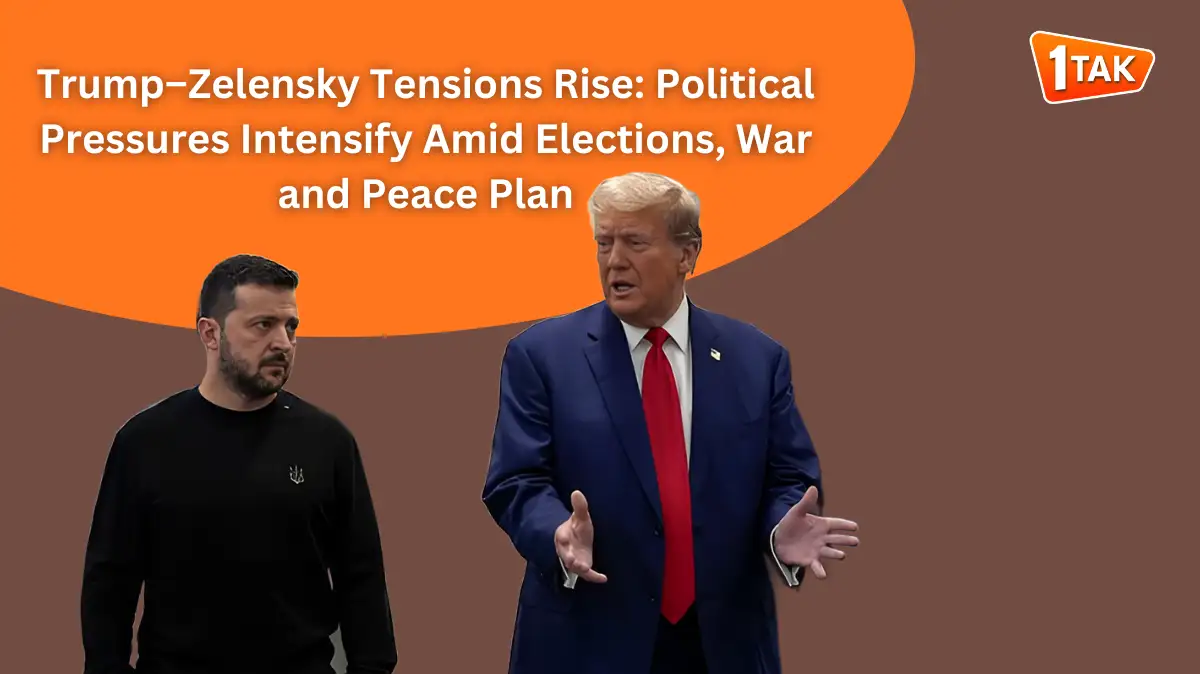
Trump Peace Plan: The Ukraine war has once again returned to the centre of global politics. Sharp exchanges between former US President Donald Trump and Ukrainian President Volodymyr Zelensky have triggered renewed diplomatic activity. Trump accused Zelensky of “using the war as an excuse to block democracy”, while Zelensky responded that if the US ensures election security, he is ready to hold voting within 60 to 90 days.
Trump’s Allegation
In an interview with Politico, Trump targeted Zelensky, saying, “Ukraine is no longer a democracy. Zelensky has used the war to delay elections.”
He also claimed that Zelensky’s term ended in May 2024, but elections were postponed due to martial law.
Trump’s remarks come as he intensifies his campaign for the US presidency, repeatedly asserting that he could “end the Ukraine war in just 24 hours.”
His criticism extended beyond Ukraine — he labelled European leaders “weak” and warned that the US might reduce economic aid if Europe fails to take stronger steps to end the conflict.
Zelensky’s Counterattack
A few hours after Trump’s statements, Ukrainian President Volodymyr Zelensky responded at a press conference. He said Ukraine is ready to restore democratic processes if international partners help secure the vote.
Zelensky said, “I openly ask the US and our European friends to help ensure election security. We only need conditions where people can vote without fear of bombings.”
He acknowledged that holding elections under continuous Russian attacks is extremely difficult, but confirmed that new discussions are underway — Ukraine’s parliament is preparing amendments to martial law that would allow an election with allied support.
Experts say Zelensky’s shift reflects pressure created by Trump’s political rhetoric. Until recently, Zelensky had called wartime elections “impossible”, but he is now signalling that they could be conducted with US or NATO assistance.
A New Peace Initiative Between the US and Europe
Amid these developments in Washington and London, another diplomatic track has gained momentum. Between December 8–10, UK Prime Minister Keir Starmer, French President Emmanuel Macron, and German Chancellor Friedrich Merz met Zelensky in London.
These meetings focused on the US-led peace proposal, which includes freezing Russian assets and using them to fund Ukraine — a plan said to have Trump’s indirect support.
After London, Zelensky travelled to Brussels and Rome, meeting NATO chief Mark Rutte and European Council President Antonio Costa. The agenda in all discussions remained the same — how to balance Trump’s potential peace initiative with European support.
While no major breakthrough was announced, sources say Zelensky’s revised 20-point peace plan is nearly final and will soon be sent to Washington.
Trump’s Aggressive Foreign Policy Tone
Trump has repeatedly claimed that if he had been in office, “the war would have ended years ago.”
He accused European nations of “living off American taxpayers” without sharing responsibility.
He also indicated that if he returns to power, he will review US assistance to Ukraine and end the policy of “unlimited funding.”
In the US, Democrats criticised his remarks, while many Republicans called Trump’s comments “harsh but realistic.”
Zelensky’s Strategic Dilemma
This is a sensitive period for Zelensky. On one side, Ukraine faces relentless Russian attacks; on the other, Western aid is becoming a political issue.
Several Ukrainian lawmakers have hinted that if the war continues longer, calls for new political leadership may intensify.
Zelensky’s team now aims to demonstrate that they are not “blocking democracy”, but rather responding to wartime conditions.
Zelensky’s close aide Oleksandr Merezhko had earlier called Trump’s remarks “aligned with Russian interests”, but Ukraine’s tone has softened — perhaps because US involvement in the peace plan is becoming indispensable.
Europe’s Balancing Act
For European countries, the situation is complicated. The UK and France want strong coordination with the US, but with Trump’s possible return, they are adopting a more flexible diplomatic approach.
France’s President Macron stated that “Europe should welcome any peace initiative that respects Ukraine’s sovereignty and territorial integrity.”
UK Prime Minister Keir Starmer also said that restoring democratic processes in Ukraine is crucial, adding that dialogue between Trump and European leaders “could become the first step toward peace.”
New Movement in Peace Talks
Tensions escalated when Trump claimed that Zelensky had not even read the US proposal.
Ukraine immediately countered that “no official proposal has been received.”
The same day, leaders of the UK, France and Germany held a phone call with Trump to discuss “strengthening the Ukraine coalition and exploring joint pathways for assistance.”
France’s Foreign Ministry later confirmed that European leaders are “coordinating discussions with Trump” on Ukraine — indicating that America’s new peace role is gradually being acknowledged.
What Happens Next?
Sources say Zelensky’s revised peace plan will be sent to Washington next week. It includes proposals on a ceasefire, the status of Russian-occupied territories, and future security guarantees.
The core challenge remains — will Trump or the US administration agree to Ukraine’s refusal to concede territory?
For now, signals suggest that Ukraine is not prepared for any “geographical compromises.”
Conclusion
The Trump–Zelensky confrontation is not just a war of words, but a signal of shifting global geopolitics. The US election season and Europe’s changing security dynamics are reshaping the Ukraine conflict.
If Zelensky’s peace plan is submitted soon, and Trump’s initiative gains formal backing, a political route to resolving the Ukraine war may finally emerge.
For the moment, it is clear that the war is no longer fought only between Kyiv and Moscow, but also across Washington and European capitals — through ideas, agendas and power politics.
Also Read