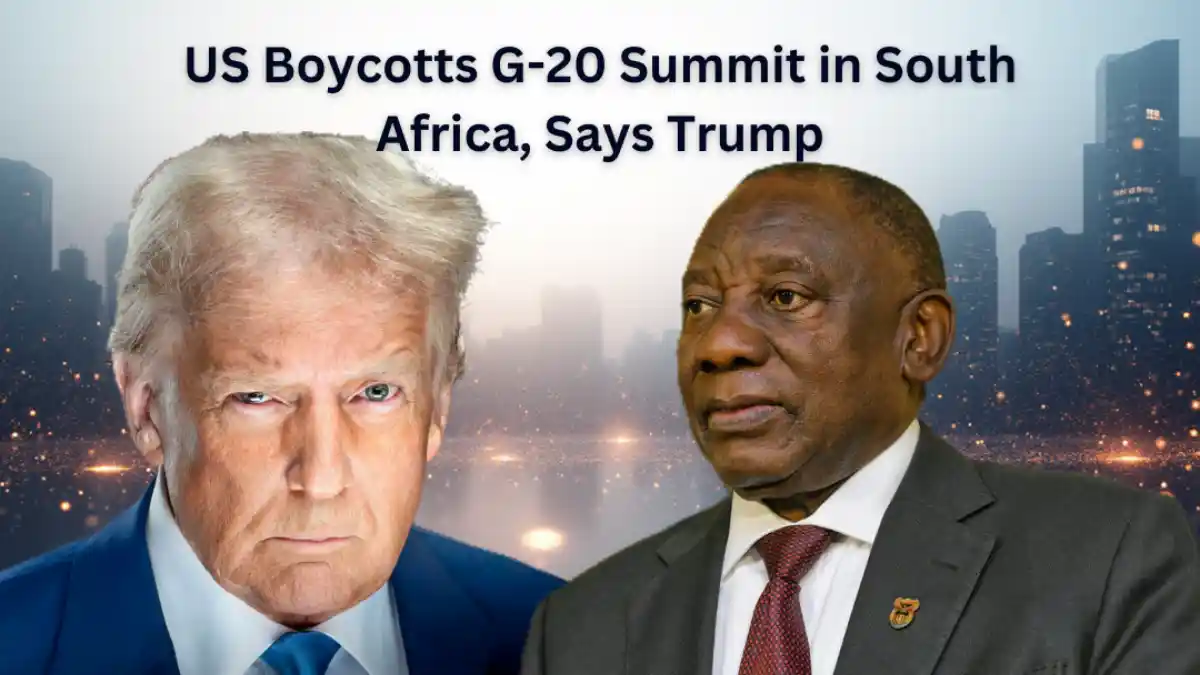
The upcoming G-20 summit, scheduled to be held in South Africa this year, has already become the centre of a major geopolitical controversy. U.S. President Donald Trump announced late Friday night that America will boycott this year’s G-20 summit in South Africa. He stated that incidents of violence, attacks, and land seizures against white farmers in South Africa are “completely unacceptable.” Calling the situation “shameful,” President Trump made it clear that no American official will participate in the summit.
“Human Rights Are Being Violated in South Africa” — Trump
Speaking to American media, President Trump said that over the past few years, there has been a rise in attacks, killings, and land seizures targeting white farmers in South Africa. “Under such circumstances, discussing global cooperation and economic partnership there is meaningless,” Trump said. “A country that ignores human rights should not be given a platform of this stature.”
Trump further added that the United States is preparing to host the 2026 G-20 Summit in Miami, promising that it will be a gathering focused on equality, freedom, and justice.
South Africa’s Sharp Response: “This Is Political Propaganda”
Just hours after the U.S. boycott announcement, the South African government issued a strong rebuttal to President Trump’s statements. President Cyril Ramaphosa said that Trump’s allegations were “political and baseless.”
According to Ramaphosa, “Our country operates under a democratic system where every citizen enjoys equal rights. The economic and social position of white citizens itself proves that there is no discrimination.” He further stated that Trump’s accusations are an attempt to tarnish South Africa’s image on the global stage.
Growing Tensions Between the U.S. and South Africa
Analysts believe this decision goes beyond a simple boycott—it signals growing diplomatic strain between the two nations. In recent years, policy differences between Washington and Pretoria have become increasingly evident.
The Trump administration has repeatedly raised concerns over alleged violence against white farmers in South Africa. In 2023, the U.S. had even proposed granting “refugee” status to these farmers, although the policy was considered stricter than existing U.S. asylum laws and sparked debate at the time.
Earlier this year, U.S. Secretary of State Marco Rubio boycotted the G-20 foreign ministers’ meeting, stating that South Africa’s current policies do not align with America’s democratic and humanitarian values.
Impact on the G-20 Summit
The G-20 Summit, scheduled for November 22–23 in Cape Town, South Africa, is now back in the spotlight following America’s withdrawal. The event was expected to bring together leaders of the world’s top 20 economies to discuss global financial stability, sustainable development, climate action, and energy policy.
As one of the key members of the group, America’s absence could significantly influence the direction of several crucial decisions. Particularly on issues like technological innovation, trade balance, and global economic aid, the U.S. plays a vital role.
International economic experts believe Trump’s move not only highlights America’s shifting foreign policy priorities but also poses a challenge to the unity and coherence of the G-20 forum.
The Underlying Reasons Behind the Boycott
Several political analysts suggest that President Trump’s decision is driven not just by moral or human rights concerns but also by domestic political calculations. With U.S. midterm elections approaching next year, Trump is believed to be sending a strong message to his traditional voter base—especially the South African-origin white community.
Additionally, the Trump administration has been pursuing a more vocal stance on global human rights and religious freedom issues. The violence against white farmers in South Africa fits into this broader policy approach.
South Africa’s Argument
The South African government maintains that its land reform policy aims to correct historical inequalities, not to target any particular community. President Ramaphosa clarified that the programme is designed to address long-standing social and economic disparities rooted in the colonial era.
“Our land policy is based on justice and balance,” he said. “Labeling it as anti-white is entirely unfair. Every South African citizen, regardless of race or background, is entitled to equal rights.”
Global Reaction and the Road Ahead
Following the U.S. boycott, other nations have begun reacting. The European Union said it respects the American decision but believes that dialogue and cooperation remain the best paths to resolve disputes. Meanwhile, China and Russia called the move an example of America’s “unilateral foreign policy.”
Economic analysts warn that if tensions between Washington and Pretoria are not resolved in the coming months, global trade and investment cooperation could also be affected.
America’s absence from a forum like the G-20 could raise questions about the credibility of the multilateral global system itself.
Conclusion
The U.S. decision to boycott the G-20 Summit is not merely a protest against an event but a broader diplomatic signal. While the White House describes it as a necessary step in defence of human rights and justice, South Africa calls it political propaganda.
In the coming weeks, it will be worth watching whether this controversy finds a resolution or deepens the divide between the United States and South Africa. For now, one thing is certain—the echo of America’s boycott will dominate this year’s G-20 Summit, and new global equations may well emerge from it.
Also Read