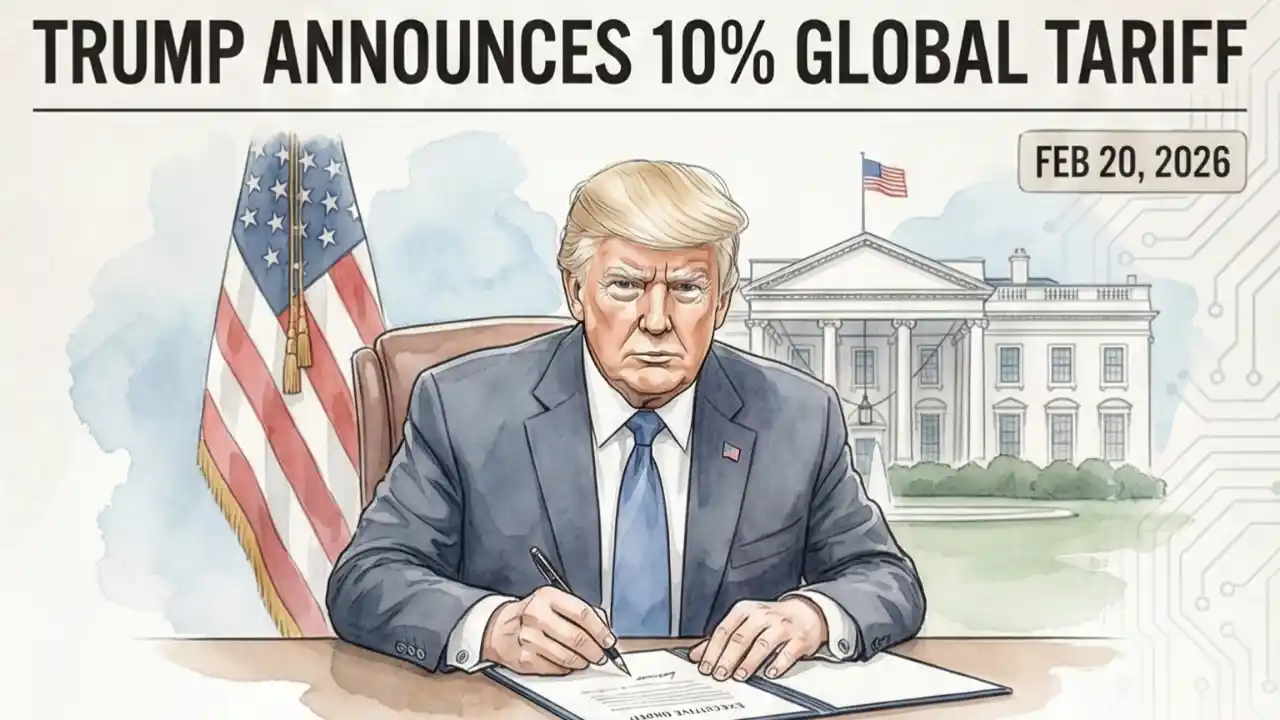
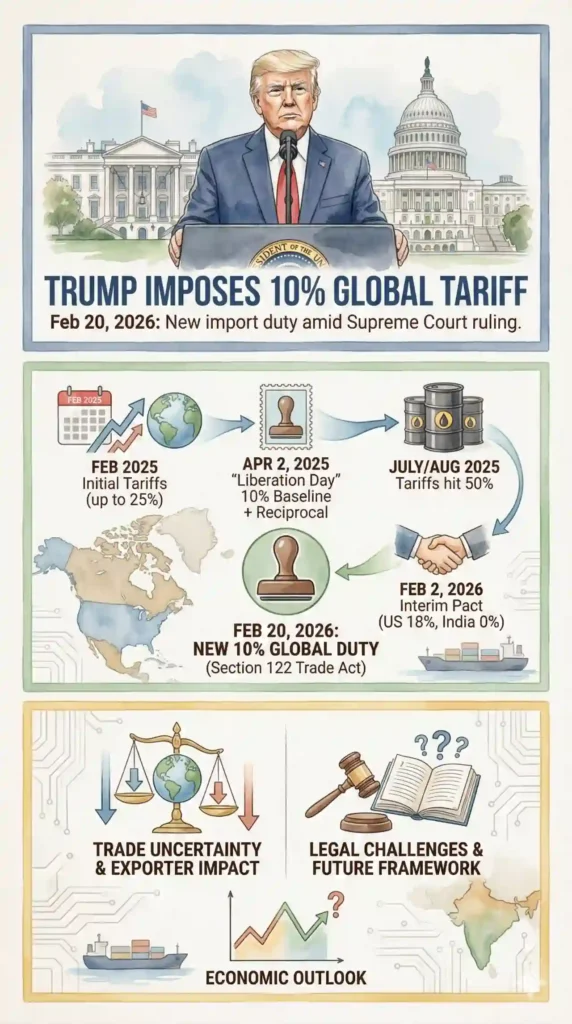
US President Donald Trump, taking a major decision on February 20, 2026, announced the imposition of a 10 percent duty on imports coming from all countries, including India, under the “US Global Tariff.” This step was taken at a time when just a few hours earlier the US Supreme Court had set limits on the broad tariffs imposed on the basis of the President’s emergency powers. The White House has said that this 10 percent import duty has been implemented temporarily for now and will remain in force until an alternative legal framework is prepared for it.
The beginning of tensions over tariffs is considered to be from February 2025. At that time, the United States imposed import duties of up to 25 percent on countries such as Canada, Mexico, and China. After that, on April 2, 2025, which the Trump administration named “Liberation Day,” a 10 percent baseline tariff was implemented on most countries. For some countries, additional ‘reciprocal’ duties were also added on top of this.
In the case of India, the situation remained somewhat different. In the meeting between Prime Minister Narendra Modi and President Trump on February 13, 2025, both countries set a target to take bilateral trade to 500 billion dollars by 2030. But just a few weeks later, on April 2, 2025, it was announced that a total 26 percent tariff would be imposed on Indian goods. This included a 10 percent baseline and an additional 16 percent duty. However, later the 16 percent portion was deferred for 90 days, due to which the effective rate at that time remained only 10 percent.
In June and July 2025, several rounds of talks took place between the two countries, but no concrete result came out. Finally, on July 31, the United States announced the imposition of a 25 percent tariff. After this, in August, linking the issue to oil purchases from Russia, an additional 25 percent duty was also imposed. In this way, the total tariff burden increased to 50 percent.
In February 2026, the US Supreme Court delivered an important verdict by a 6–3 majority. The court clearly said that under the International Emergency Economic Powers Act, the President does not have the authority to impose large-scale tariffs. After this decision, the legal basis of several ‘reciprocal’ tariffs imposed earlier became weak.
Immediately after the court’s stance, President Donald Trump issued a new executive order using Section 122 of the Trade Act of 1974. Under this, a 10 percent global import duty was implemented on all countries. The administration has said that the sectors on which separate duties are already in place will continue as before.
A White House official said that this 10 percent duty on all countries, including India, will remain in force until another legal route is adopted for it. However, the President has earlier said that there has been no change for now in the terms of the interim trade agreement reached with India.
Under the interim agreement reached between India and the United States on February 2, 2026, US tariffs were reduced from 25 percent to 18 percent. At the same time, India decided to bring duties on American goods to zero. In such a situation, how the new 10 percent global duty will be adjusted will now depend on the formal signing and final terms.
Trade experts believe that if the 10 percent general duty is added to the existing rates of the agreement, then the competitive position of Indian exporters may be affected. However, if it is adjusted within a separate framework, then the impact may remain limited.
The Supreme Court’s decision has made it clear that imposing broad tariffs through emergency powers will not be easy. Even so, the administration has indicated that other legal routes will be adopted if needed.