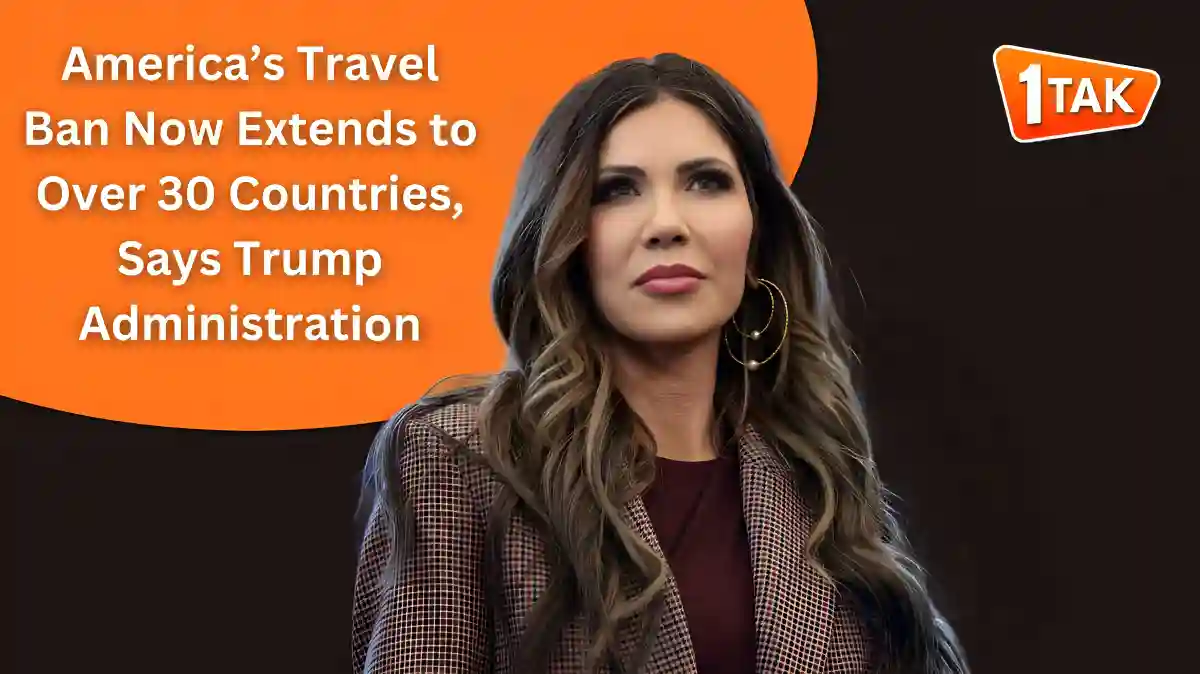
US President Donald Trump is preparing to take another stringent step. Homeland Security Secretary Kristi Noem revealed on Thursday night during Fox News’ popular programme “The Ingraham Angle” that the administration is set to expand the existing travel ban from 19 countries to more than 30 nations.
Noem said, “I cannot give an exact number, but it will be above 30. The President and his team are continuously assessing which countries pose rising security risks.” This move comes at a time when recent security incidents inside the United States have prompted the administration to reassess its national security protocols.
Security Concerns Intensify After Shooting Near the White House
Last week, a shooting incident near the White House in Washington DC created nationwide concern. The attack resulted in the death of 20-year-old National Guard specialist Sarah Beckstrom, while 24-year-old Staff Sergeant Andrew Wolf sustained critical injuries. The suspect was identified as Rahmanullah Lakanwal, a 29-year-old former soldier from Afghanistan. Lakanwal arrived in the US in 2021 under the Biden administration’s “Operation Allies” — the same programme through which thousands of Afghan refugees were resettled in America.
He now faces charges of first-degree murder and attempted murder. Officials say he was previously associated with the CIA-backed “Zero Unit” and had been struggling with mental health issues in recent months. President Trump called the incident “the greatest threat to national security” and immediately ordered a review of all Afghan refugee cases.
Background of the Travel Ban and Current List
The United States imposed a partial or full travel ban on 19 countries in June 2025. The decision was based on security assessments and concerns over lack of foreign cooperation. The current list includes: Afghanistan, Myanmar, Burundi, Chad, Republic of the Congo, Cuba, Equatorial Guinea, Eritrea, Haiti, Iran, Laos, Libya, Sierra Leone, Somalia, Sudan, Togo, Turkmenistan, Venezuela and Yemen.
These nations are considered “high-risk regions,” where US agencies face challenges in passport verification, counter-terror cooperation and security communication. The administration now plans to add nearly a dozen more countries to this list. While Noem did not confirm any names, she did state that “countries that harbour criminals and parasites are no longer welcome in America.”
Trump’s Strong Words on “Third World Threats” Spark Debate
President Donald Trump has repeatedly referred to “migration from Third World countries” as a threat to American society. He said, “We want to free America from crime, housing strain and social violence. We must secure our borders.” While the statement resonated with his supporters, it drew criticism from liberal groups and human-rights organisations.
On social media, #TravelBan2025 has been trending — with some calling it “a victory for national security,” while others describe it as “the return of ethnic discrimination.”
Review of Refugee Cases from the Biden Era
Following the new directive, the USCIS (US Citizenship and Immigration Services) has begun reviewing all pending refugee and visa applications. USCIS Director Joseph B. Edlow said that “all applications from high-risk countries will undergo re-examination,” which includes detailed interviews, background checks and classified assessments.
“We are correcting the mistakes made during the Biden administration,” Edlow said. “Anyone who does not meet our national security standards may have their refugee status revoked.” According to officials, all new Afghan applications have been suspended indefinitely.
Experts Warn of Possible Legal and Diplomatic Fallout
Political analysts believe this decision could have a significant impact on US foreign policy and global diplomacy. Several African and Asian nations have already signalled that they view such “unilateral restrictions” as unfair.
According to international law expert Leslie Bowman, “This is part of the Trump administration’s assertive domestic policy, but it may affect American companies and students, especially from countries newly added to the list.” Bowman noted that the 2026 FIFA World Cup, international trade agreements and bilateral cooperation programmes could also be affected.
What Happens Next?
According to White House sources, the new list may be released by late December or early January 2026. The administration is also considering allowing only limited “humanitarian visas” for citizens of restricted countries.
However, the policy may face several legal challenges once implemented. During previous travel bans, dozens of petitions were filed in Congress and the Supreme Court, labelling the decision as religious and racial discrimination.The United States now appears to be returning to the same debate — national security versus humanitarian responsibility.
Conclusion
The Trump administration’s latest decision could mark a major shift in America’s immigration policy. While the policy sends a strong message on security, its social and diplomatic impact may be felt for a long time.
In the coming weeks, global attention will remain fixed on the White House — to see whether the administration will enforce its “America First” doctrine as firmly as it did in 2017.
Also Read