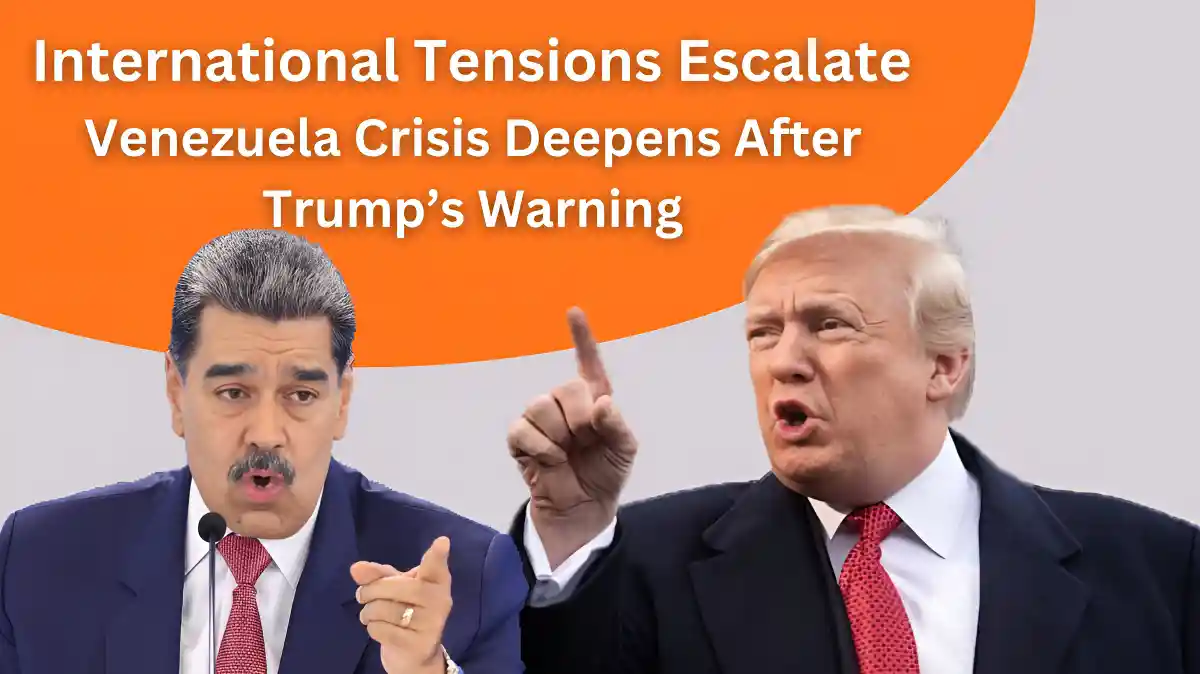
Venezuela Land Strikes: Tensions between the United States and Venezuela have entered a new and sharper phase. U.S. President Donald Trump has signalled that America may soon launch land strikes on Venezuelan territory. This move could disrupt the geopolitical balance of Latin America and trigger significant shifts across the global landscape.
Trump’s Declaration: “Time for Action on the Ground”
During a cabinet meeting held in Washington, D.C., President Trump stated that the United States will no longer remain confined to its maritime anti-drug operations. According to him, American intelligence agencies have fully mapped Venezuela drug networks and identified locations of “dangerous groups.” Calling it a matter of “national security,” Trump warned that without action on the ground, fentanyl and other lethal drugs would continue to harm American society.
He further added that this is not merely a law-and-order issue but a “national security crisis,” requiring U.S. military action beyond traditional policing methods. His remarks indicate that Washington may shift from a limited Southern Spear operation to a strategy that enters Venezuelan territory directly.
From Southern Spear to Ground Operations
Launched in September 2025, Operation Southern Spear initially focused on the Caribbean and Eastern Pacific waters. The U.S. Navy and Air Force carried out several strikes on drug-smuggling boats, believed to be operated from Venezuela and Colombia. According to the U.S. Defence Department, dozens of suspects were killed during these missions, and major drug consignments were seized.
However, American officials now say that identifying “targets” at sea has become difficult, prompting a shift toward land-based operations. This announcement has pushed the situation into a more serious and unpredictable phase.
War Against Narcoterrorism or a New Military Front?
U.S. Defence Secretary Pete Hegseth defended the operations, calling them a decisive campaign against “narco-terrorists.” He claimed that Washington is targeting only those networks categorised as “designated terrorist organisations,” including Tren de Aragua and Colombia’s ELN.
“We are confronting those who are poisoning the American people,” Hegseth said. He confirmed that while maritime activity has been scaled down, preparations for Venezuela land strikes are progressing. In his words, “This is not a drug war—it is a real fight against terrorism.”
Double Strike Controversy and Legal Debate
A recent “double strike” has intensified the crisis even further. According to eyewitness accounts and media reports, the U.S. Navy launched two consecutive attacks on a suspected drug-smuggling boat. The first strike disabled the vessel, and when the crew attempted to escape, a second strike killed everyone on board.
Washington defended the action as a regional security decision, but it sparked a wider international law debate. Some U.S. lawmakers and legal experts questioned whether the second strike could be classified as a “war crime” if the suspects were no longer capable of resisting after the first hit. The White House clarified that the decision was taken at the “operational command level,” and the President was not receiving real-time updates at that moment.
Maduro’s Counterattack: “Venezuela Will Not Tolerate an Assault on Its Sovereignty”
Venezuelan President Nicolas Maduro rejected Washington’s allegations, calling them “false and politically motivated.” He accused the Trump administration of using drugs as an excuse for a “regime-change agenda.”
Maduro stated, “Venezuela has no role in drug trafficking. The United States is simply searching for a pretext to violate our sovereignty.” Caracas also claimed that recent U.S. attacks killed innocent fishermen and civilians. The Venezuelan government has threatened to approach the United Nations and international courts, describing the U.S. actions as “a clear violation of international law.”
Global Opposition and Diplomatic Appeals
The growing Washington–Caracas tension has captured worldwide attention. From the Vatican to the European Union and Latin American nations, several voices have urged the U.S. to avoid unilateral military intervention. Pope Leo and the UN Human Rights Council issued a joint appeal, stressing that the drug crisis must be addressed through “multilateral dialogue and cooperative frameworks,” not airstrikes.
Analysts believe that if the United States launches operations inside Venezuela, it could become the largest military mission in the Western Hemisphere in decades. This would significantly impact regional politics, global energy markets, and human rights conditions.
Divisions Emerge Within the United States
In the U.S. itself, opinions on the potential U.S. military action remain sharply divided. While some see it as a “necessary and decisive step,” others view it as the beginning of “another prolonged conflict.” Legal scholars point out that the Trump administration informed Congress in October 2025 that the country is in a state of “non-international armed conflict,” giving the military extended powers. Critics argue that criminal networks should be prosecuted in courts, not targeted with missiles.
What Lies Ahead?
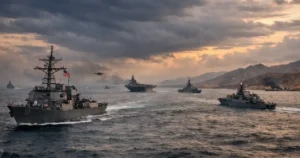
U.S. aircraft carriers and warships are currently deployed near the Caribbean. Washington claims to have identified key “drug network hubs” inside Venezuela, including ports, airstrips, and warehouses.
The world is now watching to see whether the Trump administration proceeds with Venezuela land strikes or bows to international pressure and opts for diplomatic engagement. While Washington speaks of “security and justice,” Caracas insists it is defending its “sovereignty and survival.”
The coming weeks will determine whether this remains a conflict centred on drug networks or evolves into a new geopolitical confrontation between the United States and Venezuela.
Also Read
- Starmer Defends Budget Amid Controversy, Calls Decisions ‘Necessary and Fair’
- Israeli General’s Major Revelation: Preparing for Clash with Iran, High-Tech Weapons to Dominate
- Questions Raised Over Pakistan Aid kits to Sri Lanka, Citizens Say – “Insult to Humanity”
- ‘We Are Ready’: Putin Issues Ultimatum to Europe, Says – “We Do Not Want War, But Will Not Back Down If Forced”