
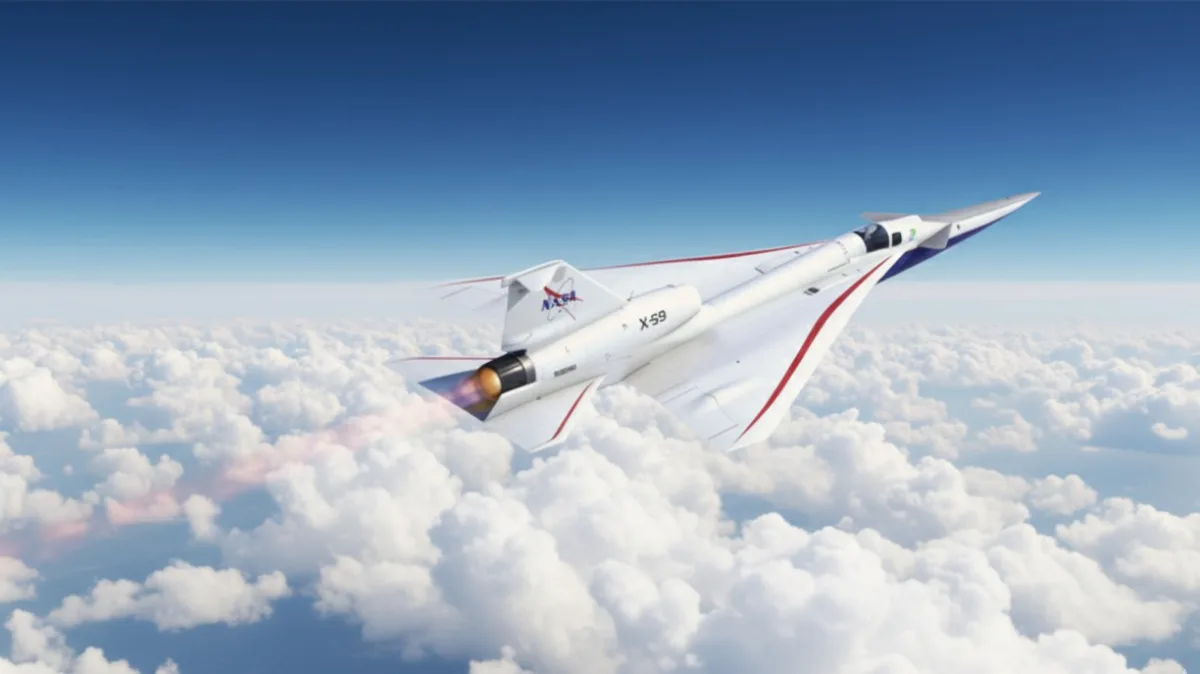
NASA and Lockheed Martin have created history by successfully completing the first flight of the X-59 supersonic aircraft. This achievement could mark a turning point for technology, the environment, and the aviation industry, as the X-59 managed to break the sound barrier without producing a loud sonic boom—only a gentle “thump” was heard on the ground. This breakthrough could redefine the future of supersonic travel.
The First Flight — When and Where
The X-59 test flight took place on Monday, October 28, 2025, at 8:14 a.m. local time in the desert region of Palmdale, California, USA. NASA’s chief test pilot, Nils Larson, flew the aircraft for about 30 minutes and safely landed it at Edwards Air Force Base. During the initial test, the plane was intentionally flown at lower speed and altitude (around 370 km/h and 12,000 feet) to thoroughly evaluate its systems, controls, and balance.
X-59 Design and “Quiet Supersonic Technology”
The X-59 has been developed under NASA’s QueSST mission—Quiet Supersonic Technology. Its biggest highlight is its unique design: a long slender nose, narrow fuselage, and an engine mounted on top at the rear to reduce the shockwave’s intensity. Typically, when a supersonic aircraft crosses Mach 1 (the speed of sound), it generates a 110–140 decibel “sonic boom.” The X-59’s advanced aerodynamic shape redirects most of that shock upward into the sky, resulting in just a soft “thump” on the ground—similar to the sound of a door closing.
- Engine: General Electric F414-GE-100
- Cruising Speed: Mach 1.4 (approximately 925 km/h)
- Altitude: 55,000 feet
- Environmental Impact: Reduced carbon emissions and noise.
Historical Context — From Concorde to X-59
In 1976, the UK and France jointly introduced the Concorde, a supersonic passenger aircraft that flew at twice the speed of sound. However, due to its loud sonic boom and regulatory challenges, Concorde was retired from service in 2003. Now, NASA and Lockheed Martin are reviving the dream of “speed with silence” through the X-59.
Supersonic Flight Ban in the US — A New Shift
In the 1970s, the US Federal Aviation Administration (FAA) banned supersonic flights over populated areas because of the disruptive sonic booms they produced. However, the Trump administration and the US Congress later directed the FAA to allow supersonic flights if the aircraft could eliminate the ground-level boom. Under the Supersonic Aviation Modernization Act, the FAA is now reviewing new regulations that could permit such quiet supersonic technologies.
What’s Next — NASA’s Mission and Pilot Programme
In the coming months, NASA will fly the X-59 over several major US cities to collect community feedback—how people perceive the sound and whether it’s acceptable. This data will be shared with the FAA and international aviation agencies to develop guidelines for safe, low-noise supersonic commercial flights. If all goes as planned, such flights could begin for passengers between 2027 and 2028—potentially reducing routes like New York to London to just three hours.
Why the X-59 is a Gamechanger
- This is the first time any country has flown a “low-noise” supersonic aircraft.
- Its technology could set new benchmarks in aviation and environmental innovation.
- US Transportation Secretary Pete Buttigieg has described it as “the future of air travel.”
- The collaboration between Lockheed Martin and NASA marks a new chapter in aerospace technology.
Conclusion
The first flight of the X-59 is not only a technological and scientific achievement but also a major step toward reimagining the future of air travel—where speed, quietness, and environmental responsibility can coexist. All eyes are now on the upcoming supersonic test flights and the forthcoming commercial aviation regulations that could reshape global air travel.
Also Read